
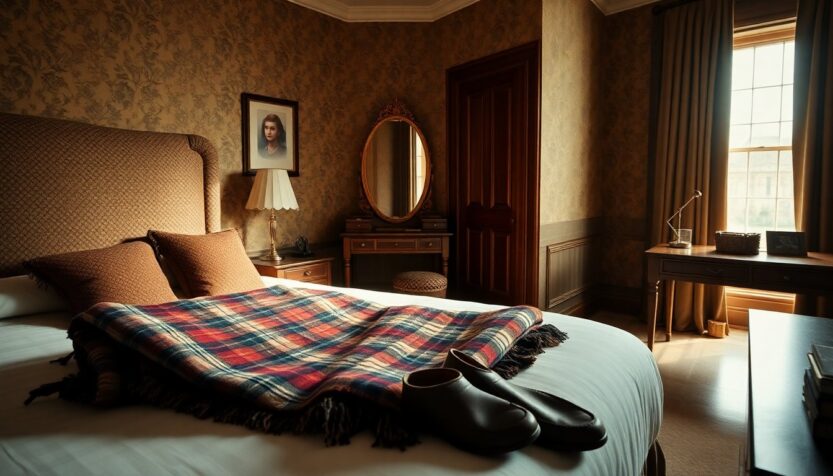
This summer visitors to Edinburgh will be given a rare peek behind the palace curtains. For a limited season the Palace of Holyroodhouse will open a private suite of rooms once used by the late Queen Elizabeth II and the Duke of Edinburgh, presenting them not as museum cases but as lived-in domestic spaces where morning routines, private conversations and quiet work took place.
What you’ll see
Curators have kept three principal rooms much as they were during the Queen’s stays: the Royal Breakfast Room, the Sitting Room and the adjacent Dressing Room. The Breakfast Room is quietly domestic — a small central table set for morning conversation, walls hung with 17th-century Flemish tapestries (woven c.1650 and installed at the palace in the 1920s) and an arrangement that underscores intimacy rather than pageantry. The Sitting Room is modest too: two red sofas flanking a hearth and a leather-topped desk by the window, the kind of corner where papers were read and briefings reviewed between audiences.
Alongside the furniture and photographs, curators will display three outfits from the Queen’s wardrobe. The garments date to 1997, July 1999 and 2017, and include a purple silk-wool coat with a green silk-crepe dress and a purple-and-green Isle of Skye tartan shawl — the ensemble she wore to open the Scottish Parliament in 1999 — plus a garden-party dress from 2017 and an evening gown from 1997. They’re presented as “material anchors,” objects that link moments of public duty with private life.
Why the approach matters
Rather than staging theatrical scenes, the palace is keeping these rooms in a preserved “lived-in” state so visitors can sense the small, everyday textures that underpinned a lifetime of public service. The intent is to humanize the institution: to show how ceremonial roles are supported by ordinary rituals — breakfasts, letters, and the clothes chosen for particular occasions.
Practicalities and conservation
The tour runs daily for 100 days, from May 21 to September 10, 2026. Emma Stead, the palace curator, describes the project as selective and unprecedented in scope: palace admission does not include the private-apartment tour, which requires a separate reservation. Conservation teams will supervise visits and manage ticketing and visitor flow to protect fragile interiors and garments. Some rooms will remain off-limits, reserved for use by King charles III, Queen camilla and the household.
What to expect next
Officials say full visiting arrangements and ticketing details will be published by the palace in due course. Until then, the announcement stands as a thoughtful experiment in public history — a way of translating the abstract idea of duty into the tangible, familiar objects of daily life.