
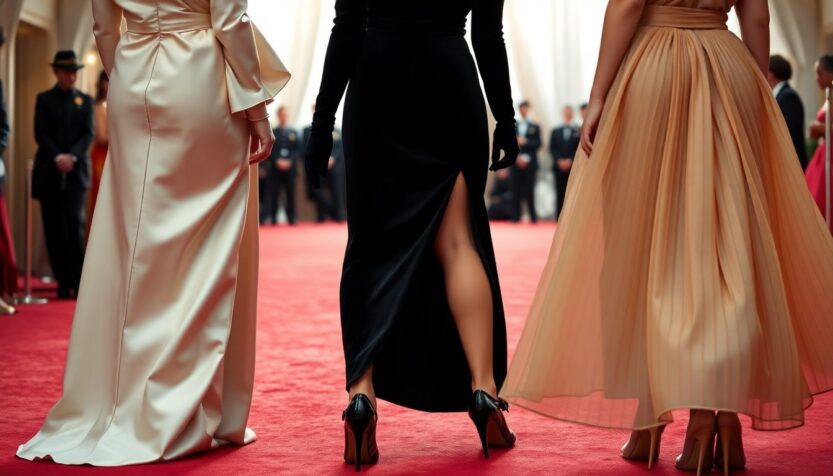
Actor Awards red carpet: couture drama and old‑Hollywood glamour
The Actor Awards carpet delivered a satisfying blend of theatrical couture and classic glamour. Stars used fashion to amplify their personalities and the films they represent, moving from sculptural experiments to silhouettes that might have been lifted from a 1950s screengrab. Photographers were rewarded with arresting lines, sweeping motion and moments that felt deliberately staged yet effortlessly lived-in.
Key players and houses
Teyana Taylor, Emma Stone, Mia Goth and Michael B. Jordan were among the names that dominated coverage, wearing pieces by Thom Browne, Balenciaga, Dior and Tom Ford. Across the night a clear throughline emerged: designers were telling stories—some succeeded by marrying concept and craft, others faltered when the idea outran the tailoring.
Showstoppers: concept executed with craftsmanship
When an idea and its construction align, the result is unmistakable.
- – Teyana Taylor in Thom Browne: A sculptural, color‑blocked look that nodded to camouflage without ever feeling literal. The outfit relied on exacting proportions and sharp seams; the geometry read brilliantly on camera because the tailoring was precise.
- Kate Hudson’s cape gown: Pure screen‑siren movement. The cape amplified every turn, and restrained styling let fabric and silhouette do the talking—old Hollywood translated into modern drama.
Menswear that landed
The night also proved restraint can read contemporary. Michael B. Jordan in Tom Ford favored clean lines and flawless fit—polish over provocation. Connor Storrie reinforced that idea: a carefully cut suit and one intentional accessory can create focus without excess. Small decisions—lapel width, pant break, shoe choice—made the difference.
Risky moves: experiments that divided opinion
Some looks pushed boundaries in ways that excited critics and split them in equal measure.
- – Sarah Pidgeon in Balenciaga: A study in scale. Minimalist top, architectural skirt—the contrast refreshed 1990s references with bold geometry. It worked if the wearer embraced the dramatic lines.
- Mia Goth in Dior: Romantic, gothic and sensual, with asymmetry and glittering red tones. Lace and complex construction added texture, though some felt the detailing nearly crowded the design’s cleaner potential.
Maternity, texture and alternative silhouettes
Notable moments came from altered proportions and material choices. Wunmi Mosaku’s glamorous maternity ensemble combined a bold hue with sweeping lines, balancing mobility and presence. Rhea Seehorn favored upholstery‑weight textiles that read sculptural and imposing under flash lighting—an intentional choice but one that raised questions about seasonality and wearability.
Misfires and conversations sparked
A few concepts didn’t survive the translation to camera. Layered looks sometimes appeared top‑heavy; tailoring that reads gorgeous in person lost its definition under intense flash. Certain choices—boudoir references, torn or distressed details—prompted debate: are they expanding the lexicon of awards dressing or courting shock value?
Sustainability and provenance also surfaced in conversation. Observers scrutinized seams, finishes and the supply chain, signaling that traceability and lighter, climate‑aware fabrics are becoming part of the red‑carpet scorecard. In short, ingredients matter—whether on a plate or in a gown.
Where the carpet landed: balance over bravado
The most memorable looks paired a clear concept with flawless execution: architecture, material and persona working in concert. When those elements line up, a red‑carpet moment does more than photograph well—it tells a story.
Expect the season’s coverage to keep circling the same questions: how far should designers push concept before wearability is compromised, and how will critics weigh innovation against coherence? For now, the Actor Awards offered a lively snapshot—equal parts craftsmanship, risk and old‑fashioned glamour.