

Who this helps
People who feel steady on the familiar stairs at home but find public or unfamiliar stairways nerve-wracking. Maybe you skip museum galleries, avoid trains with only stair access, or cling to handrails on every flight. This guide is for you.
What this is
A practical, evidence-informed routine that explains why stairs trigger anxiety, how that worry narrows daily choices, and what you can do—right away—to build stronger, steadier, more confident stair skills.
Where it matters
Urban and suburban environments: transit hubs, shops, workplaces, older buildings and public venues where step heights, lighting and handrail availability vary.
Why it matters
Fear around stairs chips away at independence. It shrinks options for travel and social life. Rebuilding stair confidence restores mobility, reduces stress and makes daily life more spontaneous.
Why stairs feel special
Stairs demand precise coordination. Vision, inner-ear balance, and leg power must sync in real time. A missed visual cue or a tiny wobble can feel catastrophic, and that single moment of unease often seeds lasting fear. The problem is part mechanical, part perceptual and part emotional.
How stair ability works
Three systems matter:
- – Sensory input: vision and vestibular (inner ear) signals that tell you where you are in space.
- Motor control: ankle, knee and hip actions that control each step.
- Cognitive appraisal: how you interpret risk and decide to move.
Training targets each system separately, then blends them into realistic practice so your body and brain learn to trust the same signals under real conditions.
A simple framework
Three pillars produce the biggest, most reliable improvements:
1. Education — learn what’s happening in your body and why small changes help.
2. Practice — short, frequent, task-specific exercises that build strength and balance.
3. Environment — tweak lighting, handrails and contrast so stairs are easier to read and use.
What helps quickly
– Small strength gains (especially in glutes, quads and calves) have outsized benefits for stepping power and stability.
– Repeated, graded exposure to steps reduces anxiety faster than avoidance.
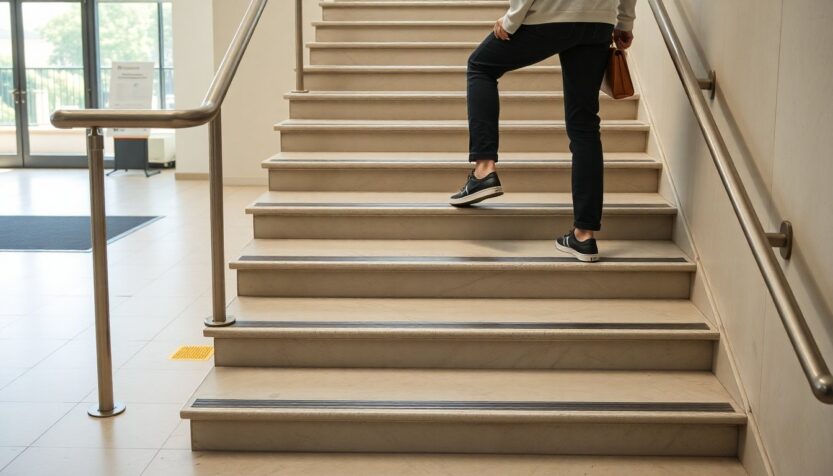
– Simple environmental fixes—consistent lighting, textured nosing, and steady handrails—make huge perceptual differences.
Pros and cons (realistically)
Pros
– Noticeable gains in weeks with consistent practice.
– Low-cost adaptations and exercises scale well for home use or clinics.
– Wearable sensors and apps can provide objective feedback and encourage adherence.
Cons
– Progress can be slower with vestibular, neurological or major musculoskeletal issues.
– Some technologies add complexity, and not everyone can access supervised programs.
– Overreliance on devices or handrails can slow development of intrinsic balance if used as a crutch.
What this is
A practical, evidence-informed routine that explains why stairs trigger anxiety, how that worry narrows daily choices, and what you can do—right away—to build stronger, steadier, more confident stair skills.0
What this is
A practical, evidence-informed routine that explains why stairs trigger anxiety, how that worry narrows daily choices, and what you can do—right away—to build stronger, steadier, more confident stair skills.1
What this is
A practical, evidence-informed routine that explains why stairs trigger anxiety, how that worry narrows daily choices, and what you can do—right away—to build stronger, steadier, more confident stair skills.2
What this is
A practical, evidence-informed routine that explains why stairs trigger anxiety, how that worry narrows daily choices, and what you can do—right away—to build stronger, steadier, more confident stair skills.3
What this is
A practical, evidence-informed routine that explains why stairs trigger anxiety, how that worry narrows daily choices, and what you can do—right away—to build stronger, steadier, more confident stair skills.4
What this is
A practical, evidence-informed routine that explains why stairs trigger anxiety, how that worry narrows daily choices, and what you can do—right away—to build stronger, steadier, more confident stair skills.5
What this is
A practical, evidence-informed routine that explains why stairs trigger anxiety, how that worry narrows daily choices, and what you can do—right away—to build stronger, steadier, more confident stair skills.6
What this is
A practical, evidence-informed routine that explains why stairs trigger anxiety, how that worry narrows daily choices, and what you can do—right away—to build stronger, steadier, more confident stair skills.7
What this is
A practical, evidence-informed routine that explains why stairs trigger anxiety, how that worry narrows daily choices, and what you can do—right away—to build stronger, steadier, more confident stair skills.8
What this is
A practical, evidence-informed routine that explains why stairs trigger anxiety, how that worry narrows daily choices, and what you can do—right away—to build stronger, steadier, more confident stair skills.9