



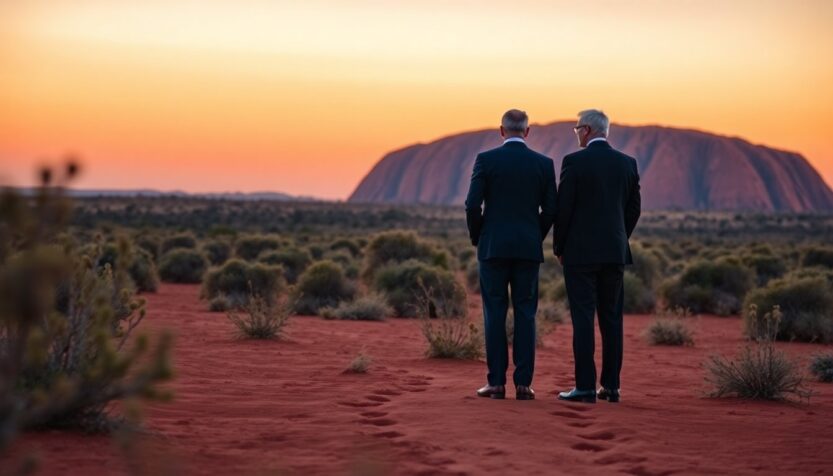
The sight of Uluru shifting from ochre to a deep red at dusk is a spectacle that draws visitors from around the world, and this natural event framed the opening of a high-profile diplomatic journey. Two years into their reign, King Frederik X and Queen Mary chose the Red Centre for the first leg of a six-day state trip, a visit that combined formal duties with unmistakably personal echoes. The couple’s presence at one of Australia’s most photographed landmarks underscores how landscapes can serve as stages for both national protocol and private memory, especially when the place visited is also part of a living cultural heritage.
Uluru’s place in royal travel imagery is well established: the rock has been a backdrop for memorable royal snapshots and public diplomacy. In 1983, Prince Charles and Princess Diana posed there during a celebrated tour, an image that helped cement Uluru’s role in global royal iconography. Decades later, Prince William and Kate Middleton returned to the same landscape, reiterating how certain locations become almost obligatory stops for visiting monarchies. In this context, the Danish monarchs’ visit reads as both continuity with that tradition and a distinctly Danish chapter in the story.
A very personal return
For the couple from Denmark the trip carries extra resonance beyond ceremonial expectation. Queen Mary was born and raised in Hobart, and the pair’s relationship itself traces back to Australia: a young Crown Prince met Mary during the Sydney 2000 Olympic Games. That encounter, which began their relationship 26 years ago, now returns to Australian soil with the full weight of a sovereign visit. The tour is their first state trip outside Europe, making every stop both an official engagement and a personal homecoming for the queen.
Why Uluru matters
Uluru is more than a scenic landmark; it is a site of sacred place and cultural continuity for the traditional custodians. The royal couple visited the Uluṟu-Kata Tjuṯa National Park Cultural Center, where the custodial community shared knowledge and ceremony. Meeting with elders from the Aṉangu people framed the evening as a moment of cultural exchange rather than mere sightseeing. The setting—where sandstone catches and reflects light—serves as an apt visual metaphor for a visit meant to highlight recognition, respect and dialogue between institutions and Indigenous communities.
Ceremony and community initiatives
After arriving in Perth and staying at Government House, the couple’s official program began with community-focused visits. At the cultural center they were welcomed by traditional dance and formal greetings from elders, an acknowledgement of the site’s living custodianship. The royals also spent time at the Kulata Academy Café, an initiative of the National Indigenous Training Academy that trains and employs young Aboriginal hospitality workers. This engagement emphasized practical support, showcasing how a state visit can spotlight local programs that combine cultural continuity with economic opportunity.
Engagements ahead
Their Australian itinerary continued with a planned sunrise viewing at the Red Centre, reinforcing the symbolic arc of sunset to sunrise at the rock, and will conclude in Hobart the following week. In Hobart, where Mary was raised and where her father and two sisters still live, the queen will undertake her final public duties in the city that shaped her formative years. The choice of venues across the trip weaves together diplomatic protocol, community projects and private ties, allowing the visit to operate on multiple levels simultaneously.
Meaning and symbolism
Seen together, the stop at Uluru and the surrounding engagements illustrate how state travel blends spectacle with substance. The state trip format provides moments for ceremonial public relations—images at recognizable sites—and for quieter acts of connection: listening to elders, highlighting local training programs and returning to places of personal significance. For the Danish monarchy, the journey to Australia is both a formal diplomatic mission and a narrative of return, where public and private histories meet against the dramatic backdrop of the Red Centre.