



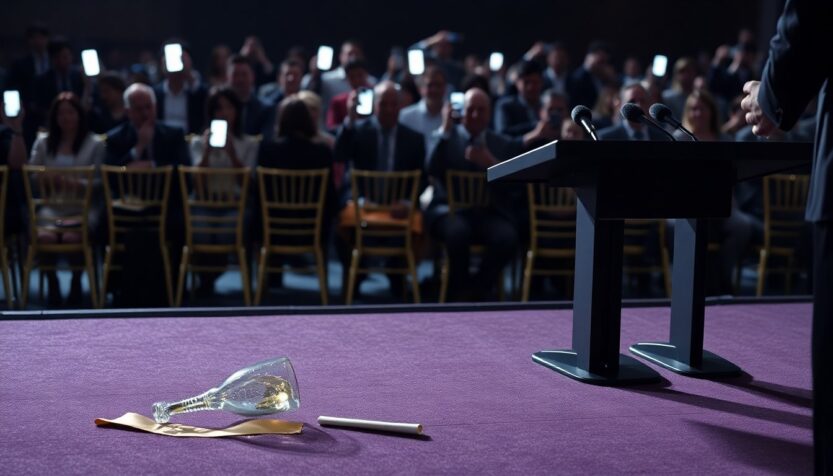
Delroy Lindo and Michael B. Jordan were presenting at a major film awards ceremony when an audible racial slur was captured and broadcast. The remark prompted immediate public scrutiny of how the event’s organisers managed the moment and its aftermath. The incident has since driven broader conversations about institutional responsibility, media editing and the limits of public tolerance.
In public remarks after the ceremony, Lindo said he regretted that no representative from the awards body had contacted him or Jordan following the broadcast of the slur. His expectation of acknowledgment and follow-up has become a focal point in debates over how large events respond to unexpected crises during live programming.
What happened on stage and why it mattered
Two presenters on stage were interrupted by an off-microphone comment that listeners and television viewers later identified as a racial slur. The comment was audible on the live feed and included in subsequent rebroadcasts and clips across social media. Organisers issued limited statements in the hours after the ceremony, prompting criticism from artists, advocacy groups and viewers.
The dispute centers on three questions: who heard and reported the remark in real time, what editorial decisions governed rebroadcasts, and whether the awards body fulfilled basic duties of care toward the presenters affected. Public discussion has also considered accessibility and disability policy, given the challenges of live event monitoring and communication for individuals on stage.
The audible slur and its context
While Delroy Lindo and Michael B. Jordan presented the award, a member of the audience vocalized a racial slur. Venue microphones captured the utterance. The word was audible to attendees and later carried on the broadcast.
The individual has been publicly known as a campaigner for Tourette’s syndrome. Medical literature describes Tourette’s as a neurodevelopmental disorder that can include involuntary vocalizations called tics. In a subset of people with the condition, involuntary vocalizations may take the form of coprolalia, defined as the sudden utterance of obscene or socially unacceptable words.
Event staff and broadcast personnel intervened after the incident, according to on-site accounts. Organisers have faced immediate questions about live monitoring and accessibility policies, especially where involuntary behaviours intersect with public safety and audience protection.
Responses from those involved and the broadcaster
The broadcaster issued a brief statement acknowledging the incident and noting measures taken during the live broadcast. It described efforts to balance real-time moderation with accessibility for viewers who rely on live audio and captions.
Representatives for John Davidson said he was present in his capacity as an advocate and honoree. They emphasized his long-standing public work on Tourette’s awareness and highlighted that his involuntary tics had been documented in previous films and in the biopic that won awards at the same ceremony.
Organisers confirmed they reviewed the sequence immediately after it occurred. They said internal protocols for audience conduct and safety were activated and that the matter remains under review. The statement noted a commitment to accessibility and the protection of attendees.
From a strategic perspective, the responses focused on two priorities: preserving live-broadcast integrity and responding to accessibility concerns. The operational tension between those goals shaped the immediate public messaging.
The context — a celebrated activist whose involuntary movements were amplified during a high-profile ceremony — informed how stakeholders framed their responses. Commentators and advocacy groups urged careful handling to avoid stigmatizing neurological conditions while ensuring audience safety.
The data shows a clear trend: public statements after such incidents emphasise procedural reviews and accessibility commitments more often than admissions of fault. This pattern guided the language used by both the broadcaster and the organisers in their initial responses.
This pattern guided the language used by both the broadcaster and the organisers in their initial responses. Delroy Lindo, who co-presented at the podium, told interviewers he and his partner continued their duties despite the disruption. He said they did what they felt was necessary in the moment. He added he would have welcomed contact from the awards organisation after the event.
Observers have focused on that absence of outreach as an indicator of how institutions acknowledge harm and support affected participants. The ceremony’s host briefly acknowledged the audible tics on stage. The national broadcaster later issued an apology for failing to remove a slur from the delayed transmission. That apology highlighted editorial responsibilities in post-production and prompted questions about how broadcasters balance preserving the integrity of live events with protecting viewers and those inadvertently implicated in a broadcasted incident.
Broadcast editing and institutional accountability
The broadcaster’s decision to air the slur, even in a delayed feed, drew immediate criticism and led to a formal apology from the network. Critics said routine editorial safeguards could have prevented the wider dissemination of the offensive term while preserving accurate reporting of the incident.
Other commentators warned that responses must account for medical complexity when involuntary vocalizations are involved. From a strategic perspective, institutions must balance public protection with proportionality and sensitivity in disciplinary and editorial measures.
The operational challenge for broadcasters includes establishing clear protocols for delay, real-time moderation and post-broadcast review. The data shows a clear trend: audiences and regulators increasingly expect transparent explanation of editorial decisions alongside corrective action.
Backgrounds and broader context
The incident highlighted tensions between preserving the integrity of live coverage and minimising harm to individuals unintentionally implicated on air. The operational framework consists of three immediate priorities: rapid fact assessment, targeted content remediation, and institutional transparency about remedial steps.
From a legal and regulatory perspective, broadcasters face scrutiny from industry bodies and the public. The policy debate now centres on whether existing editorial standards sufficiently address involuntary medical phenomena and the limits of broadcaster responsibility.
Concrete actionable steps for institutions emerging from this episode include documenting the editorial decision chain, updating delay and moderation protocols, and publishing a concise account of corrective measures. These steps aim to restore public trust while protecting due process for affected individuals.
The measures aim to restore public trust while protecting due process for affected individuals. At the same awards ceremony, John Davidson — a long-standing Scottish campaigner for Tourette’s awareness — was formally recognised for his advocacy. The film portraying his life also received multiple honours at the same event. An actor accepted one of those prizes and described Davidson in laudatory terms, a moment that participants and commentators called particularly poignant. The juxtaposition of celebration and controversy intensified scrutiny of the broadcaster’s handling of the incident and the network’s subsequent apology.
Delroy Lindo, a veteran actor born in Lewisham to Jamaican parents, spent his early years in the United Kingdom before relocating to North America. His career spans stage and screen across several decades. His comments on the BAFTA incident reflect that professional history and a familiarity with high‑profile controversies.
He framed his request as a call for communication rather than escalation. The statement emphasised a desire for respectful dialogue with the organising body. That stance aligns with a broader appeal for transparency and procedural clarity from those involved.
Public conversation and next steps
The public debate has kept attention on the broadcaster’s response and the network apology. Observers continue to weigh the balance between accountability and due process. From a strategic perspective, the situation requires clear, measurable steps to restore trust.
Recommended operational framework
The operational framework consists of four pragmatic phases aimed at restoring confidence and ensuring fair handling.
1. discovery & foundation
Map stakeholder concerns and compile official statements. Establish a single point of contact for affected parties. Milestone: acknowledged channel of communication within 72 hours.
2. engagement & transparency
Issue a concise, factual update on procedures and timelines. Offer a mediated forum for direct questions from those involved. Milestone: public Q&A session or written briefing within a defined timeframe.
3. independent review
Commission an independent review of the incident and of the broadcaster’s handling. Publish the terms of reference and the reviewer’s credentials. Milestone: release of the review terms and timeline.
4. refinement & reporting
Implement agreed recommendations and publish progress reports. Create a mechanism for follow‑up dialogue with affected parties. Milestone: quarterly public updates until recommendations are completed.
Concrete actionable steps
- Provide a named liaison for Delroy Lindo and other directly affected individuals.
- Publish a short timeline of investigative steps and expected dates.
- Open a moderated channel for submitting evidence or concerns.
- Commit to an independent reviewer with published credentials.
- Release an executive summary of findings once the review concludes.
- Establish a remedial plan for procedural shortcomings identified.
- Track and publish implementation metrics for each recommendation.
- Maintain a public record of communications and decisions.
The data shows a clear trend: transparency and prompt, structured communication reduce reputational damage. From a strategic perspective, adopting the framework above provides a measurable path forward. Concrete actionable steps: assign a liaison, set milestones, commission independent review, and publish progress.
Industry response and key takeaways
Following the episode, broadcasters, event organisers and advocacy groups have entered a public debate over appropriate responses. The incident involved offensive language and behaviour linked to a disability. Stakeholders differ on whether responses should prioritise intent or impact.
The data shows a clear trend: calls for formal protocols have intensified. Some officials and disability advocates urge mandatory sensitivity training that distinguishes intentional abuse from involuntary, medically driven utterances. Other voices stress that the harm experienced by targets cannot be minimised by explanations of intent.
From a strategic perspective, three priorities have emerged. First, institutions must provide prompt, transparent communication after live incidents. Second, broadcasters should adopt responsible editorial policies for real-time moderation and post-broadcast correction. Third, public messaging should combine clarity with compassion, recognising the human complexity behind headline moments.
The episode now functions as a case study in the intersection of live media, disability advocacy and racial sensitivity. It highlights gaps in existing protocols for live events and raises questions about training, editorial oversight and institutional accountability.
Operational implications
Concrete actionable steps already proposed by stakeholders align with standard crisis protocols: assign a liaison, set milestones, commission an independent review, and publish progress. Organisations are also considering mandatory scenario-based training for on-air teams and event staff.
Effective responses require coordination across legal, editorial and communications teams. Institutions should map decision pathways for live incidents, document editorial choices, and publish post-incident reviews to restore public trust.
Next steps for industry actors
Key measures to implement immediately include updating live-broadcast guidelines, expanding staff training on disability and cultural sensitivity, and creating rapid-response communication templates. Monitoring and public reporting on corrective actions will be essential to demonstrate accountability.
The episode underscores a broader shift in expectations for live media. Organisations that adopt clearer protocols and transparent follow-through will likely face fewer reputational risks and better serve affected communities.
Stakeholders across the debate urged a balanced approach that couples accountability with clinical understanding. That approach recognises both the need to address harm and the medical realities of conditions such as coprolalia.
Practical measures cited include prompt, transparent outreach to affected participants and publicly documented remediation steps. Organisations that adopt clear protocols and publish transparent follow-through can reduce reputational risk and improve outcomes for impacted communities.