
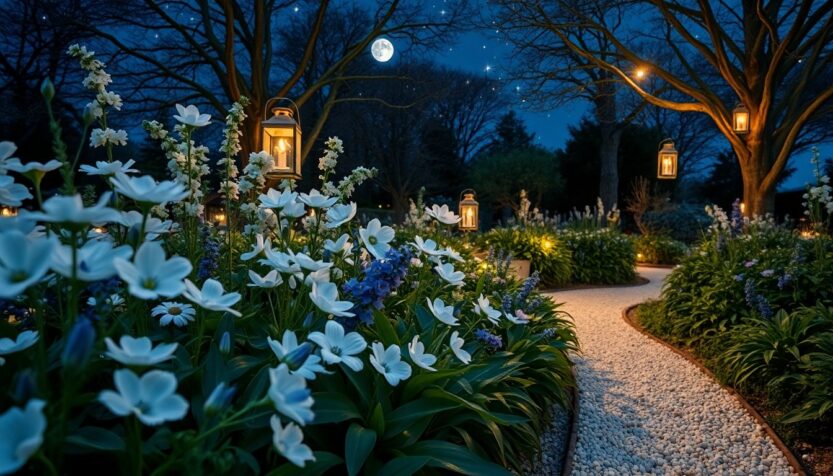
A moon garden is a specially crafted outdoor space designed to showcase its beauty after sunset. This enchanting landscape features pale blooms, shimmering foliage, and reflective elements that enhance the soft illumination of the moon. Although the term ‘moon garden’ is relatively new, the practice of creating such serene environments has deep roots in various cultures, highlighting humanity’s timeless fascination with the night and its tranquil beauty.
These gardens are experiencing a revival as sanctuaries for meditation and personal reflection. They offer a serene environment for individuals to unwind and reconnect with nature in today’s fast-paced world. By incorporating specific plants and design elements, anyone can create their own moonlit retreat within their backyard.
The historical significance of moon gardens
The origins of moon gardens can be traced back to ancient civilizations that esteemed the moon as a symbol of balance and harmony. In ancient China, the appreciation of the moon was intricately linked to seasonal festivities and artistic expressions. Courtyards were designed with pale flowers, reflective water bodies, and white stones that sparkled under the moonlight. During the Mid-Autumn Festival, communities gathered in these gardens to celebrate the moon’s fullness, enjoying its reflections in serene ponds or polished stone basins, thus laying the groundwork for what we recognize today as moon gardens.
In Japan, the tradition of moon viewing also held significant importance within Japanese gardens. The practice known as tsukimi emphasized simplicity and balance, utilizing carefully raked gravel, tranquil water features, and elegantly shaped trees to create striking silhouettes against the night sky. These gardens were intended for evening enjoyment, serving as a peaceful escape from daily chaos, akin to modern moon gardens.
Global perspectives on moon gardens
In regions like Persia and the Middle East, evenings became prime time for outdoor enjoyment as the air cooled after sunset. Garden designers in these areas included fragrant night-blooming plants and symmetrical architectural features to craft sensory paradises that catered to spiritual and aesthetic experiences.
In the Americas, various night-blooming plants such as moonflower, evening primrose, and certain types of cacti have cultural significance. These plants are cherished for their captivating fragrances and luminous flowers, enhancing the nighttime landscape.
The evolution of moon gardens
During the Victorian and Edwardian eras, the concept of moon gardens began to take shape as a distinct design style. Gardeners in Europe and the United States became enamored with exotic night-blooming plants and gardens that flourished in the cool evening air. Lantern-lit strolls amidst fragrant blooms became a popular pastime, as people sought to enjoy the serene beauty of their surroundings.
In the early 20th century, the establishment of white gardens, such as Vita Sackville-West’s renowned White Garden at Sissinghurst, significantly influenced the modern aesthetic of moon gardens. While not explicitly designed for moonlit appreciation, Sackville-West’s garden demonstrated how a monochromatic palette could illuminate the night, inspiring gardeners to create their own luminous sanctuaries.
Modern moon gardens and their significance
By the mid-20th century, gardening literature began to refer to intentionally designed night-oriented spaces as moon gardens. Filled with glowing plants, silvery leaves, and delightful evening fragrances, these spaces became increasingly popular as peaceful retreats in suburban backyards. Today, moon gardens are experiencing a resurgence not only for their visual allure but also for their ecological contributions, supporting nocturnal pollinators like moths and bats.
In an age dominated by incessant noise and digital distractions, moon gardens provide a personal haven of tranquility. The soothing color palette and gentle fragrances create an ideal environment for reflection and meditation. This calming ambiance encourages individuals to slow down, while the unfolding of night-blooming flowers serves as a metaphor for the natural world’s unwavering rhythms. Even a modest corner adorned with white blossoms and soft grasses can transform into a private oasis. Many incorporate a simple bench or stone seat in their moon garden, inviting moments of stillness and contemplation beneath the expansive night sky.
These gardens are experiencing a revival as sanctuaries for meditation and personal reflection. They offer a serene environment for individuals to unwind and reconnect with nature in today’s fast-paced world. By incorporating specific plants and design elements, anyone can create their own moonlit retreat within their backyard.0