
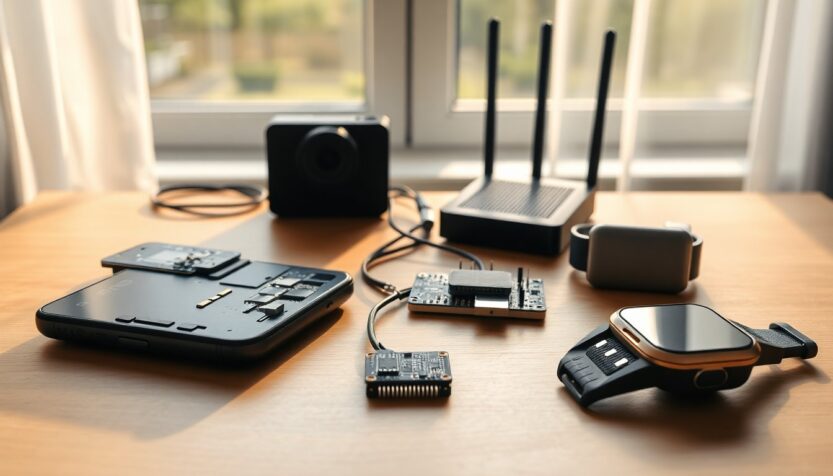
Edge AI is quietly reshaping everyday gadgets. Instead of shipping raw sensor streams to distant servers, modern devices are doing the heavy lifting themselves: running compact machine‑learning models on the phone, camera, router or wearable. The payoff is immediate — snappier responses, lower bandwidth use and stronger privacy — but getting there takes careful co‑design of models, silicon and software.
How Edge AI actually works
– The basic pipeline is familiar: sensors → preprocessing → inference → decisioning. What’s different is where the inference happens — on the device — and how models are adapted to do so.
– Models are slimmed down through pruning, quantization and knowledge distillation, then compiled into efficient kernels (TFLite, ONNX Runtime and vendor toolchains are common). These transformations shrink memory footprints and cut compute needs so networks fit within limited caches and thermal envelopes.
– Hardware is heterogeneous: low‑power CPUs, DSPs, GPUs and increasingly NPUs (neural processing units) share the workload. A runtime scheduler parcels tasks to whichever block gives the best throughput‑per‑watt. Secure boot, hardware roots of trust and signed models protect integrity, while OTA update channels and versioning allow incremental model upgrades or federated learning-style improvements without centralizing raw training data.
Why designers pick the edge
– Latency: Eliminating the cloud round trip unlocks millisecond responses for wake‑word detection, AR overlays or camera autofocus.
– Privacy: Raw audio, video and biometric streams can be processed and summarized locally, reducing exposure and legal surface area.
– Bandwidth and cost: Sending only compact metadata or flagged events trims upstream traffic and cloud billings.
– Resilience: Devices can continue to operate when connectivity is spotty.
Trade-offs and hard engineering problems
– Fragmentation: SoCs differ wildly. Tuning a model for one vendor’s NPU often requires reworking kernels and schedules for another, which boosts development and testing effort.
– Capacity limits: Aggressive compression helps fit models on device but can shave accuracy, especially for edge cases. Sometimes hybrid approaches — light local inference plus cloud refinement — are necessary.
– Power and thermal constraints: Peak energy draw matters for battery life and comfort, so models and runtime policies must be power‑aware.
– Security and updates: The endpoint becomes the primary attack surface. Robust secure update mechanisms, rollback paths and runtime integrity checks are essential at scale.
Real-world use cases
– Smartphones: On‑device speech recognition enables offline dictation and faster voice assistants; cameras do portrait segmentation and HDR adjustments locally for near‑instant results.
– Wearables: Continuous sensor fusion for health monitoring keeps raw biosignals on the device while sending only alerts or summaries.
– Home and security devices: Local anomaly detection and person detection reduce false alarms and unnecessary uploads.
– Automotive and mobility: Driver monitoring and cabin analytics run at the edge to preserve safety even when connectivity drops.
– Industry and healthcare: Edge inference supports low‑latency anomaly detection on the factory floor and preliminary triage at the point of care, limiting sensitive data exposure.
The developer story and toolchain
– Tooling has matured: standardized runtimes, model compilers and model zoos shrink time‑to‑market. Compiler‑level optimizations extract parallelism and trim memory overhead, while hardware‑aware neural architecture search is starting to design networks with edge constraints baked in.
– Formats like TFLite and ONNX help portability, though conversion losses and vendor‑specific binaries remain pain points. End‑to‑end stacks that handle optimization, signing and OTA delivery are especially valuable to product teams.
Market dynamics and outlook
– The ecosystem sits at the intersection of silicon vendors, OEMs, OS providers, cloud platforms and independent software developers. Chipmakers who bundle NPUs into mainstream SoCs are pushing on price/performance; software providers compete on developer ergonomics and secure update tooling.
– Expect consolidation around standardized runtimes and better automated toolchains. As hardware costs fall and tooling improves, more consumer features will migrate fully on‑device.
– A useful yardstick: mid‑range SoCs now commonly include NPUs in the ballpark of 5–20 TOPS, enabling real‑time inference for compact models under ~50 MB after quantization — good enough for many consumer scenarios today and likely broader ones soon. When those pieces come together, devices feel faster, more private and more resilient — which is precisely why manufacturers are betting on the edge for the next wave of user‑facing intelligence.