



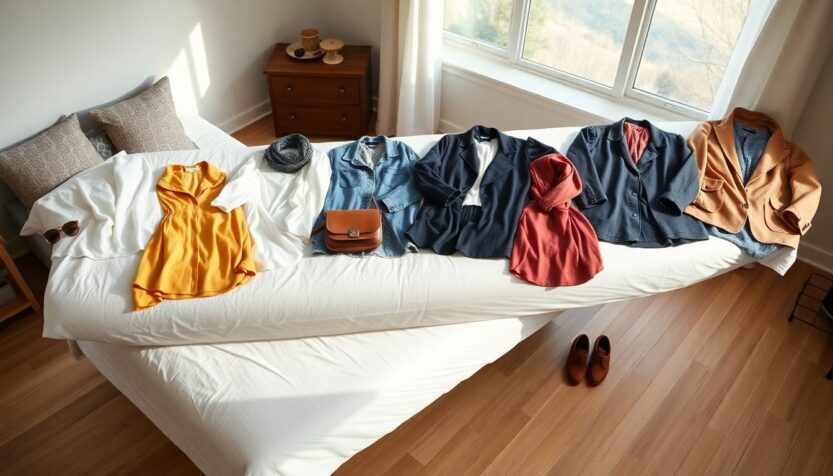
Laura Tully is a wardrobe stylist who lives in Boise, Idaho with her husband and three kids, and her approach to clothing centers on effortless dressing. Rather than treating each morning like a fashion exam, she builds small systems that turn outfit choices into reliable defaults. For her, a great look is one that arrives without agonizing over combinations—an intuitive, repeatable solution rather than a last-minute experiment. In this piece, we walk through how she plans seven days of outfits, the core concepts she uses, and the practical edits anyone can adopt to streamline their closet decisions.
How she plans a week of looks
Laura organizes a week by thinking in terms of outfit formulas—simple templates that can be adapted with different pieces. An outfit formula might be a blazer + tee + straight-leg jeans for one day, then a knit dress + ankle boots on another; the structure stays the same, while textures and colors vary. She maps these templates to the calendar, keeping one or two days intentionally casual for family life and one day tailored for meetings or client calls. That balance lets her move through the week without wardrobe friction. The goal is not monotony but predictability: curated variety within a small set of dependable combinations.
Outfit formulas in practice
Each formula starts with a foundation piece—often a pair of trousers or a versatile dress—and adds around two supporting elements. Laura favors layering because it is forgiving and adaptable: a sweater over a button-down, or a structured coat over soft knits. These layers act as the building blocks of each look. She also uses color rules (neutral base, one accent color) and texture contrasts (smooth leather with slubby knits) to keep outfits interesting without complicating choices. By rehearsing a handful of formulas, she can assemble looks in minutes, which is especially useful on busy mornings with kids and appointments.
Key pieces and her practical approach
Laura’s wardrobe choices emphasize longevity and flexibility: well-cut outerwear, durable shoes, and comfortable yet polished staples. She describes curating a small collection of dependable items that mix and match easily—a real-world take on a capsule wardrobe. The term capsule wardrobe here refers to a compact, interchangeable set of garments that cover most daily needs. Rather than chasing trends, she invests in fits that flatter her shape and fabrics that hold up through family life. This means a balance of smart tailoring for client-facing days and relaxed essentials for neighborhood runs and school drop-offs.
Capsule items and accessories
Accessories are the finishing touch that makes a repeated formula feel fresh: scarves, a signature pair of earrings, or a single standout bag. Laura leans on shoes as mood-setters—sneakers for weekend energy, loafers for midweek polish, boots for cooler weather. She also recommends keeping a small repair kit and a shoe-care routine so favorite items stay wearable longer. These small habits are part of what she calls low-effort style maintenance: tiny investments that keep your rotation reliable and reduce the urge to replace versus repair.
Styling tips you can use
To simplify dressing, Laura suggests three practical moves: define two or three personal outfit formulas, identify a short list of versatile pieces that anchor those formulas, and create a go-to set of accessories that elevate basics. Start by photographing outfits that worked and save them as visual prompts—this becomes a quick reference on mornings when time is tight. She also encourages periodic closet edits: remove single-use items and replace them with multi-functional pieces. Over time, these small systems compound into a wardrobe that supports your life rather than demands daily problem solving.
Ultimately, Laura’s method is about designing decision-friendly style so that clothes serve your life, whether you’re running a household, seeing clients, or grabbing coffee with friends. Her Boise-based practice blends thoughtful tailoring with approachable, everyday pieces, and her core message is simple: build structure, keep quality, and let a few reliable formulas do the heavy lifting. The result is a week of outfits that feel intentional yet require very little thought—exactly what she considers a successful approach to dressing.