

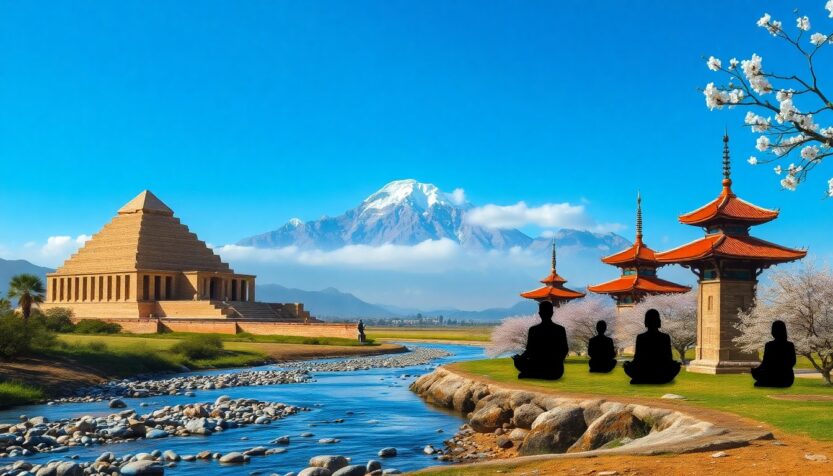
From the ancient banks of the Nile to the serene heights of the Himalayas, humanity has pondered profound questions for ages. These inquiries encompass the nature of existence, the concept of a fulfilling life, and what lies beyond death. Despite vast differences in languages, symbols, and rituals, the world’s major religions—including Ancient Egyptian beliefs, Judaism, Christianity, Zoroastrianism, Hinduism, Buddhism, and Taoism—reveal strikingly similar insights when examined at their core.
At the heart of these diverse traditions lies a common understanding: reality transcends the tangible and measurable. All major religions convey that the universe is not solely a material existence; instead, there exists a sacred order, a specific way of being that humanity should strive to align with. Human fulfillment is achieved not by imposing our vision of a perfect world but by harmonizing with the inherent flow of existence.
The internal struggle for righteousness
These spiritual paths emphasize that true fulfillment cannot be reduced to mere external conformity. The real challenge lies within—the choice between good and evil, the pursuit of understanding the ultimate truth versus denying its existence. For instance, in Ancient Egyptian beliefs, the god Osiris weighed the hearts of the deceased against the feather of Ma’at, symbolizing truth and justice. Similarly, Jewish prophets assert that God seeks mercy over mere ritual sacrifice, advocating for a life of kindness and humility.
Teachings of love and compassion
Throughout these traditions, the call for compassion resonates. Jesus Christ echoed these sentiments, stating, “Blessed are the pure in heart.” The Zoroastrian principle of good thoughts, good words, and good deeds emphasizes a holistic approach to life, purifying both the individual and the world. The Bhagavad Gita champions selfless action, performed with a disciplined mind, while the Buddha’s Noble Eightfold Path begins with an emphasis on achieving right intention and understanding. In Taoism, the sage aspires to embody the simplicity of an “uncarved block,” remaining open and receptive to the world.
The consensus across various epochs and regions is clear: ritual devoid of genuine righteousness is empty; authentic spirituality involves transforming our desires, egos, and negative feelings into love, compassion, and balance.
Life beyond death in religious beliefs
Notably, none of these religious traditions views death as the ultimate cessation of existence. The Ancient Egyptians dedicated significant resources to ensuring that the ka and ba would continue beyond this life. Judaism evolved its understanding from the concept of Sheol to the belief in resurrection and the World to Come. Christianity places great emphasis on the resurrection of the body, while Zoroastrianism envisions Frashokereti, the final renewal of the world accompanied by resurrection. Both Hinduism and Buddhism share the belief in the cycle of samsara and the potential for liberation, whether termed moksha or nirvana. Even in Taoism, there is a notion of merging with the eternal Tao and returning to one’s ultimate home.
Shared visions of ultimate reality
While these beliefs manifest in different forms—re-embodiment, resurrection, or transcendence—the underlying message remains consistent: the human narrative does not conclude at the grave. Each faith envisions a state where the soul is in perfect alignment with the ultimate reality, free from strife, illusion, and separation. Whether it is the paradise of Osiris, the Christian heaven, the pure land envisioned by Ahura Mazda, or the realization of Brahman, all religions share a vision of peace that transcends human understanding.
These shared insights are too prevalent and specific to dismiss as mere coincidence. Humanity may have collectively stumbled upon universal truths, or perhaps there exists a singular sacred order that has revealed itself through various lenses across cultures. Though the expressions may differ, they can be likened to different routes leading to the same mountain summit. Climbers from diverse valleys may use various names for the peak, yet they all describe the same breathtaking sunrise once they reach the top.
The call for unity
In an era often dominated by religious conflict, it is vital to recognize that the core teachings within each tradition consistently guide us toward the same principles: live in truth, cultivate a pure heart, love your neighbor, and align with the sacred order that sustains our world. This universal message resonates from the banks of the Nile, the heights of Mount Sinai, the sites of Golgotha, the mythical Mount Meru, and the banks of the Yellow River.
If the world’s spiritual traditions, despite their outward differences, consistently arrive at similar moral and metaphysical conclusions, it raises an important question: could this convergence be compelling evidence that humanity has uncovered something profoundly real about existence? Perhaps we risk losing sight of this truth at our own peril.