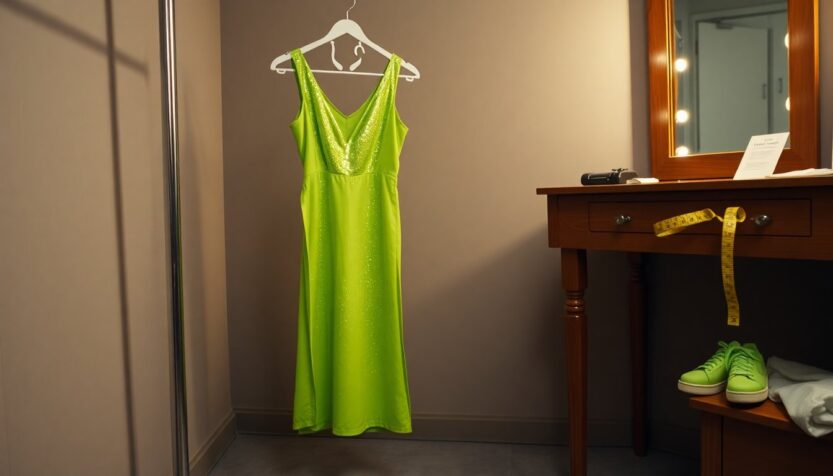
The actress Hilary Duff recently took another look at a defining scene from the Lizzie McGuire Movie in a video for Vanity Fair. In the clip she rewatched the performance of “What Dreams Are Made Of” and offered a candid reaction to her on-screen wardrobe choices. While the moment is widely remembered for its energy and early-2000s charm, Duff singled out one element that didn’t sit well with her at the time: the bright green outfit worn by the character Isabella. She also noted a small consolation — the brown wig — which she admitted she liked despite disliking the costume’s overall aesthetic.
The costume in question is a fitted green jacket paired with a matching skirt and finished with a sheer, floor-length overlay that gives the look its distinctive silhouette. The scene contrasts Lizzie’s soft lavender two-piece with Isabella’s bold ensemble, creating a memorable visual duality. Duff explained that the movie’s costumes were made by the film’s costumer, who created original pieces rather than supplying designer labels. Duff reflected that, unlike the television series where she had input on her wardrobe, the movie’s costuming felt less like an extension of her own style — and as a teenager she simply didn’t love the lime green number.
A closer look at the performance
The sequence itself is staged as a pop concert, with Lizzie stepping into the spotlight and the faux-celebrity Isabella performing as an Italian pop star opposite her. The contrast between costumes, choreography and camera work made the scene instantly iconic and a frequent flashpoint for fans revisiting the film. The performance is remembered for its catchy song and theatrical staging, but also for the strong visual identities assigned to each character: one soft and pastel, the other bold and neon. That clear sartorial storytelling contributed to the scene’s continued appeal, even when the actor behind one of the looks admits she wasn’t comfortable in it.
Fans and fashion commentators have returned to the performance for years, celebrating it as a moment of pure early-2000s nostalgia. The outfits, hairstyles and onstage props often resurface in social-media conversations and memes, with the green ensemble frequently singled out as a striking choice. Duff’s fresh commentary in the Vanity Fair rewatch adds a new layer to how audiences interpret that look: hearing the performer herself call the outfit something she “hated” reframes the costume as part of the movie’s playful, slightly over-the-top aesthetic rather than a reflection of her personal taste.
Why Duff disliked the outfit
Duff’s reasons combine practical and personal elements. She noted that the film’s wardrobe was conceived by a dedicated costume team who made original pieces — “it wasn’t like a designer or anything,” she said — and that the finished looks weren’t as influenced by her own preferences as the clothes she chose on the TV series. As a young performer she remembered disliking the loud color and the way the silhouette felt on her. Still, she qualified her criticism by praising the creative work involved and acknowledging that the designer “crushed it” in execution, highlighting the difference between appreciating craftsmanship and personally liking the result.
Costuming and creative control
The distinction Duff made between show wardrobe and movie costuming speaks to broader ideas about creative control and character construction. On the TV series Duff had more influence over what she wore, which tied costume choices closely to her sense of self. For the film, the costumer aimed to create distinct identities for each role, using color, texture and accessories to communicate character traits quickly to the audience. In that process, the actor’s comfort can become secondary to the visual story being told, which explains why Duff could admire elements like the wig while disliking the full look.
Why the moment endures
Ultimately, the exchange of opinions and the rewatch both underscore why the sequence remains a cultural touchstone. The candidness of Hilary Duff during the Vanity Fair conversation adds to the scene’s lore and reminds viewers that iconic images can be the product of many creative choices, not all of which reflect the performer’s personal taste. Whether celebrated for its choreography, its fashion or its nostalgic power, the “What Dreams Are Made Of” performance continues to spark conversation — and Duff’s frank take simply makes fans see the costume in a new light while reaffirming the scene’s lasting place in pop-culture memory.