

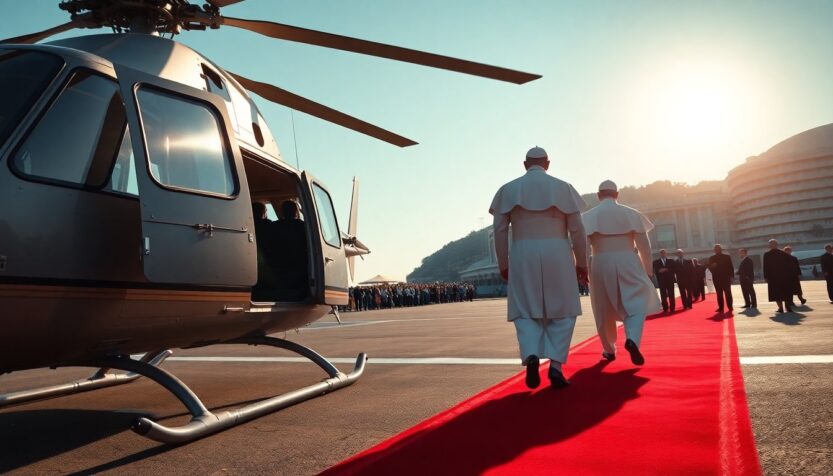
The arrival of Pope Leo XIV in Monaco drew immediate attention as a mix of ceremony and contemporary travel. The pontiff touched down by helicopter after leaving the Vatican, stepping into bright Monegasque sunshine for what was described as his first foreign trip of 2026. Observers noted the historical resonance of the moment: it had been 488 years since a pope last visited the principality, the previous occasion being the journey of Paul III in 1538. The scene at the heliport and the nearby courtyard set the tone for a visit that combined public liturgy with private conversation.
Reception at the Prince’s Palace
At the heart of the welcome was the meeting between the pontiff and the ruling family in the courtyard of the Prince’s Palace. Prince Albert and Princess Charlene received the pope alongside their children, presenting an image of dynastic continuity and contemporary etiquette. The two children, Crown Prince Jacques and Princess Gabriella, reflected family formality in their attire: Jacques in a dark suit mirroring his father’s style and Gabriella in a white dress reminiscent of her mother’s ensemble. This public-facing moment reinforced how appearances and protocol remain central when heads of state and spiritual leaders meet.
The Grimaldi family and ceremonial protocol
Dress, symbolism and tradition
Elements of ceremony were visible in clothing and gesture. The female members of the family wore dark attire while adopting a head covering, a nod to the longstanding custom that couples liturgical respect with sartorial choices. One particular garment, the mantilla — a lace or silk veil traditionally worn by women at papal audiences — was evident among the older female relatives. Meanwhile, Princess Charlene maintained the longstanding convention for sovereign wives by appearing in white during her audience with the pope, a symbolic practice that signals deference and continuity in diplomatic-religious encounters.
Family presence and notable attendees
The wider Grimaldi circle formed a composed tableau. Princesses Caroline and Stephanie stood together as visible pillars of the dynasty, while the younger generation, including Charlotte Casiraghi and her brother Pierre, joined the gathering. Pierre attended with his wife, Beatrice Borromeo, and other relatives such as Louis and Marie Ducruet completed the family group. The arrangement of these figures — older and younger members side by side — emphasized both family solidarity and the continuity of public roles in the principality.
The pope’s itinerary and messages
After the palace reception, the private discussions between Pope Leo XIV and Prince Albert underscored the visit’s substantive layer. The two had previously met at the Vatican in January, and their subsequent exchange in Monaco touched on a range of topics: religious life, the pursuit of peace, environmental stewardship and international solidarity. At the close of the private meeting, Princess Charlene joined for the customary exchange of gifts, an act that combined personal courtesy with the diplomatic rituals typical of high-level visits.
Moving from private chambers to public addresses, the pope offered remarks from the palace balcony before proceeding to the Cathedral of the Immaculate Conception to pray with the local bishop. He also spoke to people gathered in the square in front of the church of Sainte-Dévote, offering words meant for both spiritual reflection and communal encouragement. The visit culminated in an open-air mass at the Stade Louis II, attended by a crowd numbering in the thousands, where the liturgy and scenery combined to form a memorable capstone to the papal stop.
Public and symbolic outcomes
The Monaco visit served multiple purposes beyond the immediate ceremonies: it reaffirmed diplomatic ties between the Holy See and a small but prominent European principality, it highlighted shared concerns over global matters like the environment and solidarity, and it showcased how monarchy and papacy continue to interact in modern public life. In blending formal protocol with accessible public worship, the event illustrated how contemporary papal travels can be both symbolic and practical, reaching local communities while engaging with leaders on pressing global topics.
In the end, the day in Monaco offered a compact narrative of continuity: ancient customs such as the use of the mantilla and the white dress tradition sat alongside modern logistics like helicopter arrival and stadium liturgy. For residents and visitors alike, the visit by Pope Leo XIV will be remembered as a rare intersection of history, faith and family on the Mediterranean shore.