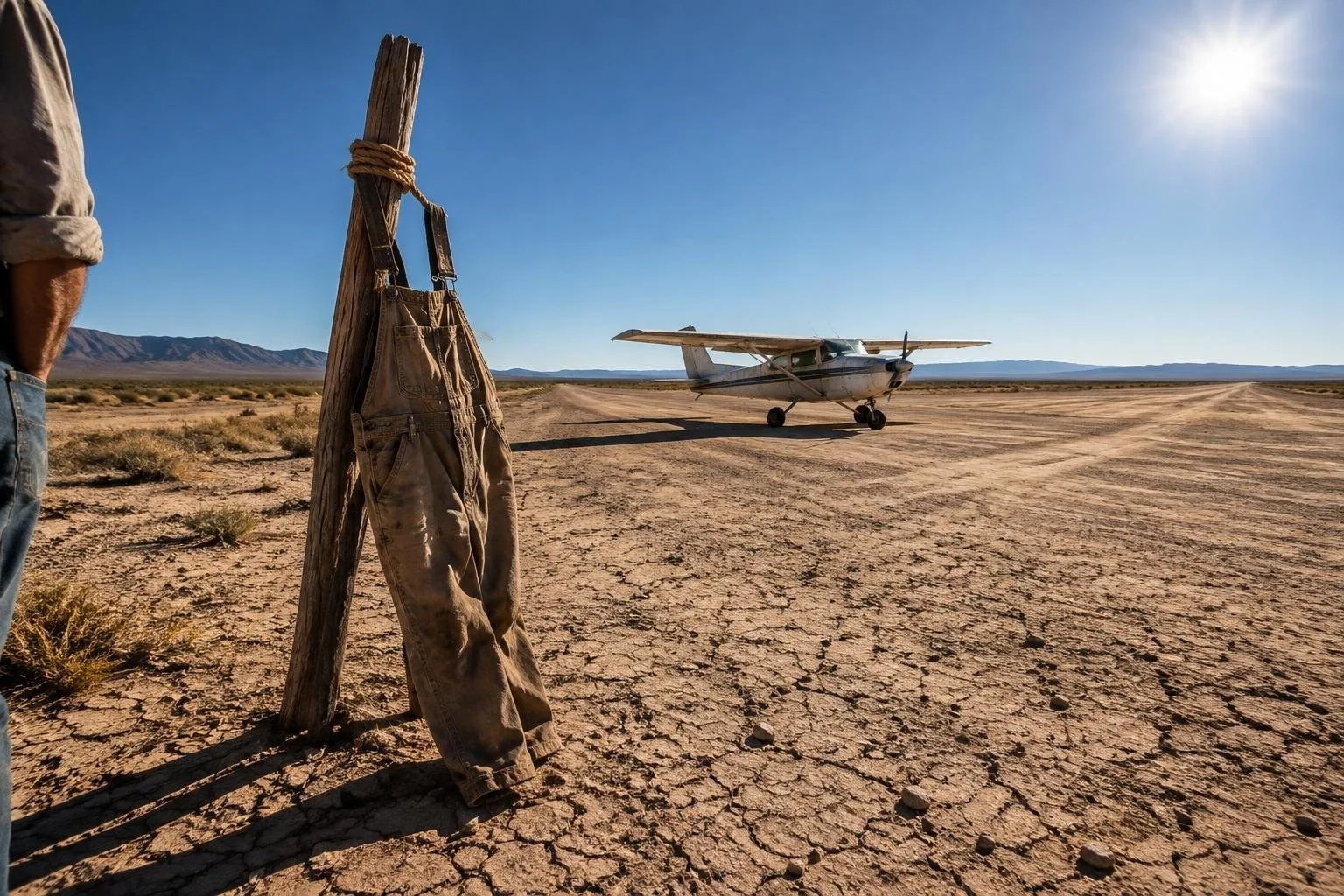
Throughout my life I have crossed paths with scholars, executives, and hobbyists, yet the most unforgettable encounter was with a man named Earl – a farmer who wore bib overalls and carried a sky-full of ambition.
Earl’s unexpected journey to the cockpit
In the early 1980s, at the modest airstrip of Safford, Arizona, Earl appeared far from the typical image of an aviator. He owned nothing more than a farm and a pair of work-worn overalls. Nevertheless, his father’s crop-dusting Cessna 172 sat idle on the tarmac, and one day the older man simply said, “Get in and learn.” Earl had never set foot in a classroom for flight school, nor possessed a pilot’s license. He absorbed the basics of navigation, radio procedures, and handling techniques by listening intently to the pilots who stopped at the field, asking questions, and committing each answer to memory. My own routine at the time involved flying everything from hang gliders to an ultra-light, eventually graduating to a pressurized Cessna P-210. The sky became our shared playground, not a career ladder.
A desert road landing that became legend
One scorching afternoon, while cruising over the Arizona desert, I realized I was off course. The rational move would have been a call to Albuquerque Center for vectors back to Safford. Instead, my gaze fell on a solitary double-wide mobile home perched beside a dusty track. Impulse won; I touched down on the unpaved lane, parked the aircraft, and knocked on the door. A woman greeted me, eyes darting between me and the plane. “Darling, you’re lost, aren’t you?” she said, pointing toward a distant mountain and replying, “It’s right through that mountain over there.” Following her tongue-in-cheek directions, I climbed back into the cockpit, took off, and, true to her hint, found Safford Airport without further incident. The memory of that daring landing remains sharper than any textbook lesson.
When the instructor fell asleep in a pressurized Cessna
Months later Earl and I embarked on a cross-state trip to Reno in the very same Cessna P-210. As we climbed, Earl explained the intricacies of the constant-speed propeller, the landing-gear lever, and the aircraft’s radios. Mid-flight, he turned to me with a grin and said, “Wake me up in an hour.” I laughed, assuming a joke. Within twenty minutes Earl’s head dropped, and a soft, chainsaw-like snore filled the cabin. The autopilot held our altitude, the weather stayed friendly, and I followed his earlier instructions. Approaching Reno, I nudged him awake; he blinked, verified our position, and together we completed a smooth approach and touchdown. He never offered a word of praise, yet his quiet confidence felt like the highest compliment.
Beyond the cockpit: lessons from a farmer in overalls
Earl loved to recount a bizarre episode from a mountain-laden flight in a heavily loaded Cessna 172. A sudden, violent jolt caused one of the doors to swing ajar. Instinctively, Earl reached for the handle to close it, but a passenger, assuming Earl knew a hidden problem, opened his own door. Soon both front doors were gaping to the sky, prompting a bewildered shout from the rear seat: “What the hell are you doing?” The front passenger replied, “If Earl’s getting out, I’m getting out too!” The image still makes me laugh, but it also illustrates Earl’s habit of confronting the unexpected with plain-spoken practicality.
What endures most is Earl’s philosophy: formal credentials are not the sole measure of competence. He never needed a wall of diplomas because he practiced self-taught learning backed by curiosity, observation, and the willingness to ask. Some cease to study once school ends; others, like Earl, keep the classroom open wherever they go. His story reminds us that the person in bib overalls can possess deeper insight than the one in an expensive suit. The next time a farmer in a small plane tells you to “wake me up in an hour,” trust that he knows exactly what he’s doing — just double-check those doors.