
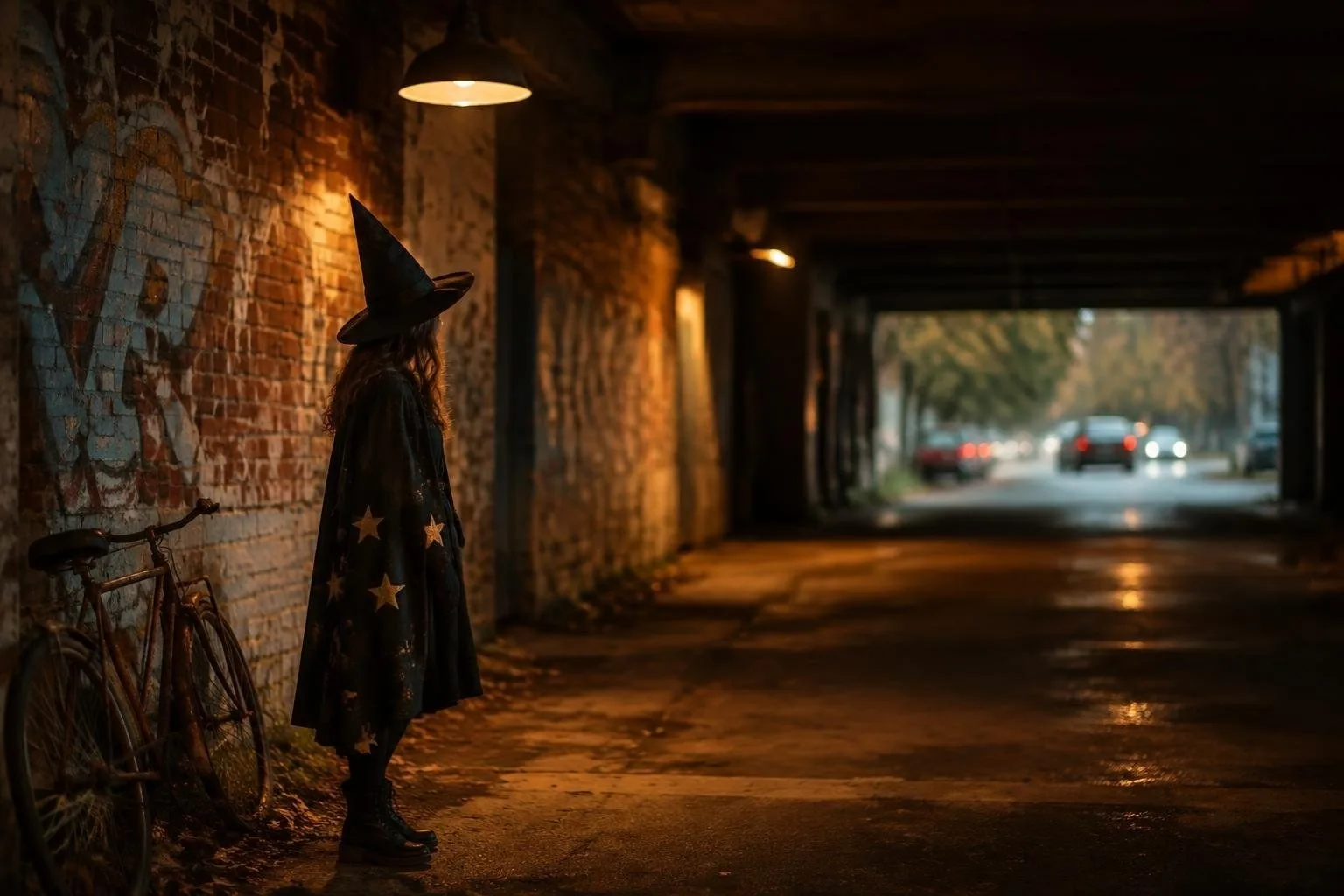
Every commuter passes by stretches of asphalt, dim underpasses, or quiet walkways without noticing the visual stories they hold. Photographer Matt Healy turned those unnoticed corridors into a personal project, pairing them with model Fran Summers to capture moments that feel both intimate and anonymous. At the same time, college students grapple with the modern, commercialized version of Halloween, seeking ways to keep the holiday’s wonder alive without breaking the bank. Meanwhile, celebrities pushed the boundaries of costume creativity, opting for hyper-specific references that only true fans would recognize.
Urban liminality: how forgotten streets become a visual narrative
Healy first spotted the allure of these marginal spaces during routine drives from Tottenham to Essex. The monotony of underpasses and narrow service lanes sparked a mental montage of solitary hideaways—places where one could disappear from the world for a few breaths. He approached his creative director, Gerry, with a simple brief: shoot beside a busy motorway, break the kinetic backdrop with studio-style portraits, and let the environment speak. Little more than a few styling ideas and the potential involvement of model Fran Summers guided the concept.
In the final images, Summers appears relaxed, as if she were a friend lingering in a childhood hideout. The photographs blend the raw, gritty texture of concrete with an almost cinematic stillness, inviting viewers to re-imagine everyday infrastructure as a canvas for personal stories. The project, initially intended as a quiet summer diversion, found a home in Perfect magazine, emphasizing that memory and place can intertwine without elaborate setups.
College Halloween: nostalgia versus practicality
Elizabeth Hossack recalls Halloween as the pinnacle of her childhood magic—pumpkin patches, hot cider, and the thrill of dressing up months in advance. Entering college, however, she confronted a culture where the holiday often feels reduced to a brief, consumer-driven flirtation. Between research papers and rent, many students dismiss elaborate costumes as an unnecessary expense, opting for last-minute, mass-produced outfits that rarely reflect personal taste.
Hossack argues that Halloween remains a rare outlet for self-expression. She demonstrates that creativity can thrive on a budget: repurposing existing wardrobe pieces, borrowing from friends, or scavenging thrift stores, Etsy, and Depop for unique accessories. By sewing a red Felt “A” onto a second-hand corset, she invoked Olive Pendergast from *Easy A* without spending a fortune. This approach reframes Halloween as a platform for turning mundane garments into theatrical statements, reinforcing that the night’s value lies in effort and imagination rather than price tags.
Celebrity costumes go hyper-specific: the era of niche references
While everyday partygoers wrestle with budget constraints, celebrities mobilized entire teams of makeup artists, prosthetic designers, and stylists to deliver costumes that border on performance art. Heidi Klum, for instance, teased a brain-like ensemble that ultimately resolved into a disembodied hand—a nod that skipped popular media references entirely. Kim Kardashian chose to embody her 13-year-old daughter, North West, while North answered with a caricature of reality-TV star Natalie Nunn, complete with a fabricated chin.
Other notable looks included Janelle Monáe’s original aquatic creature dubbed “Phish Boy,” and the Kardashian-Jensen family’s rotating interpretations of *The Addams Family*, Disney’s *Belle* and *Beast*, and even Rapunzel. These selections illustrate a shift toward self-referential design: costumes that reward viewers familiar with specific pop-culture moments, from obscure 1990s rom-com characters to anime spirit mediums. The trend showcases how high-profile wardrobes can inspire everyday fans to dig deeper into niche fandoms, encouraging a more personalized, less commercial Halloween experience.


