



Summary
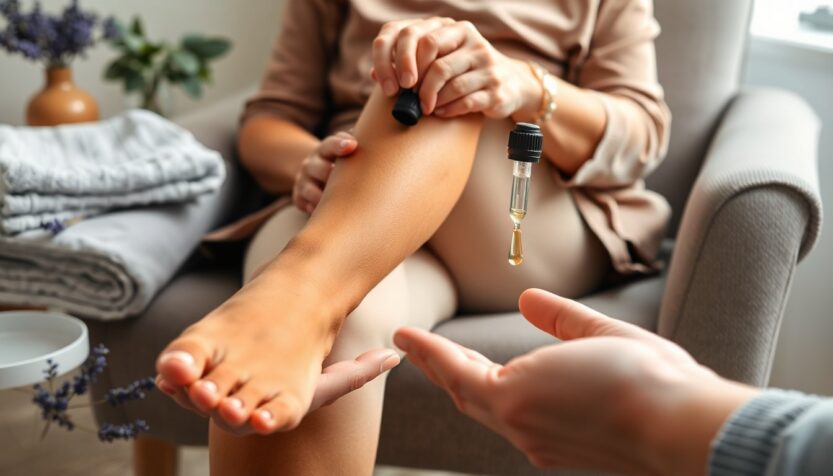
Topical aromatherapy can serve as a gentle, noninvasive adjunct for older adults with symptomatic venous changes. It won’t cure valve failure or reverse major hemodynamic problems, but when used alongside compression, exercise and medical care it may ease sensations of heaviness, improve local skin comfort and support lymphatic clearance. Evidence is mostly preliminary and modest in size; clinicians should focus on safety, standardised dilutions and careful integration with conventional treatment.
Why varicose veins become more common after 60
Aging alters veins in several predictable ways. Loss of collagen and elastin weakens the vessel wall, and valve leaflets stiffen or deform, allowing backward flow. At the same time, reduced calf‑muscle activity lowers venous return. The result is chronic venous hypertension, with dilated, winding superficial veins and sometimes skin changes that reflect deeper dysfunction rather than mere cosmetic worry. Hormonal shifts—particularly after menopause—can accelerate connective‑tissue remodeling, making veins more vulnerable in many women.
Because these processes are structural and mechanical, mainstays of management remain risk reduction, compression therapy and medical assessment. Still, patients frequently ask about topical options to relieve local symptoms and protect skin integrity; that is where evidence‑informed clinical aromatherapy can fit as an adjunct.
How clinicians view topical aromatherapy for venous symptoms
Clinical aromatherapists trained in evidence‑based practice treat essential oil blends as supportive measures. The goal is symptomatic relief and skin care rather than correction of valvular incompetence. Practical protocols rely on low concentrations in emollient carriers, patch testing for tolerance, and pairing topical use with compression, movement and skin hygiene. When supervised appropriately, some people report short‑term improvements in leg comfort, skin hydration and the subjective sense of lightness. However, robust randomized trials demonstrating disease modification are lacking.
Mechanisms: how topical oils might help
Three main mechanisms explain potential benefits:
– Carrier oils hydrate the epidermis and strengthen barrier function, which helps fragile, mature skin.
– Small, lipophilic constituents in essential oils can interact with cutaneous receptors and local inflammatory pathways, potentially modulating neurogenic inflammation and microvascular tone.
– The massage used to apply blends stimulates lymphatic flow and engages the calf pump, amplifying mechanical improvements in venous return.
Dermal absorption depends on molecule size, lipophilicity and formulation. Dilution, vehicle choice and application technique all influence tissue exposure and tolerability.
Pros and cons — a realistic appraisal
Pros
– Noninvasive and easy to incorporate into daily care.
– May reduce local discomfort, itching and perceived heaviness.
– Encourages self‑care behaviors (massage, movement) that themselves have therapeutic effects.
– Low cost compared with many interventions.
Cons
– Evidence from controlled trials is limited and effect sizes are generally modest.
– Risk of allergic contact dermatitis or phototoxicity with some oils.
– Product quality and constituent profiles vary widely between suppliers.
– Not suitable for advanced disease (open ulcers, acute DVT) or as a replacement for indicated vascular treatments.
Practical guidance for clinical use
– Use conservative dilutions: around 1% total essential oil in a neutral carrier is a reasonable starting point for most mature skin; short, clinician‑supervised use up to 2% may be acceptable in targeted circumstances.
– Patch test a new blend for 24–48 hours before broader application.
– Apply with light, centripetal strokes toward the groin to support lymphatic return; avoid aggressive rubbing or heating techniques on fragile skin.
– Integrate aromatherapy into a multimodal plan: graduated compression, daily ambulation, leg elevation and skin emollients.
– Avoid application to broken skin, active infection, or in the presence of unexplained severe swelling. Refer promptly for medical assessment if DVT is suspected.
– Label blended products with constituent names and concentrations and document batch/lot numbers when possible to support traceability.
Which oils are commonly used and why
Some botanicals appear repeatedly in clinical practice because of their chemical profiles and tolerability:
– Helichrysum (H. italicum): contains sesquiterpenes and esters with anti‑inflammatory properties; often chosen to support microvascular resilience.
– Rosemary ct. verbenone: a mild circulatory stimulant with antioxidant activity, favoured for mature skin.
– Geranium (Pelargonium graveolens): used for perceived fluid balance and skin elasticity, helpful around hormonal transitions.
– Lavender (L. angustifolia): anti‑inflammatory, calming and generally well tolerated; can reduce irritation when combined with other oils.
Why varicose veins become more common after 60
Aging alters veins in several predictable ways. Loss of collagen and elastin weakens the vessel wall, and valve leaflets stiffen or deform, allowing backward flow. At the same time, reduced calf‑muscle activity lowers venous return. The result is chronic venous hypertension, with dilated, winding superficial veins and sometimes skin changes that reflect deeper dysfunction rather than mere cosmetic worry. Hormonal shifts—particularly after menopause—can accelerate connective‑tissue remodeling, making veins more vulnerable in many women.0
Why varicose veins become more common after 60
Aging alters veins in several predictable ways. Loss of collagen and elastin weakens the vessel wall, and valve leaflets stiffen or deform, allowing backward flow. At the same time, reduced calf‑muscle activity lowers venous return. The result is chronic venous hypertension, with dilated, winding superficial veins and sometimes skin changes that reflect deeper dysfunction rather than mere cosmetic worry. Hormonal shifts—particularly after menopause—can accelerate connective‑tissue remodeling, making veins more vulnerable in many women.1
Why varicose veins become more common after 60
Aging alters veins in several predictable ways. Loss of collagen and elastin weakens the vessel wall, and valve leaflets stiffen or deform, allowing backward flow. At the same time, reduced calf‑muscle activity lowers venous return. The result is chronic venous hypertension, with dilated, winding superficial veins and sometimes skin changes that reflect deeper dysfunction rather than mere cosmetic worry. Hormonal shifts—particularly after menopause—can accelerate connective‑tissue remodeling, making veins more vulnerable in many women.2
Why varicose veins become more common after 60
Aging alters veins in several predictable ways. Loss of collagen and elastin weakens the vessel wall, and valve leaflets stiffen or deform, allowing backward flow. At the same time, reduced calf‑muscle activity lowers venous return. The result is chronic venous hypertension, with dilated, winding superficial veins and sometimes skin changes that reflect deeper dysfunction rather than mere cosmetic worry. Hormonal shifts—particularly after menopause—can accelerate connective‑tissue remodeling, making veins more vulnerable in many women.3
Why varicose veins become more common after 60
Aging alters veins in several predictable ways. Loss of collagen and elastin weakens the vessel wall, and valve leaflets stiffen or deform, allowing backward flow. At the same time, reduced calf‑muscle activity lowers venous return. The result is chronic venous hypertension, with dilated, winding superficial veins and sometimes skin changes that reflect deeper dysfunction rather than mere cosmetic worry. Hormonal shifts—particularly after menopause—can accelerate connective‑tissue remodeling, making veins more vulnerable in many women.4
Why varicose veins become more common after 60
Aging alters veins in several predictable ways. Loss of collagen and elastin weakens the vessel wall, and valve leaflets stiffen or deform, allowing backward flow. At the same time, reduced calf‑muscle activity lowers venous return. The result is chronic venous hypertension, with dilated, winding superficial veins and sometimes skin changes that reflect deeper dysfunction rather than mere cosmetic worry. Hormonal shifts—particularly after menopause—can accelerate connective‑tissue remodeling, making veins more vulnerable in many women.5
Why varicose veins become more common after 60
Aging alters veins in several predictable ways. Loss of collagen and elastin weakens the vessel wall, and valve leaflets stiffen or deform, allowing backward flow. At the same time, reduced calf‑muscle activity lowers venous return. The result is chronic venous hypertension, with dilated, winding superficial veins and sometimes skin changes that reflect deeper dysfunction rather than mere cosmetic worry. Hormonal shifts—particularly after menopause—can accelerate connective‑tissue remodeling, making veins more vulnerable in many women.6