
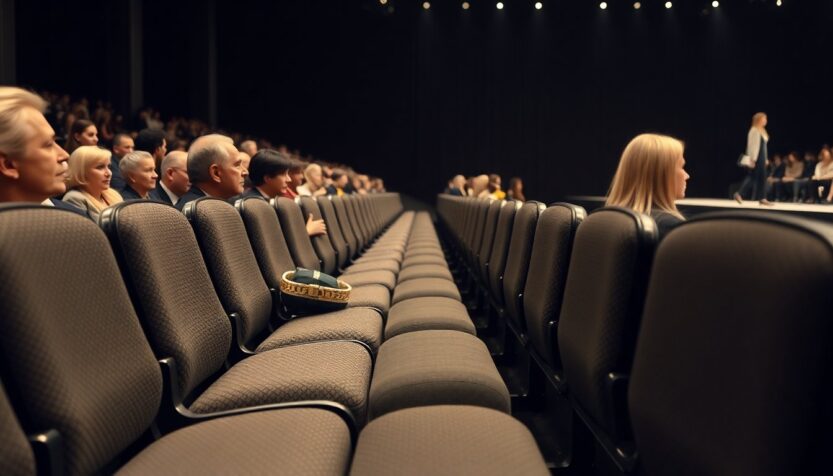
The interplay between wealth and style has long shaped haute couture and ready-to-wear presentations. In recent seasons this relationship has drawn sharper scrutiny: who occupies the front row, what they represent, and how their presence reframes a collection’s message. Observers increasingly read runs of seats as a kind of stage text that speaks as loudly as garments themselves.
One particularly vivid example is the Paris-based label Matières Fécales, a brand that emerged in early 2026. Founded by Steven Raj Bhaskaran and Hannah Rose Dalton with backing from Dover Street Market, the label is known for a provocative post-human aesthetic and theatrical shows. Their naming choice, deliberately sardonic, immediately complicates who the brand addresses and why its front-row cast matters.
The front row as cultural signal
Front-row attendees have always been a form of social currency, but today their presence is interpreted through political and ethical lenses. A guest is no longer read only as a fashion patron; they are a public figure whose corporate or philanthropic affiliations shape audience reactions. For designers, seating choices can therefore function as a statement—intentional or not—about alignment, compromise, or aspiration.
Power, optics and the runway
When Bhaskaran and Dalton themed a recent show “The One Percent”, the concept turned the runway into a commentary on access and authority. The collection explored historical couture codes alongside imaginings of future elites. Casting familiar faces from the ultra-wealthy—such as Bryan Johnson and Daphne Guinness—into later chapters of the show emphasized the crossover between fashion spectacle and concentrated capital.
High-profile guests and public debate
Controversy swells when guests symbolize broader social anxieties. The attendance of figures tied to major tech companies or vast fortunes often provokes intense online conversation. For example, public reactions followed appearances by Mark Zuckerberg and Priscilla Chan at a Milan show, and attention mounted around Jeff Bezos and Lauren Sánchez at Paris couture presentations. These moments prompt questions: Do designers endorse a guest’s politics by inviting them? Or are such visits merely pragmatic acknowledgments of global patronage?
Why some guests provoke more criticism
Not all wealthy attendees trigger the same backlash. Celebrities like Rihanna and Beyoncé often receive warm public responses because their cultural labor and visibility generate different kinds of identification. By contrast, guests associated with controversial business practices attract skepticism. social media amplifies those distinctions, turning attendance into a proxy debate about values, inequality, and the ethics of taste.
Historical context and industry shifts
luxury fashion has a long history of friendship with affluent patrons. Tales of collectors and socialites shaping couture narratives go back decades. Yet, what has changed is public access to personal histories and corporate structures: the internet has made it easier to scrutinize where wealth originates and how it is wielded. Stories that once lived in magazine profiles now circulate broadly and immediately, reframing applause into criticism in real time.
From glossy profiles to instant scrutiny
Previously, magazines spotlighted private lives and debutante circles as part of a romanticized fashion ecosystem. Today, that system is dissected on feeds, where commenters trace family fortunes and corporate ties. Even events like Le Bal des Débutantes are now parsed for the provenance of attendees’ wealth. Designers and editors must adapt to an environment where every guest list can spark investigation and debate.
Designers’ choices and the future of the front row
Designers navigate a complicated set of incentives when curating front rows. Financial patronage, media visibility, and creative alliances all play a role. Some labels embrace the tension, using provocative seating to add narrative layers to their shows. Others attempt quieter diplomacy, balancing commerce with conscience. The result is an evolving choreography between fashion’s creative aims and the sources of its support.
In the end, runway audiences will remain a mirror of broader social dynamics. As brands like Matières Fécales stage critical takes on power, and as audiences grow savvier about money’s influence, the politics of the front row will continue to be a central storyline in fashion’s public life.