

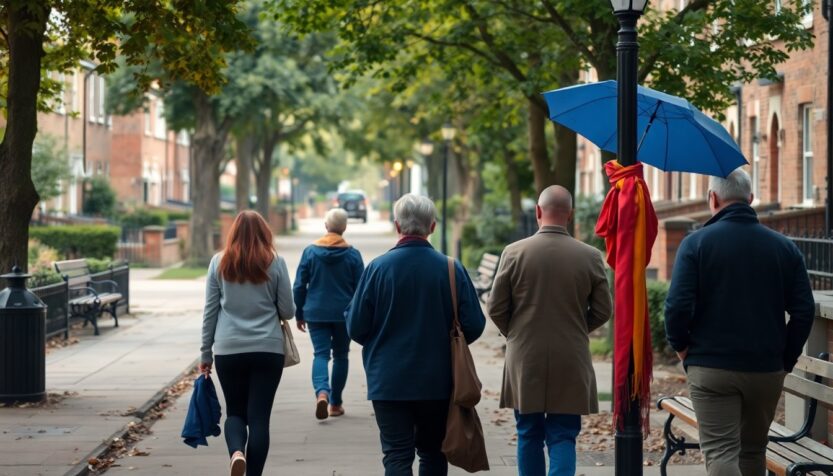
I split my time between Canada and London, and while visiting Southwest London with my children and first grandchild I stumbled across a neighborhood ritual that felt refreshingly simple: a Walk and Talk. The idea is deliberately modest — no sign-ups, a clear meeting time, and a small visual cue so new people can find the group — which makes it easy to join. For me, the structured social walk offered a few hours of adult conversation away from family duties and an appealing way to be outside with others without pressure or planning. That low-friction format is a big part of why the model spreads so quickly.
Early on I met Fiona, a long-time participant, who recommended I speak with Alison Palmer, one of the people helping the movement gain traction in Wimbledon Park. Alison’s experience running peer-led book clubs in schools — training older pupils to present and encouraging younger ones to read — translated neatly into leading a volunteer-driven walking group. On my podcast, Your Outside Mindset, Alison explained how the Walk and Talk expanded across locations and attracted thousands of participants simply by being visible, welcoming, and easy to replicate online.
Origins and community impact
The Walk and Talk in Wimbledon Park began as a small volunteer effort with a consistent weekly time and an obvious meeting point: off to the side of the café, look for people in green T-shirts. There is no registration, no fee, just a fixed rendezvous — commonly 10:30 on Saturday mornings — that removes barriers to attendance. That predictable rhythm matters: it counters loneliness on weekends and builds casual routines. The initiative is intentionally community led, with organisers posting everything needed to launch a similar group, including practical instructions and etiquette, so that others can copy the approach without reinventing it.
A newcomer’s stroll
As an outsider looking for some independent time while staying with family, I turned up alone and felt a little awkward, but the group of about fifteen people greeted me warmly. Members ranged widely in mobility and age; some walked briskly while others kept a gentler pace, and everyone respected those differences. We talked as we moved, laughed a lot, and finished with an unexpected invitation to tea at the park’s bowling club. That hour felt restorative in part because the Walk and Talk sets a single, simple aim: to walk together and talk, with no agenda and no assumptions about commitment.
From Wimbledon Park to Pine Falls
Back home in Pine Falls, Manitoba, I looked at our Village Green with fresh eyes. A level path circles the green space and seemed perfect for the same low-key experiment. A couple of friends agreed to start meeting at 1 pm, and word spread slowly: people joined when they could, and the slot became an almost-daily habit. Most participants are retired and live alone, so the lack of coordination — no texts confirming attendance, no pressure to RSVP — is liberating. The result is an informal community within a community: people who see one another regularly, exchange stories, and enjoy a predictable outlet for company.
Why the format works
The success of the model hinges on a few repeating features. First, the simple framework — a named activity, a meeting place, and a consistent time — removes decision friction. Second, volunteer leadership keeps the format flexible and affordable; volunteers help orient newcomers but don’t micromanage the group. Third, visibility matters: a recognizable cue like a green shirt or a fixed bench signals that this is a gathering anyone can join. Those elements combine to create a low-stakes social ritual that supports social connection and physical activity without bureaucracy.
How to start your own Walk and Talk
If you’re inspired to begin, pick a safe public path, choose a weekday or weekend time that meets local needs — weekends can help those who work, midday suits retirees — and make the plan public through community notice boards or social media. Keep the rules minimal: no registration, be punctual but forgiving, and emphasise that all paces are welcome. Consider a small visual identifier and a follow-up spot like a café or park bench where people can linger afterward. The aim is straightforward: create a dependable, volunteer-led moment each week where people can walk, chat, and feel less alone.