

Brooklyn family turns a 19th-century house into a lived-in home
Let’s tell the truth: this is not a staged showhouse. The Brooklyn home of Alison Piepmeyer reflects the slow accretion of family life over years.
Photographed by Lyndsay Hannah Photography, the residence displays books, considered color choices and a growing collection of objects. Alison, her husband Zach, and their children, Linus and Georgie, bought the 19th-century house “in rough shape” in 2026.
They spent the following four years renovating, decorating and filling rooms with items that matter to them. The result is a home shaped by personality and patience rather than by trends.
The emperor has no clothes, and I’m telling you: the value here lies in cumulative decisions and lived experience, not in instant perfection.
The house and its transformation
Let’s tell the truth: the work here is decisive rather than decorative. The most striking feature is the deliberate contrast between the house’s historic fabric and contemporary, often theatrical finishes.
The couple chose saturated paint tones and layered textures to create warmth and daily comfort. They prioritized a layout that supports family routines while allowing strong visual moments in key rooms.
The project extended beyond surface cosmetics. It involved sequential choices about color, object placement and use that reveal personality over time. Paint becomes an announcement. Books serve as both reference and display. Small objects are curated to narrate household history.
The photography and room descriptions underline an honest, lived-in aesthetic rather than a gallery-perfect staging. Rooms show traces of use: soft edges, informal groupings and mixed materials that invite everyday life.
The emperor has no clothes, and I’m telling you: value here accrues from cumulative decisions and domestic habits more than from single, showy gestures. The result is a house that looks collected, not catalogued.
Design choices favor function married to feeling. Surfaces are bold where the family needs energy and subdued where calm is required. Textiles and paint are layered to hide wear and to age gracefully.
Practical considerations guided many selections. Storage is integrated without erasing visual interest. High-traffic areas use durable finishes chosen to withstand family life. Lighting schemes combine task and mood to accommodate varied activities.
The transformation offers a counterpoint to staged interiors. It demonstrates how sustained, modest investments in material and organization can create a home that reads as both purposeful and lived-in. Expect the narrative to continue to unfold through small, deliberate updates rather than abrupt overhauls.
Books as architecture: how shelving shapes rooms
Let’s tell the truth: shelving does more than hold objects. It organizes light, sightlines and circulation in rooms. In this brownstone, built shelving became a tool for shaping space rather than merely filling it.
The homeowners followed a clear hierarchy: structure before spectacle. They repaired walls, floors and joinery first, then introduced shelving systems tuned to each room’s proportions. That sequence preserved the historic fabric while allowing shelves to read as architectural elements.
The emperor has no clothes, and I’m telling you: poorly scaled shelves collapse spaces. Here, narrow stacks open sightlines in compact rooms. Deep, anchored units give weight to taller spaces. Every shelf dimension was chosen to correct a spatial imbalance or to amplify a view.
Shelving also anchored intimacy. Open shelves near seating areas create layered visual warmth. Closed cabinetry conceals utility in kitchens and bathrooms. The family combined both approaches to maintain order without erasing personality.
Books functioned as both content and finish. Their spines provided color and texture in lieu of expensive surface treatments. Curated displays emphasized rhythm over uniformity: editions, objects and negative space were arranged to read like masonry courses.
So that the interventions stayed reversible, most shelving was built within existing openings or installed as freestanding units. That practical choice preserved the house’s long-term integrity while giving the family room to evolve the interiors.
Let’s tell the truth: Alison treated books as deliberate architectural elements, not mere reading material. That decision followed a practical commitment to preserve the house’s long-term integrity while allowing the family to reshape spaces over time.
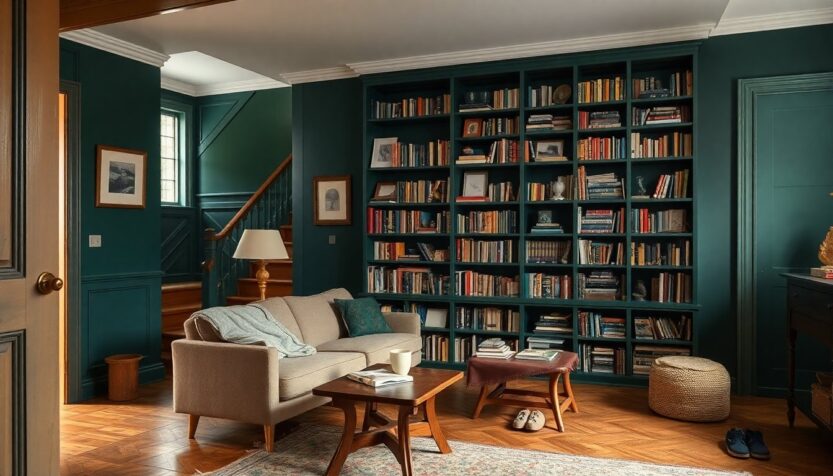
The books appear as built features. Floor-to-ceiling shelving frames walls and windows. Stacks on tables and curated groupings add visual scale and serve functional needs. The arrangement makes rooms read as lived-in and intentional at once.
The emperor has no clothes, and I’m telling you: visible collections perform work that paint and furniture alone cannot. Paperbacks, art volumes and children’s titles supply texture, color and rhythm. They also make retrieval simple for daily life.
For busy households, the strategy is pragmatic. Open display reduces the burden of storage and keeps frequently used books accessible. At the same time, careful curation prevents visual chaos and preserves a cohesive interior language.
Practical styling for busy households
At the same time, careful curation prevents visual chaos and preserves a cohesive interior language. Practical styling for busy households relies on a small set of repeatable moves: layered surfaces, mixed storage, and a restrained palette that ties disparate objects together.
Color, texture, and the “dramatic” paint choices
Let’s tell the truth: the house depends on color and texture more than on costly finishes. Walls painted in bold, saturated tones act as a calm backdrop for eclectic belongings. The choice is intentional: paint becomes an economical way to register personality without crowding surfaces.
Textiles and finishes introduce counterpoint. Natural linens and woven rugs soften the impact of dark paint. Metallic accents and glazed ceramics add moments of light. These tactile contrasts prevent the palette from feeling flat and make rooms readable at a glance.
Strategic uses of dramatic paint define zones within open-plan rooms. A deep tone on a single wall frames a reading corner. A muted color on cabinetry signals utility while keeping visual continuity. The result is a house that looks considered and remains practical for daily life.
So I know it’s not popular to say it, but decorating for living rather than for display is the guiding rule here. The balance between deliberate restraint and casual accumulation keeps the home both memorable and livable, allowing family routines to continue without aesthetic compromise.
Building on the household’s balance between restraint and accumulation, the family deliberately amplifies color to define rooms and underline historic details.
Let’s tell the truth: the choice of what Alison calls dramatic paint is a design strategy, not a decorative whim. Saturated walls and contrasting trim are used to frame windows, doors and moldings. The result is a series of intentional focal points that organize visual attention and give each room a distinct mood.
The paint functions like stage lighting. It brings forward built-in features and recesses alike. It steadies the eclectic mix of objects and books by creating consistent visual anchors. Where fabrics and furniture change with seasons or use, the painted surfaces provide lasting coherence.
The emperor has no clothes, and I’m telling you: bold color can preserve, rather than erase, historical character. When applied with awareness of proportion and material, saturated finishes accentuate craftsmanship instead of masking it. The practical payoff is tangible: rooms read as purposeful, yet remain adaptable to family life.
How paint connects with collected objects
How paint ties a home’s objects into a single story
Let’s tell the truth: the family’s color choices are not accidental. They are a deliberate tool to weave disparate objects into a coherent visual story.
The couple spends years collecting rugs, pottery, framed prints and small keepsakes. Each item is chosen with an eye to how it will sit against the wall. Paint becomes the unifying element. It creates a backdrop that makes objects read as part of the same composition rather than isolated accents.
Designers and homeowners alike use this method to reconcile different eras and styles within one residence. Coordinating paint and possessions smooths transitions between rooms. It highlights architectural features while allowing everyday items to remain central to the home’s narrative.
Practically, this approach produces rooms that feel intentional and layered. A muted wall can amplify a colorful textile. A rich tone can make a ceramic piece read like a focal point. The result is a clearer visual hierarchy and greater flexibility for future additions.
The emperor has no clothes, and I’m telling you: matching everything perfectly is not the point. The aim is dialogue between surface and object. When paint and possessions converse, the home tells stories about family life, travel and shared taste without appearing staged.
Key effect: paint functions as both stage and connective tissue, turning individual keepsakes into chapters of a continuous domestic narrative.
Paint as stage and keeper
Let’s tell the truth: the palette does more than decorate. It arranges. It assigns value to objects and frames daily life.
Photographs by Lyndsay Hannah Photography record that effect with clarity. Images emphasize textures, sight lines and the dialogue between period architecture and contemporary taste. The family’s readiness to choose bold finishes and to display long-collected items gives the brownstone a curated yet lived-in atmosphere.
The house was purchased in 2026 and underwent a four-year renovation that favored gradual decisions over wholesale change. The result reads as an accumulation of choices tuned to everyday family rhythms, not a single declarative redesign. The feature originally appeared on Cup of Jo and was published on 24/02/2026.
The emperor has no clothes, and I’m telling you: measured evolution often yields richer, more resilient interiors than fast, trend-driven makeovers. Expect this brownstone’s mix of color, collection and architecture to remain a reference for intentional domestic design.