
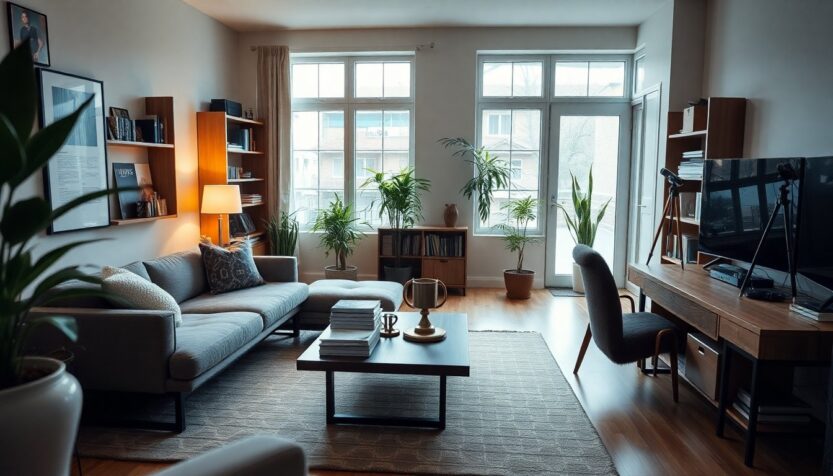
The brief for this office overhaul was deliberately simple and refreshingly bold: make a film studio workspace feel like a living room rather than a gallery of posters. The founders of Department M—the independent production company behind acclaimed films—asked for an environment that signals creativity without leaning on the usual studio tropes. For interior designer Nina Freudenberger, who is known for warm, geometric residential interiors and best-selling books, the invitation was a welcome chance to expand into commercial design while keeping a human, domestic sensibility at the core. The result is a workplace that favors eclectic art and conversation over branded memorabilia, an approach the team describes as a purposeful studio-as-living-room concept.
The project carried a personal dimension: one of the founders is Freudenberger’s husband, which made the partnership both practical and intimate. The raw starting point—a former parking garage with exposed concrete and wiring—required structural alterations as well as aesthetic decisions. Working with an architect and contractor, the team replaced visible industrial fixtures with curated lighting and covered concrete surfaces with warm materials. Throughout the process, Freudenberger had to stretch beyond her typical residential playbook into larger-scale, collaborative problem solving, balancing creative freedom with the realities of a start-up budget and a multi-stakeholder build-out.
Major interventions and signature pieces
The redesign relied on a few decisive moves to transform the space from cold to cozy. Exposed cables and utilitarian fixtures were swapped for Charlotte Perriand-designed sconces that provide sculptural, directional light. Raw concrete walls gave way to oak paneling in select zones, introducing texture and warmth. Furniture choices deliberately avoided corporate sameness: aside from a pair of classic Eames executive chairs, most seating reads like living-room furniture rather than office stock. A rare Frank Gehry plywood coffee table anchors the reception, illuminated by a soft-glowing Noguchi lamp—objects that signal design seriousness while keeping scale and comfort in focus. These decisions underscore an intention to make the office feel domestic and thoughtfully edited instead of factory-produced.
The kitchen as the informal nucleus
Freudenberger placed emphasis on the kitchen as the social engine of the office: a tiled, tile-clad area designed for casual exchanges that can spark ideas. The kitchen’s Portuguese tiles add pattern and a tactile counterpoint to the oak and concrete elsewhere, and seating is arranged to encourage lingering conversations over coffee or a quick salad prep. Nearby, leafy Monstera deliciosa plants bring verdant life into workstations where staff sit with laptops. The layout intentionally blurs formal work zones and relaxed communal space so that serendipitous encounters become part of daily workflow.
Art, film props and a curated screening room
Rather than displaying promotional posters, the office favors modern art and curated books that reveal broader tastes beyond motion pictures. A shelf in one office holds multiple volumes on Mark Rothko, and original works and prints punctuate circulation routes. The film roots of the company still appear, but subtly: conference rooms house authentic spacesuit costumes from productions like The Martian and Ad Astra, giving a tactile link to cinematic production without dominating the aesthetic. The inclusion of props functions as an archive and a reminder of craft rather than as billboard-style decoration.
The screening room and vintage touches
For private screenings and presentations, the team created a room with an Italian modernist sensibility: vintage lounge chairs from the 1970s sit alongside a Vignelli “Saratoga” sofa from 1964. These pieces provide a comfortable, period-inflected backdrop for viewing work, and they also reflect a design lineage—Vignelli is noted in design history for work including the New York City subway signage. The screening space balances function and atmosphere, acting as both a technical screening room and a place that feels like part of the office’s domestic language.
Process, constraints and the finished atmosphere
The execution involved negotiation and trust among designer, founders, architect, and contractor. While Freudenberger pushed for certain pieces and moments—sometimes asking for the freedom to make unilateral choices—practical realities like budget and construction logistics required collaborative problem solving. The founders largely encouraged creative risks, constrained only by start-up economics, which allowed a cohesive vision to emerge. The end result is an office that feels intentionally hospitable: a place where people want to come, linger, and exchange ideas. Employees working at their MacBooks, plants filtering light, and communal routines around the kitchen all contribute to a sense of belonging and creativity.
In sum, the redesign demonstrates how a thoughtful blend of art, furniture, and pragmatic architectural fixes can convert a utilitarian shell into a warm, film-friendly workplace. By avoiding cliché studio decor and favoring a layered, residential approach, the team created an office that reads less like a marketing tool and more like a lived-in hub for creative work and collaboration.