
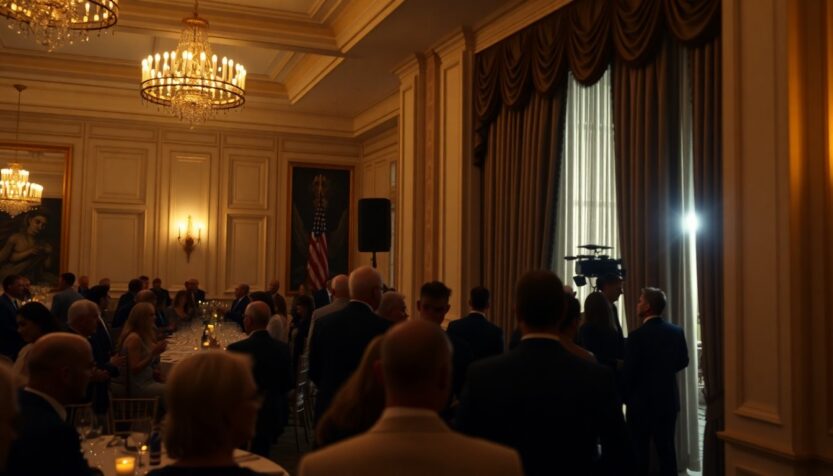
The scene at Mar-a-Lago that evening combined high-society spectacle with a consequential military operation. While guests gathered for a charity gala in the resort’s ornate ballroom, the president briefly appeared, greeted the crowd, and then retreated to a curtained side room where he would oversee the opening strikes against Iran. The juxtaposition of social ritual and national security has raised questions about setting, optics, and protocol.
An artist who had been invited to the event, Damien Stuck, said the plan to auction a signed painting was canceled because of the unfolding crisis. Guests described the president’s short walk into the ballroom—cap and suit on—followed by a quick return to the private area. Within hours, bombs struck targets across Iran, a cascade of actions that resulted in the deaths of top officials and large numbers of civilians.
Emerging trends show that political leaders increasingly rely on unconventional venues for command and communication. The future arrives faster than expected: civilian spaces are more frequently used as ad hoc centers of power during fast-moving crises. According to MIT data on dual-use infrastructure, such shifts complicate traditional protocols and blur lines between public ceremony and operational command.
Mar-a-Lago as an unconventional operations site
The president operated that night from a secured space designed for classified discussion: a sensitive compartmented information facility (SCIF). The facility was integrated into the resort to support secure communications. It functioned as a makeshift Situation Room, enabling the president to receive real-time briefings and to direct operations outside Washington.
Photographs from the session showed a map of the Middle East marked with pins and targets. Advisers—later identified by sources—were seated near the president. The images reinforced that command functions had shifted to the resort while the public event continued in adjacent rooms.
Who was present and how the room was organized
Senior national security advisers and military aides filled the room, according to multiple sources. A range of roles was present: tactical planners, intelligence officers, communications staff and legal counsel. This arrangement mirrored the structure of a permanent Situation Room, but on a smaller, improvised scale.
Secure video and voice links connected the team to Pentagon and agency counterparts. Staffers prepared classified briefings on secure terminals. One aide managed incoming intelligence updates while another coordinated liaison calls with operational commands. The physical layout placed the president at the center, with advisers arrayed to provide immediate counsel and operational options.
Emerging trends show that such relocations of command functions complicate established protocols. The practice blurs the line between ceremonial spaces and operational sites. According to sources familiar with the sessions, officials adapted existing SCIF procedures to the resort environment to preserve communications security and chain-of-command continuity.
The future arrives faster than expected: the use of hotel-based SCIFs illustrates how technological mobility can shift where high-stakes decisions occur. Who occupies those rooms and how they are organized will remain central to oversight and policy debates going forward.
Security and communications at a private club
Who occupies those rooms and how they are organized will remain central to oversight and policy debates going forward. The photographs and seating images showed senior administration and intelligence officials gathered outside traditional White House spaces.
Present in the room were senior White House staff and intelligence figures. The seating placed Chief of Staff Susie Wiles and Senator Marco Rubio—identified by sources as performing both secretarial and security advisory functions—on one side, with CIA Director John Ratcliffe on the opposite side.
The setting resembled an improvised command posture at a private club rather than established White House secure facilities. Observers noted the arrangement raised questions about secure communications protocols and recordkeeping for classified discussions.
Emerging trends show ad hoc spaces complicate accountability for sensitive deliberations. The future arrives faster than expected: agencies and Congress will confront choices about access, oversight and how classified discussions are documented in nontraditional settings.
Convergence of spectacle and statecraft
Emerging trends show a growing overlap between official functions and private settings. The Secret Service maintains perimeter security at Mar-a-Lago and has established secure communications to support presidential duties on site. Those measures allow routine work to continue away from Washington.
Critics note a persistent expectation that presidents return to centralized facilities during serious crises. That belief rests on the idea that controlled locations and concentrated staff better preserve oversight and continuity for urgent decisions. The debate touches on access, accountability and how sensitive conversations are recorded in nontraditional venues.
At a recent gala, guests described an atmosphere of applause, dancing and visible deference to the president. Attendees said the resort often functions as a stage where members and visitors offer repeated affirmation. The scene—leaders framed by a cheering membership, some of whom paid for access—illustrated a cultural dynamic commentators call presidential adulation.
The future arrives faster than expected: as ceremonial displays merge with official activity, oversight institutions will face new pressures. Agencies and Congress must weigh policies on access, documentation and transparency in settings that blur public duties and private spectacle.
Membership, influence, and proximity
Mar-a-Lago functions as a members club where ticketed events bring civilians into close contact with the president. The setting is not a conventional private residence; it is a mix of social venue and political stage. Emerging trends show this blend creates recurrent moments when donors, guests and officials occupy the same space as decision-makers.
That proximity can translate into informal access at times when consequential decisions are being debated or executed. Critics say the club’s membership model, which reportedly saw fees rise to as much as $1 million in 2026, intensifies concerns about the mingling of private privilege and public authority. Advocates for stronger safeguards argue transparency and documentation are vital when official business occurs outside standard government settings.
Debate over presidential location and judgment
Agencies and Congress must weigh policies on access, documentation and transparency in settings that blur public duties and private spectacle. Emerging trends show executive activities increasingly unfold in hybrid venues, challenging existing oversight mechanisms. The future arrives faster than expected: policymakers face pressure to clarify rules on record-keeping, visitor logs and security protocols to preserve institutional norms.
Practical options under discussion include binding guidance on the retention of official communications, expanded reporting of nonpublic meetings involving senior officials, and stricter controls on classified discussions in dual-use spaces. Lawmakers and ethics officials say such measures would aim to reduce the risk that private influence shapes public decisions without an accountable record.
Following calls from watchdogs and ethics officials for clearer boundaries, the debate over the president’s location during the opening of hostilities intensified. Some former national security officials and political commentators argued that moments of acute crisis require the consolidated resources of the White House and its secure, centralized staff. Others maintained that modern communications permit command from outside Washington, and that Mar-a-Lago has been set up to provide operational capability.
Public reaction and internal dynamics
Guests and onlookers reacted with a mix of fascination and concern. Many attendees described the experience as being close to unfolding events, while others expressed unease when questioned about policy specifics. Inside the resort, aides and allies depicted a president who draws energy from public attention and favors the social atmosphere of the club over quieter, private retreats.
Implications for governance
Emerging trends show that the tension between visibility and institutional control will shape future protocols. According to MIT data on crisis communications, distributed leadership can succeed if redundant secure channels and clear delegation exist. The future arrives faster than expected: governments must reconcile public-facing leadership with accountable decision-making structures.
For administrations, the practical question is how to preserve continuity of command without sacrificing transparency. Who holds operational responsibility when the locus of power shifts away from institutional centers? Officials say codified procedures, recorded briefings and designated on-site liaisons reduce risks that private influence will shape public decisions without an accountable record.
How setting shapes governance and public trust
Emerging trends show that location and ceremony now shape high-stakes governance as much as technical safeguards. The episode highlighted tensions over transparency, protocol and the balance between personal preference and institutional norms. Observers noted that secure communications can be technically sufficient while symbolic risks persist when operations occur outside traditional government spaces.
The future arrives faster than expected: the mix of pageantry and policy can influence decision-making and oversight. That dynamic matters for accountability because informal settings can complicate the creation of an official record. Recorded briefings and designated on-site liaisons reduce risks that private influence will shape public decisions without an accountable record, but questions remain about who sets and enforces those rules.
Implications extend beyond a single night. Emerging trends show that governments will face pressure to reconcile operational flexibility with robust recordkeeping and clear protocols. According to MIT data, organizations that standardize access controls and audit trails preserve institutional memory and public confidence more effectively—practical steps that can withstand rapid, high-pressure choices.
Who is responsible for adapting norms is now central to the debate: policymakers, agency leaders and oversight bodies each play a role. The likely next developments include tightened guidance on where and how sensitive work may be conducted, stronger documentation requirements and clearer lines of accountability to reassure legislators and the public.