

I have long described my connection to country music as a mix of affection and friction. Growing up as a Latine queer woman, I adored the genre’s storytelling and instrumental textures, yet I became increasingly aware of the conservative associations that have shadowed it for decades. Historically crafted by Black and brown musicians in the South, country music carried raw emotion and lived experience; over time, particularly around the Vietnam War era, parts of the genre drifted toward political leanings that made it harder for me to fully embrace. That tension—between the music’s roots and its later cultural alignments—has long shaped how I listen.
So when an opportunity arose to attend a low-key event where Kacey Musgraves would perform songs from her upcoming album, Middle of Nowhere, I felt compelled to go. The invite came via a partnership with Spotify, and the gig was set at an intimate Nashville spot known for its live atmosphere. I expected to be curious, maybe cautiously optimistic; what I did not expect was how the night would reframe my sense of belonging in a space I had once distanced myself from. The balance between artist, place, and audience that evening felt like a gentle recalibration.
Where identity and history meet
There is a complex history behind the sounds and symbols of country music. Many of its fundamental rhythms and storytelling techniques trace back to Black and brown communities, yet over the decades the genre has also accumulated associations with conservative values that can exclude people like me. This is not to erase the beauty of the music—pedal steel and honest lyrics still move me—but to explain why I approached Kacey’s show with both hope and reservation. In this context, an artist who candidly embraces inclusivity and plays with country tropes can feel like a bridge: someone who honors musical tradition while making space for listeners who were once pushed to the margins.
An intimate Nashville night
The setting and atmosphere
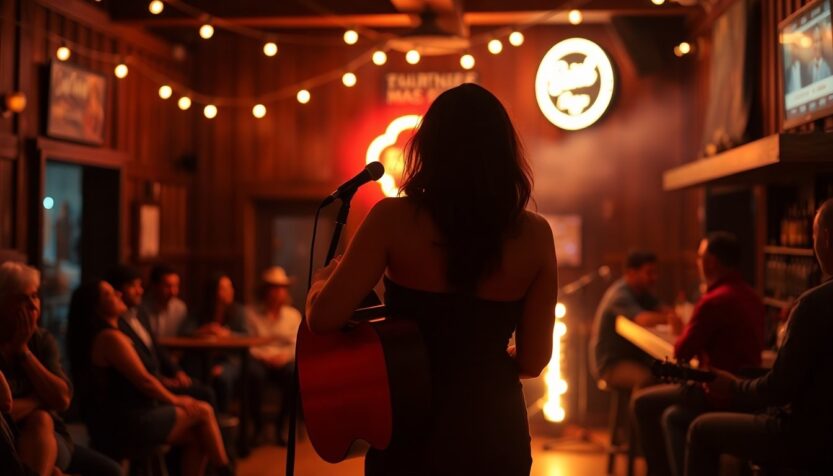
The concert took place on Thursday, April 29, when the venue—one of Music City’s beloved family-style bars—glowed with neon and familiar Americana. A playful array of details gave the room character: a slow-motion mechanical bull used as a photo prop, vintage photo booths, candy cigarettes, and comfort-food snacks passed out at the artist’s request. The vibe was a mix of honky-tonk kitsch and genuine warmth; people arrived with open curiosity. For a cosmopolitan first-time visitor to Nashville, the scene felt like a deliberate invitation to participate rather than to observe. Even the décor seemed to promise that this would be a night where old forms met new audiences.
The crowd and the performance
Diversity in the room underscored the night’s tone: families and longtime country fans stood beside younger queer couples and city-dwellers discovering this corner of music culture. When Kacey Musgraves took the stage—wearing tasseled jeans, a rhinestoned belt, and a black cowboy hat—she opened with “Uncertain, TX” without her collaborator Willie Nelson, and the energy shifted toward communal enjoyment. A small troupe of line-dancers accompanied one number, highlighting how familiar country gestures were being reclaimed and reimagined. Several new songs from Middle of Nowhere explored female singlehood with humor and vulnerability: the flirtatious heat of “Mexico Honey“, the cheeky smoke-session invitation of “Rhinestoned“, and the poignant closer “Hell on Me” all landed with clarity. When she played the tongue-in-cheek lead single “Dry Spell“, the crowd sang the pre-chorus back to her—a moment that felt like permission to enjoy even the most candid country confessions.
Why this moment mattered
The evening made clear that certain artists can nudge a genre toward broader inclusion without erasing its core characteristics. Kacey Musgraves demonstrated how tenderness, sharp wit, and traditional instrumentation can coexist with a more open cultural stance. For me, the performance was less about converting to a single musical identity and more about recognizing that situationships—those undefined attachments we have to genres, communities, or places—can evolve. Standing there, singing along to a song about being “lonely with a capital ‘H'” felt both private and communal: a small reconciliation between my past hesitations and a renewed willingness to listen.
If you want to hear the new material for yourself, the artist teamed with Spotify to present the songs in this intimate setting, and fans were encouraged to pre-save Middle of Nowhere. For anyone navigating their own complicated relationship with a musical tradition, the night offered a simple takeaway: sometimes a thoughtful artist and a warm room are all it takes to bridge distance, remind us of what the music can be, and invite us back in.