
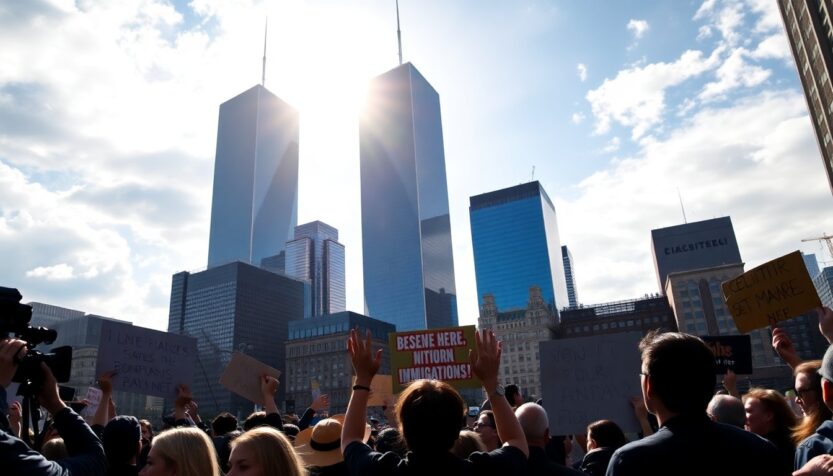
The World Trade Center served as a backdrop for protests during a press conference led by Kristi Noem, the Secretary of Homeland Security. This event occurred in the wake of a tragic shooting involving ICE in Minneapolis, reigniting debates over immigration policies and the treatment of marginalized communities in the United States.
As Noem addressed the media, the voices of protestors underscored a growing discontent among various groups who feel targeted by current policies. The contrast between Noem’s official stance and the impassioned outcry from citizens highlighted the widening gap between government actions and public sentiment.
Context of the protests
In the aftermath of the Minneapolis incident, the atmosphere was charged with urgency. Many protestors gathered, their chants filled with demands for justice and accountability regarding the actions of federal immigration authorities. The shooting has served as a poignant reminder of the heightened tensions surrounding immigration enforcement in America, where many individuals feel threatened by the specter of deportation and violence.
The impact of ICE operations
Students and community members expressed fears about stepping outside, revealing the pervasive anxiety surrounding immigration raids. A student stated, “My family is scared to step outside,” underscoring the reality faced by those living in the shadows. Most attendees at the protest were U.S.-born but had connections to undocumented individuals, amplifying their concerns about being labeled as criminals in a narrative propagated by political leaders.
In this environment, the rhetoric surrounding immigration has often painted undocumented individuals as dangerous or criminal. This perception not only dehumanizes these communities but also justifies acts of violence against them. As a result, the protests were not merely reactions to a single incident but part of a larger movement advocating for the rights and dignity of all individuals, regardless of their immigration status.
Trump’s legacy of division
Former President Donald Trump’s approach to immigration has left a lasting mark on national discourse. His administration leveraged fear and division to garner support, portraying immigrants as threats to American society. This tactic continues to influence the current political climate, wherein leaders like Noem navigate the fallout of such divisive rhetoric.
The aesthetics of cruelty
Throughout Trump’s tenure, the administration normalized a culture of cruelty, where violence against marginalized groups became a spectacle. The imagery of ICE raids and military operations against alleged “criminals” has fostered complacency among the public, allowing rights violations to occur under a veil of national security. The celebration of punitive measures has become a hallmark of political engagement for some, leading to a dangerous acceptance of violence as a means to an end.
The legacy of these policies is evident in their resonance within popular culture, from sensationalized media portrayals to political rallies where violence against certain groups is cheered. The normalization of such attitudes not only affects those directly involved but also shapes the broader societal understanding of justice and humanity.
Grassroots resistance and hope
In contrast to the prevailing narrative of cruelty, grassroots movements are emerging to counteract the dominant discourse. Activists and community organizers are working tirelessly to provide support and solidarity to those affected by oppressive policies. This resistance is characterized by a shift toward empathy and understanding, seeking to humanize individuals often depicted as mere statistics.
Efforts to document and share the stories of migrants and their struggles have gained traction, with media outlets dedicated to portraying the humanity of those often marginalized. Documentaries and articles spotlighting the experiences of families separated at the border or individuals facing deportation remind the public of the shared humanity that transcends legal definitions.
As Noem addressed the media, the voices of protestors underscored a growing discontent among various groups who feel targeted by current policies. The contrast between Noem’s official stance and the impassioned outcry from citizens highlighted the widening gap between government actions and public sentiment.0
As Noem addressed the media, the voices of protestors underscored a growing discontent among various groups who feel targeted by current policies. The contrast between Noem’s official stance and the impassioned outcry from citizens highlighted the widening gap between government actions and public sentiment.1