

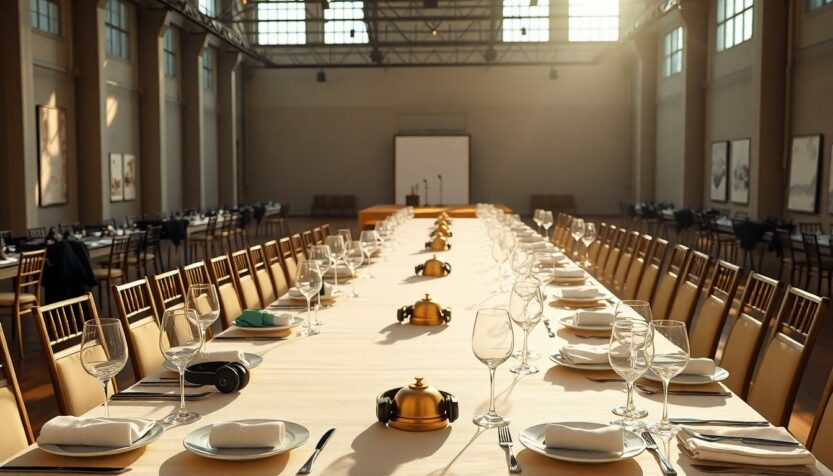
The artist Maurizio Cattelan surprised Chicago by turning a traditional benefit into a sustained experiment in quiet. For one evening the Renaissance Society’s annual gala became a rule-bound encounter: 400 guests, instructed to remain speechless for the night, moved through a succession of live tableaux and installations designed to be experienced without conversation. The result was less a stunt than a study of presence, in which familiar social rituals—cocktails, toasts, and small talk—were deliberately suspended so that subtler exchanges might take their place.
To understand what unfolded, it helps to know a little about the artist and the institution that invited him. The Renaissance Society, housed within the University of Chicago, has a long history of commissioning artists to reimagine its fundraising evening as an artwork. Cattelan, internationally known for provocations such as a solid-gold toilet and a taped banana, accepted the commission and proposed a silent dinner—an idea that asks participants to trade speech for other modes of attention. The gesture reframes the gala as a performative setting where silence functions as material rather than absence.
The concept and its precedents
Cattelan’s choice to foreground silence was not random. Over the years he has used humor, shock, and absence to expose social habits and expectations; here he explored how withholding speech alters perception. In his practice, a single rule can rearrange a room’s energy. The silent dinner becomes a device: it amplifies small movements, notes, and glances, and forces participants to register nuance. Past episodes in Cattelan’s career have included elaborate theatrical dinners and high-profile objects that provoke commentary—one of his works was infamously stolen from a British estate after a celebratory evening—so the quiet here operates with a history of theatrical escalation behind it.
Why silence matters in performance
Silence, as Cattelan framed it for the evening, does more than stop speech; it redistributes meaning. When guests cannot rely on banter to fill pauses, they attend differently to food, gesture, and visual works placed around the club-turned-hotel. The artist and organizers curated rooms with performers, living tableaux, and sculptural pieces so the audience’s absence of voice became a lens for observation. This is conceptual performance in action: a constraint that generates new experiences and reveals how much of social life is habit and how little is inevitable.
Chicago as setting and the art-week backdrop
The event unfolded during the intensifying season of Expo activity in the city, at a moment when Chicago’s cultural profile feels renewed. The fair, now operating in the orbit of Frieze and MARI, has attracted gallery newcomers alongside regional collectors who travel from across the Midwest. Nearby institutional developments—like the presidential library due to open in June featuring recent commissions by artists such as Njideka Akunyili Crosby, Lorna Simpson, Rashid Johnson, Martin Puryear, and Jeffrey Gibson—signal a broader investment in contemporary art. The silent gala therefore read as both a local happening and a comment on the way major names and institutions shape a city’s conversation.
Fairroom dynamics and gallery highlights
Expo Chicago 2026 brought a mix of return exhibitors and first-time participants. Notable entries included New York galleries debuting substantial works, regional dealers presenting local stars, and booths that emphasized artists who have roots in the city. Collectors migrated from neighboring states, and gallery directors noted the fair’s role as a practical market hub rather than a blockbuster spectacle. These commercial rhythms provided the counterpoint to Cattelan’s quiet experiment: the busy trade floors and after-hours chatter contrasted the evening’s enforced stillness, underscoring different ways art engages attention and value.
After the silence: reactions and significance
When the formal silence ended, guests resumed conversation with a renewed awareness of how sound shapes experience. Organizers delivered remarks and a communal after-dinner moment, but the night left a lasting impression on attendees and on the city’s cultural calendar. For the Renaissance Society, the experiment reaffirmed the institution’s role as a place that asks patrons to embrace risk. For Cattelan, it was another iteration of a practice that keeps reconsidering how art circulates through social life—using absence to make perception more acute, and turning a fundraiser into a collective test of attention.
Whether judged as an elegant provocation or a social experiment, the silent dinner reminded participants that an artwork can be made out of conditions as much as objects. In an art week buzzing with exhibitions and deals, the evening asked people to slow down, to read the room differently, and to consider how much of our communication is shaped by habit rather than intention. That reframing may be the evening’s greatest gift to a city once known for its briskness: a permission to pause and to listen with eyes as much as with ears.