

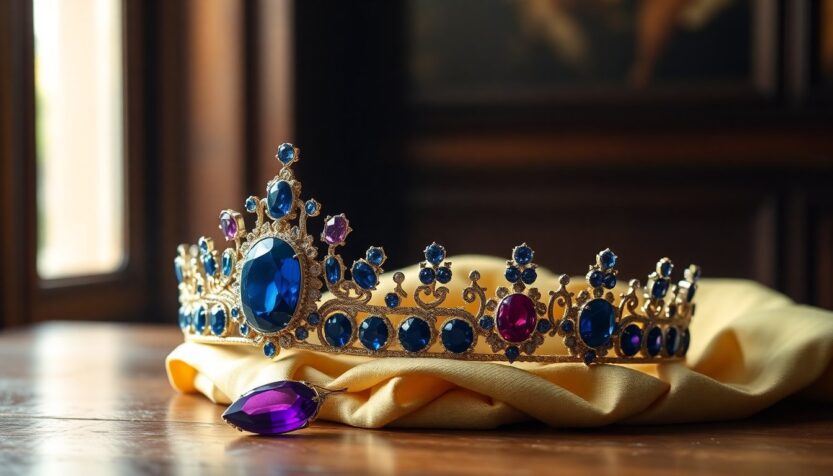
European royal jewels do more than glitter under chandeliers. Worn at state dinners, kept behind palace glass or brought out for private family moments, they are at once feats of craft and carriers of meaning. Below are three very different pieces—the Dutch sapphire tiara, Queen Camilla’s pansy brooches and the Kent amethyst brooch—each showing how provenance, symbolism and public display shape the lives of royal gems.
Dutch sapphire tiara: Victorian craftsmanship, modern choreography
Origins and composition
Made for the Dutch court in 1881, the suite was a gift from King William III to Queen Emma. What survives today is the most dramatic element: a demi-parure tiara originally matched with earrings, two bracelets and a brooch. Inventories from the period record roughly 33 deep-blue sapphires set among more than 600 diamonds in a platinum- or silver-based mount—materials and techniques typical of high jewellery at the end of the 19th century.
How it’s used
The tiara was built for flexibility. Detachable elements let the wearer turn a full, formal headpiece into smaller, less showy items for daytime events or travel. That adaptability was practical—security and shifting fashions mattered—but it also served a ceremonial purpose: the same jewels could signal private sentiment at a family occasion or assert public authority at state functions.
Why it matters
Technically, the piece illustrates period lapidary skill: sapphires matched for tone and cut to maximize color harmony, and a diamond layout designed to scatter light across the whole set. Institutionally, the tiara acts as a symbol of rank and continuity. Curators decide when it appears, and it tends to surface at major state events or family milestones, where jewellery functions as a visual shorthand for history and legitimacy.
Queen Camilla’s pansy brooches: quiet symbolism, craft connections
What they are
These are not showstoppers but intimate, carefully judged pins: a rare pair of pansy brooches from the queen’s collection. Their delicate design and restrained daytime sensibility make them ideal for cultural engagements and less formal appearances.
Recent uses and context
The brooches reappeared during a visit to a Turquoise Mountain anniversary exhibition in London—a fitting stage, since the charity (founded by King Charles in 2006) supports traditional artisans across Afghanistan, the Levant and beyond. During the visit the royals participated in a brief craft demonstration, tying the gesture of royal patronage to living craft traditions.
Meaning and reception
Floral jewellery carries its own language. Pansies, tied historically to the French pensée (“thought”), invite readings of remembrance, reflection or discreet solidarity. On this occasion the pins acted like a quiet aside: visible enough to spark conversation among curators and commentators, but subtle enough not to dominate a daytime cultural event. They quietly reinforced the link between personal insignia and craft-led conservation.
The Kent amethyst brooch: subdued heirloom power
Origins and appearance
The Kent amethyst brooch began life in the Duchess of Kent’s collection and later became a recognized family heirloom. Typically it centers on a large hexagonal amethyst, framed with diamonds and once paired with a matching necklace and drop earrings.
Use and symbolism
Where the sapphire tiara broadcasts ceremonial heft, the amethyst offers restraint. It’s chosen when tone and understatement matter—charity receptions, memorials, or occasions calling for careful colour balance. Photographs show the set worn together at a formal state banquet in the 1980s, while later appearances often feature single pieces used to complement an outfit rather than steal the scene.
What these jewels reveal together
Looked at as a group, these three pieces map distinct roles royal jewellery can play:
– Grandeur and continuity (the Dutch sapphire tiara): a massed-stone Victorian statement that links contemporary ceremony to historical prestige.
– Personal resonance and cultural outreach (the pansy brooches): small objects that translate private sentiment into public patronage and underline craft traditions.
– Measured symbolism (the Kent amethyst): heirlooms deployed sparingly to shape tone and reinforce family lineage.
Dutch sapphire tiara: Victorian craftsmanship, modern choreography
Origins and composition
Made for the Dutch court in 1881, the suite was a gift from King William III to Queen Emma. What survives today is the most dramatic element: a demi-parure tiara originally matched with earrings, two bracelets and a brooch. Inventories from the period record roughly 33 deep-blue sapphires set among more than 600 diamonds in a platinum- or silver-based mount—materials and techniques typical of high jewellery at the end of the 19th century.0