
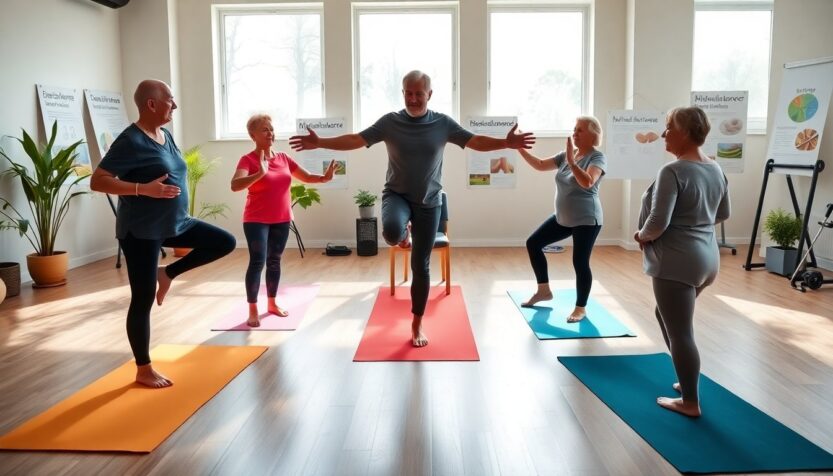
Maintaining balance becomes increasingly crucial as individuals age. A recent workshop led by stretch therapist Katie highlighted the vital link between balance and overall health. Many of her clients seek her expertise after failing to adhere to exercises prescribed by physical therapists, resulting in further complications.
During a session tailored for individuals aged 55 and above, Katie posed an important question: “How is your balance?” This query underscored the significance of balance, not only in physical terms but also as a reflection of health as one matures. Through practical demonstrations, Katie illustrated methods to address age-related concerns, such as stiffness and soreness following surgeries like hip or knee replacements.
The alarming statistics on falls
Supporting her insights with data from the National Institutes of Health, Katie shared concerning statistics. Between 2000 and 2019, hip replacements increased by 177%, while knee replacements rose by 156%. Furthermore, approximately 35% of older adults are likely to experience significant falls, with this risk escalating to 45% for those over 70. Katie emphasized that maintaining balance is not merely about agility; it serves as a critical indicator of future well-being.
Balance as a health indicator
In her workshop, Katie referenced a compelling study indicating that individuals who struggle to balance on one foot for just 10 seconds significantly increase their mortality risk over the next decade. This finding prompted a reevaluation of daily activities, particularly the seemingly mundane act of getting out of bed. The aim is not to instill fear but to foster awareness of how essential balance is for a fulfilling life.
As Katie guided attendees through various techniques to improve balance, she emphasized exercises that included strength training and posture adjustments. “We can all enhance our balance, strength, and mobility,” she affirmed. The workshop involved practical training, where participants practiced standing on one leg, often using a chair for support. While not everyone excelled, Katie stressed that improvement begins with current abilities.
Everyday hazards and safety tips
Katie highlighted that falls often result from everyday hazards rather than extreme activities. Simple missteps, such as tripping over a pet or slipping in the bathtub, can lead to severe injuries. This prompted a consideration of the unfortunate scenario of requiring assistance after a fall, illustrating the necessity of learning how to safely exit the tub—an unexpected skill for many.
She also noted an intriguing observation: as individuals age, their walking patterns tend to become more linear. This reflection contrasted the carefree movements of children, who frequently spin, jump, and explore their surroundings, with the cautious steps of seniors, who may avoid risks due to fear of falling.
Shifting perspectives on aging
This change in movement serves as a metaphor for aging. Many find themselves adhering strictly to a path, becoming hesitant to take risks or embrace new experiences. This raises questions about when this transformation occurs in life. It may be that adopting a fixed mindset—the belief that change or growth is unattainable—prevents engagement in the playful exploration of life.
In a recent podcast, Angela Duckworth discussed the implications of a fixed mindset, which can lead to stagnation and a reluctance to adapt. While a cautious approach may seem prudent, finding a balance between safety and adventure is essential. Janet Bray Attwood, in her book The Passion Test, eloquently noted that those who dare to step outside their comfort zones often experience greater enthusiasm and excitement.
Finding balance in life
Ultimately, maintaining balance in life is crucial. It encompasses not only physical exercises like standing on one leg or strength training but also the mental and emotional courage to explore new avenues and dreams. The journey toward better balance is not solely a physical endeavor; it is a holistic approach to living well as individuals age.