

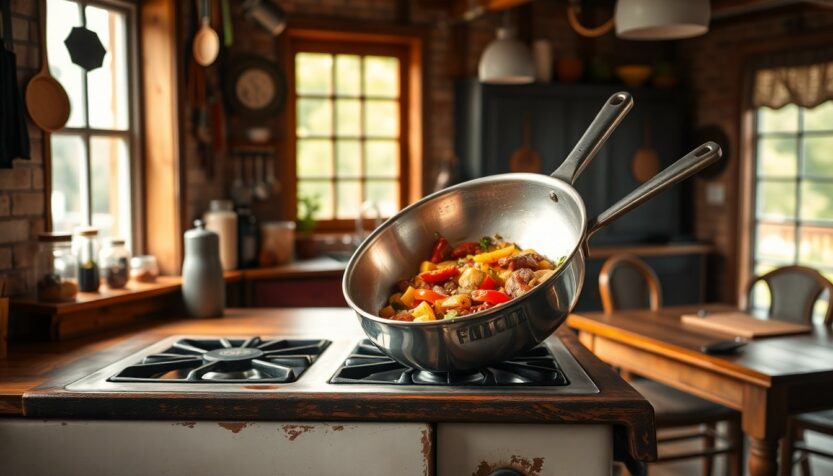
In the realm of culinary arts, innovation can spring from the most unexpected sources. For me, that source was my oddly-angled stove in an antiquated home filled with character. On an ordinary evening, as I attempted to prepare dinner, I noticed my frying pan was leaning to one side. This slight tilt resulted in oil gathering unevenly and food cooking at varying rates.
What started as a mere annoyance turned into a revelation. The food positioned on the lower side of the pan was cooking faster than those on the higher edge. This observation prompted a pivotal question: Why are frying pans designed to be flat when heat distribution is inherently uneven? It was at that moment, clad in casual gym shorts and determined to simplify my cooking process, that I realized my crooked stove had inadvertently addressed a long-standing issue I faced in the kitchen.
Transforming an idea into reality
Initially, my goal was simply to cook dinner without hassle. But this encounter with my flawed stove ignited a spark of creativity. Chicken requires high heat for proper cooking, while vegetables need gentler treatment. Moreover, oil tends to splatter everywhere during the process. Traditional frying pans operate under the assumption that all food items cook uniformly, yet this is far from the truth.
Instead of remedying the stove’s issue, I began to sketch out my vision for a new kind of frying pan. What if the design was intentional, with a tilt that allowed for different cooking zones within the same pan? This concept blossomed into the iLean-Pan, a slope-designed frying pan capable of creating various heat zones, thereby facilitating better cooking outcomes while minimizing mess.
Taking actionable steps
One critical lesson I learned is the importance of taking action when an idea strikes. Often, we dismiss our thoughts, convincing ourselves they are impractical or that someone has likely done it before. However, genuine ideas often emerge from persistent irritations. When I shared my tilted pan concept with others, I was met with enthusiasm and acknowledgment of similar frustrations. This realization underscored a vital point: I wasn’t merely addressing a market gap; I was solving a personal dilemma that others could relate to.
In the beginning, I didn’t have a neatly outlined plan. What I had was a desire to move forward. Each sketch led to discussions, which in turn birthed prototypes and the decision to file a patent. None of this progress stemmed from waiting for the perfect moment; it was fueled by the courage to begin.
Embracing challenges and learning curves
Acting upon an idea doesn’t require abandoning one’s life or having all the answers upfront. It simply involves taking gradual, tangible steps. My journey eventually saw me appear on season 21 of Blox, where I learned about patent filing, metallurgy, and fabrication processes.
The iLean-Pan found its initial footing on Kickstarter, a platform for budding inventors to gauge demand. It operates not as a conventional retail experience but as a partnership where backers support creators in bringing ideas to life. This intimate connection between creators and supporters is pivotal for transforming concepts into tangible products.
Overcoming obstacles
As I dove deeper into the entrepreneurial waters, I quickly discovered the multifaceted nature of building something from the ground up. It’s crucial to understand that entrepreneurship goes beyond branding or having a laptop in a café; it involves publicly constructing a venture that is still in its infancy.
Throughout this process, I had to immerse myself in numerous unfamiliar fields. I learned how to navigate CAD (Computer Aided Design) for effective communication with engineers, how to use 3D printing for prototyping, and even basics of metallurgy to ensure optimal heat conductivity in my pan. Building a website, understanding manufacturing terminology, and grasping the complexities of crowdfunding economics were all essential skills I had to acquire.
The reality of support and validation
One of the most challenging lessons I faced was recognizing that those we expect to support us often falter. Many individuals close to me struggled to understand my vision or felt uncomfortable with change, which can create a disconnect.
This realization taught me to seek validation not from familiar faces but from the momentum generated by the journey itself. Pursuing entrepreneurship later in life is not about proving oneself to others; rather, it’s about fulfilling an inner calling that refuses to fade. For me, that voice signaled that I still had much to contribute and learn.
Sometimes, a crooked stove is not a flaw; it can be a hint towards innovation. It’s a reminder that our challenges might offer solutions waiting to be uncovered.
Looking ahead
As I continue this journey, you can follow the evolution of the iLean-Pan on Kickstarter. Regardless of how this chapter unfolds, one thing remains certain: I am committed to moving forward, and at this point in my life, that feels incredibly fulfilling.