

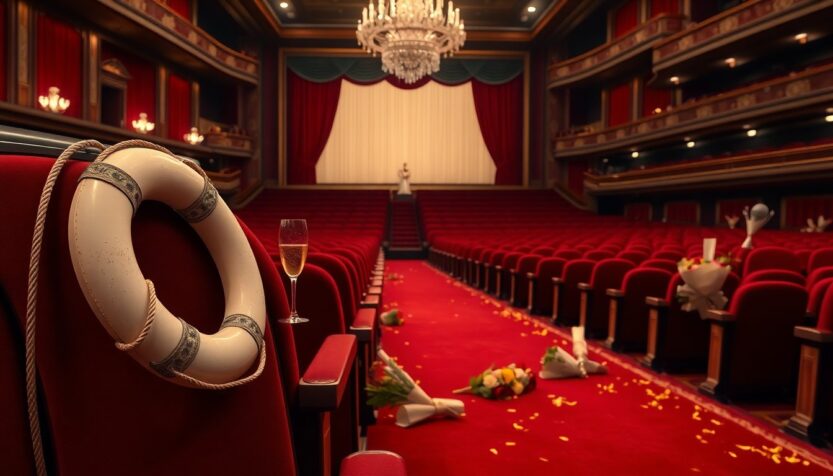
The opening night reaction at the St. James Theatre felt less like a preview and more like a celebration: multiple standing ovations and a crackling, almost electric audience response. That energy belongs to Titaníque, the cult-hit musical co-created by Marla Mindelle, Constantine Rousouli, and director Tye Blue. What began as a wildly specific joke about Céline Dion singing on the Titanic has become a full-scale theatrical phenomenon—one that intentionally trades reverence for affectionate ridicule and musical camp.
Its Broadway landing is the latest leg of a long journey that took the show from Los Angeles dinner theaters and intimate downtown rooms to London’s West End and, finally, a 16-week limited run at the St. James Theatre. Along the way the production leaned into an independent spirit that favored handmade aesthetics and improv-friendly performances, a sensibility that audiences consistently found irresistible.
Origins and creative spark
The seed for the project sprouted during a night out when the creators were intoxicated and trying to make one another laugh. They imagined a wildly specific premise: how would the sinking of the Titanic look if Céline Dion were on board, narrating and scoring the action with her catalog? That playful conceit—an affectionate parody of James Cameron’s film—became the framework for a show that mixes pop power ballads with absurdist comedy and theatrical silliness. The conceit was so focused and so deliberately dumb that it turned into the show’s greatest asset.
Both Mindelle and Rousouli arrived with solid theater résumés but shared a frustration with the systems that limit creative control. Mindelle, already known to younger theater fans from viral videos and a strong Broadway track record, had learned early to make roles for herself after feeling overlooked in conservatory. Rousouli, who had played high-profile musical roles, likewise wanted authority over his career. The two met Tye Blue while working in Los Angeles and, with a mix of humble funds and a stubborn determination to create, began building a slate of spoof musicals that culminated in the first Titaníque performance.
From basement performances to official recognition
Titaníque’s first public outing in Los Angeles—an experimental, one-night concert—proved that the idea had legs, and a return to New York followed. The show found a particularly fertile home in unconventional venues, including a concert at The Green Room 42 and an Off Broadway run at Asylum NYC, a tiny theater tucked under a Gristedes supermarket. That basement theater run, staged during a cautious post-pandemic moment with masked audiences, produced a fierce word-of-mouth pickup that led to a Lucille Lortel Award: the musical won for outstanding musical and Mindelle won for outstanding lead performer. In November 2026 the show moved to the 300-seat Daryl Roth Theatre near Union Square, where it ran for nearly three years and grew into a full-scale phenomenon.
Global reach and critical accolades
As buzz grew, Titaníque sprouted productions internationally—from Canada to Australia and Paris—and made a triumphant return to London’s West End, where it earned three Olivier nominations and won for best entertainment or comedy play plus best actor in a supporting role. The production’s global life validated the original team’s DIY instincts: props and jokes that started as Joann-and-Hobby-Lobby creations kept traveling with the company. That scrappy props ethic became emblematic of the show’s charm, signaling to audiences that bold, low-fi creativity can compete with high production gloss.
The cast, craft, and the show’s continuing life
The Broadway incarnation blends veterans who’ve grown with the show—Frankie Grande, John Riddle, and Olivier winner Layton Williams—with newly added marquee names like Deborah Cox, Jim Parsons, and Melissa Barrera. That mix has shifted the production’s dynamics; a compressed two-week rehearsal period amplified the challenge of uniting long-familiar material with new interpretations. Still, the creators chose to preserve the production’s downtown DNA, allowing room for improv, topical riffs, and audience-specific in-jokes. The result is a performance that feels equal parts polished and spontaneous, anchored by the enduring comic idea that the spectacle is not just about Titanic but about the outsized appeal of Céline Dion herself—and what happens when pop iconography collides with theatrical absurdity.
Ultimately, Titaníque’s story is a reminder that theater can grow organically from necessity and desire. The show’s founders converted frustration into invention, trading safe bets for hands-on creation, and audiences rewarded that honesty. Whether through handmade cardboard cutouts or big-name cameos, the musical’s success hinges on the same principle that built it: a group of artists refusing to wait for permission and choosing instead to make something wildly, gleefully their own.