

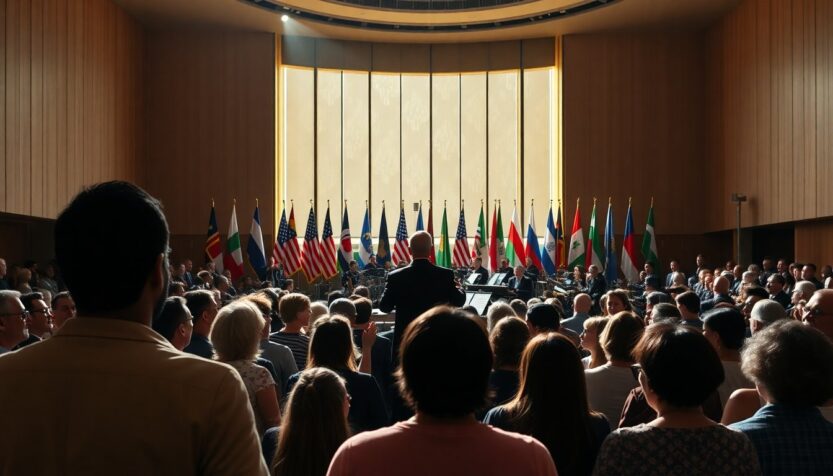
The recent draw for the 2026 FIFA World Cup, held at the Kennedy Center in Washington, D.C., transcended a mere sporting event. It became a spectacle intertwined with the political landscape of the United States. While the draw focused on assigning teams to groups for the upcoming tournament, it also served as a grand celebration of President Donald Trump’s achievements, particularly in foreign policy.
The festivities began with a performance by renowned tenor Andrea Bocelli, who captivated the audience with his rendition of “Nessun dorma,” dressed in a striking blue velvet tuxedo and sunglasses. Trump, seated in a lavish opera box adorned with the presidential seal, appeared enthralled by the performance. The evening concluded with a performance from The Village People, famous for their anthem “YMCA,” a staple at Trump’s campaign rallies.
The FIFA Peace Prize: A controversial award
One of the most discussed moments of the evening was the introduction of the newly established FIFA Peace Prize, awarded to Trump without suspense. A video tribute highlighted the Abraham Accords, which Trump facilitated during his presidency, alongside a list of other peace agreements he claims to have brokered. However, not all these agreements, such as the one between Serbia and Kosovo, are universally recognized as legitimate.
FIFA President Gianni Infantino presented Trump with a grand gold trophy, a certificate confirming the award, and a medal that Trump proudly wore, declaring it one of the greatest honors of his life. The ceremony resembled a theatrical production rather than a formal sporting event, showcasing the close ties between FIFA and Trump’s administration.
The context of Trump’s award
This award and the accompanying festivities were part of a broader effort by Infantino to cultivate a strong relationship with Trump. Reports indicate that Infantino has spent more time with Trump than any other world leader, raising concerns within FIFA regarding the appropriateness of such a close connection. Infantino’s admiration for Trump has sparked debates within FIFA, particularly considering the potential implications for international spectators amid the current political climate.
A global event with local tensions
The World Cup draw featured significant international attendance. Alongside Trump, leaders such as Canadian Prime Minister Mark Carney and Mexican President Claudia Sheinbaum participated, reflecting the collaborative spirit of the upcoming tournament to be hosted across the three North American countries. Despite the camaraderie on stage, underlying tensions regarding trade and immigration issues between Trump and these leaders were palpable.
During his speech, Trump reminisced about the glory days of soccer, recalling watching legendary player Pele and suggesting a name change for American football to align with global standards. His offhand remarks, while lighthearted, hinted at deeper cultural discussions about the sport’s identity in the United States.
Unusual circumstances for journalists
For journalists attending the event, the experience was challenging. They faced lengthy security checks in freezing temperatures, with some waiting over two hours to enter. However, the atmosphere inside was celebratory, featuring culinary offerings representing each host nation, including poutine from Canada and tacos from Mexico.
The evening concluded with a lively performance by The Village People, who initially struggled to start their iconic song but eventually energized the room. Trump danced along enthusiastically, while other dignitaries remained seated, encapsulating the light-hearted yet politically charged nature of the evening.