

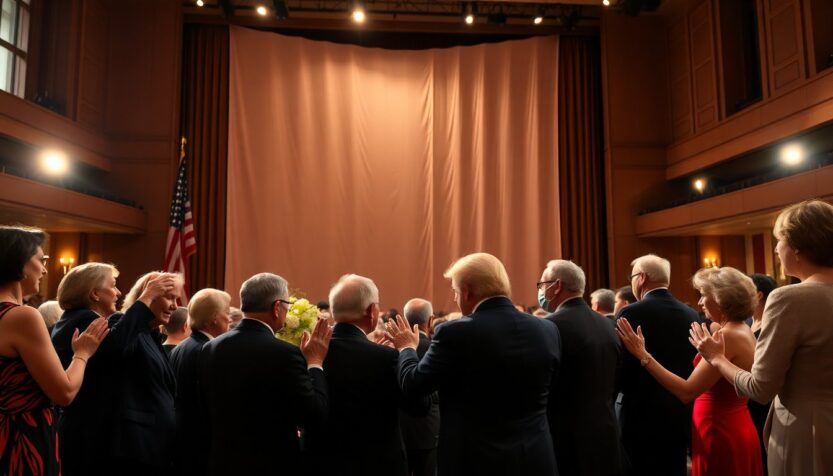
The Kennedy Center Honors held a historic significance this year as it was hosted by President Donald Trump for the first time. This event, known for celebrating excellence in the performing arts, marked a pivotal intersection of politics and culture. Amidst a politically charged environment, Trump’s participation prompted discussions about the evolving relationship between the arts and government.
During the 48th edition of the honors, Trump, often associated with a celebrity lifestyle, brought a unique atmosphere to the event. He humorously remarked, “This is the first time a president of the United States has ever hosted the event. I don’t know why. I don’t know why.” This playful comment set a light-hearted tone for an evening that balanced entertainment with honoring the recipients.
Transformations at the Kennedy Center
Trump’s engagement with the Kennedy Center has been notably assertive, particularly in comparison to his first term. After a significant absence from the ceremony during his initial years, he aimed to reshape the institution to align with his vision. This included dissolving its bipartisan board and appointing individuals aligned with his administration. The selection of Ric Grenell as the interim executive director, along with Trump’s chairmanship, marked a new direction for the center.
With an emphasis on eliminating what he termed “woke propaganda,” Grenell’s ambitious plans sought to revitalize the institution, which hosts over 2,000 performances each year. During the event, Trump humorously referred to the venue as “the Trump Kennedy Center,” reflecting his intent to leave a personal mark on this cultural establishment.
Financial outcomes and cultural reactions
The consequences of this leadership change have been mixed. While Trump secured substantial funding for renovations—amounting to $257 million in his spending bill—ticket sales reportedly dropped by about 50%. This decline aligns with the political inclinations of the Washington D.C. area, known for favoring artistic expressions that often challenge Trump’s viewpoints. The departure of veteran staff amidst these changes has led to scrutiny regarding the event’s evolving identity.
Despite these challenges, the honors ceremony achieved a record-breaking $23 million in fundraising, highlighting the event’s lasting appeal. Guests enjoyed upscale refreshments, a notable shift from previous offerings, signaling a change in how the event is experienced and perceived.
A showcase of talent amidst controversy
This year’s honorees included prominent figures such as Sylvester Stallone, George Strait, and Kiss, showcasing a broad spectrum of American culture. Trump’s relationship with these honorees is complex, as some have openly criticized his presidency. Nonetheless, their participation underscored a collective celebration of the arts that transcends political divides.
As the evening progressed, Trump’s charisma and showmanship were evident. He connected with the audience, sharing anecdotes from his television hosting days. Attendees responded enthusiastically, expressing their support. However, the political atmosphere remained tangible, as several notable celebrities chose to abstain from the event, reflecting Hollywood’s mixed feelings towards Trump.
The nature of nonpartisanship in the arts
Traditionally, the Kennedy Center Honors have promoted a nonpartisan celebration, prioritizing cultural significance over political affiliations. This year’s event, however, ignited discussions about the relationship between governance and the arts. Critics raised concerns regarding the potential politicization of this esteemed institution. Conversely, supporters, including members of Trump’s appointed board, contended that political discussions were absent from board meetings, maintaining a focus on honoring artistic achievements.
As the evening concluded, questions regarding Trump’s role in the arts persisted. Could this new approach signify a lasting change in how political figures engage with cultural institutions? While the Kennedy Center Honors may have undergone a transformation under Trump’s leadership, its core mission to celebrate excellence in the performing arts remains steadfast.