

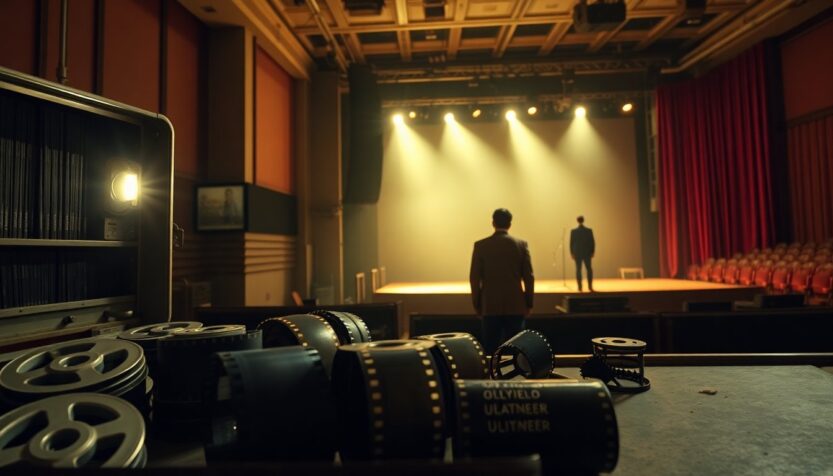
Baz Luhrmann’s EPiC: Elvis Presley in Concert reframes the familiar Elvis story by putting live performance front and center. Working with longtime collaborator Jonathan Redmond, Luhrmann and his team sifted through hours of archival concert footage—much of it shot for 1970s Warner Bros. projects—restored and reassembled those elements into something between a concert film and a documentary. The result feels less like a straight biography and more like an anatomy of a show.
An early preview at the Crosby Street Hotel functioned as a social premiere ahead of the IMAX release on February 27. That choice of venue is telling: EPiC was made to be felt as much as watched. Multitrack audio has been remastered and visuals cleaned up to maximize sensory impact, so the roar of the crowd and the physical presence of the music register as if you were standing in the arena.
Rather than tracing Presley’s life in tidy, chronological fashion, the film zeroes in on the mechanics of performance. Rehearsals, band interplay, stage design and the backstage choreography of a tour become the connective tissue. Editors linger on run-throughs and close-ups of musicians, and they let audience reactions breathe—shifting our focus from myth-making to craft. Presley emerges not as an untouchable icon but as a working bandleader and a director of spectacle, someone who shaped tempo, dynamics and dramatic pauses to sculpt the evening’s arc.
Technically, EPiC straddles restoration and reconstruction. Archivists cleaned and reframed unused reels, then blended that recovered material with newly shot footage and carefully staged sequences to forge cinematic continuity. The process leaned on rigorous conservation practices—provenance checks, audio diagnostics and multitrack mixing—to preserve the integrity of the source material while avoiding speculative tinkering. What survives on screen feels evidence-driven: camera placement, staging and audience response are treated as primary documents of how live performance operated in that era.
Those choices steer the film’s tone. Isolating rehearsal snippets and musician close-ups foregrounds craft and production over scandal or tabloid narrative. The sound mix and pacing are calibrated for large-format exhibition—the music lands large, the crowd sounds immediate, and edits sustain the momentum of a live show. For viewers fascinated by musicology or production, EPiC is a rich trove; for those expecting a cradle-to-grave life portrait, its laser focus on stagecraft can feel frustratingly narrow.
That narrowness is deliberate. Luhrmann sidesteps many of the more contentious threads of Elvis’s life—substance struggles, managerial manoeuvres, intimate relationships—choosing to suggest them by song selection or fragmentary audio rather than explicit interrogation. The film’s curatorial stance creates intimacy but limits critical distance; it offers an impressionistic portrait that privileges moments of performance over exhaustive context. Practical omissions follow: industry negotiations, tour financing and long-term career impact receive little attention, as if the film has isolated performance as a single variable to be studied closely.
Where EPiC truly shines is in showing how live work reconstructed Presley’s public identity. Camera work and editing present the band as a collaborative engine and the audience as an active participant—performance is social, not solitary. Rehearsal footage and backstage banter highlight Presley’s role in programming and arrangement, making a persuasive case that he was deeply involved in shaping his shows, not merely delivering songs.
A personal note: coming from a background in medical innovation, I found Luhrmann’s montage approach almost clinical in its precision—small, revealing vignettes that privilege functional outcomes over melodrama. That method reframes Presley’s later career as one of renewal and agency rather than decline, and it makes EPiC less a life story than an argument: that the core of Elvis’s legacy, perhaps, lies in the work he did each night onstage.