



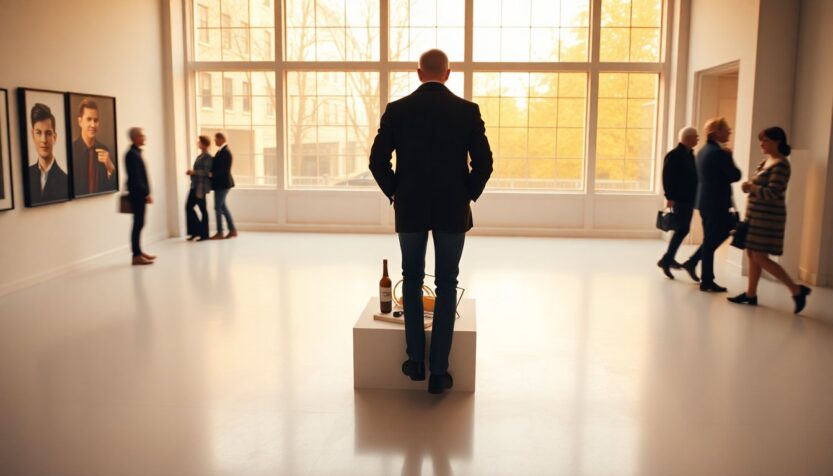
Larry Gagosian never met Marcel Duchamp, a fact the dealer often notes with a wistful curiosity; Duchamp died in 1968. In recounting his early years in Los Angeles—between college and the first small gallery he ran on a Westwood patio—Gagosian says he has long been drawn to Duchamp’s radical propositions. Those gestures helped redefine what could be called art, and that conceptual lineage is central to why Gagosian chose to inaugurate his new space with Duchamp’s work. The decision reads as both personal admiration and a public statement about the gallery’s ambitions as it transitions within the same building it has occupied for decades.
There is a literal overlap of addresses and histories: Duchamp exhibited at Cordier & Ekstrom in the same 980 Madison structure where Gagosian established his flagship in 1989. Gagosian still remembers the terrace and the summer sculpture displays—and now, after nearly forty years of continuous shows upstairs, the gallery will close those rooms and open a fresh ground-floor space linked to his restaurant, Kappo Masa, which he has owned since 2014. That move marks an architectural and curatorial reset at a site that once housed the Parke-Bernet auction house, and it frames the Duchamp exhibition as both a tribute and a reopening gesture.
A new chapter at 980 Madison
For this reconfiguration, Gagosian worked closely with Caplan Colaku Architecture, commissioning Jonathan Caplan and Mani Colaku to devise an interior that deliberately departs from the upstairs aesthetic. Instead of a smaller replication of the white rooms above, the ground-floor gallery presents a quiet, insulated environment with sumptuous stone floors and a carved-out white cube at the building’s heart. The scheme includes private viewing rooms and offices threaded through the plan, marrying public exhibition space with the discreet infrastructures collectors expect. The ownership change—former mayor Michael Bloomberg is now the building owner—meant an extended stay upstairs so the Johns exhibition could run its course before Bloomberg Philanthropies assumed control.
Opening with Duchamp: a deliberate relaunch
Rather than launch with a blue-chip live-artist spectacle, the inaugural presentation opts for the historical punch of Marcel Duchamp. The show gathers emblematic works that emphasize the artist’s continuing shock value: Fountain, L.H.O.O.Q., and a version of Bicycle Wheel that stands out as one of the few remaining non-institutional editions. Choosing Duchamp for a debut is a curatorial signal: to foreground the genealogy of concept-based practice. The timing aligns with a major exhibition at the Museum of Modern Art—a development Gagosian called fortuitous—where curators have emphasized how Duchamp’s pieces still possess an uncanny presence, behaving like time capsules of questions that remain unresolved.
Duchamp’s influence and market resonance
The term “Duchampian” often gets stretched into a buzzword, but the artist’s imprint on contemporary practice is unmistakable. From Jeff Koons’s stainless-steel Rabbit to Maurizio Cattelan’s toilet America, the gesture of recontextualizing everyday objects is Duchamp’s legacy. Appropriationists such as the Pictures Generation and figures like Richard Prince trace a direct intellectual line back to Duchamp, while younger makers like Cameron Rowland interrogate ownership and value in ways that echo the original provocations. The market reflects this pedigree: works associated with Duchamp’s lineage have fetched significant sums, including a notable sale in 2026 when In Advance of the Broken Arm sold for just over $3 million, and recent auctions curated by specialists at Phillips.
What the show contains
Gagosian’s presentation concentrates on ready-mades and emblematic gestures. By assembling canonical pieces in a condensed gallery footprint, the show allows viewers to experience the peculiar force of familiar objects anew: a urinal placed on a pedestal that still reads as audacious, a postcard transformed into an anti-icon, or a suspended bicycle wheel that arrests motion through stasis. These are not mere historical relics; they are living prompts. The exhibition also includes works by artists who were Duchamp’s contemporaries or direct heirs, such as Jasper Johns and Robert Rauschenberg, with loans from the Cy Twombly Foundation, reinforcing the networked history of midcentury New York practice.
Gagosian’s hands-on stewardship and the passing of a torch
Throughout the redesign and installation process, Gagosian says he engaged deeply with minute details, insisting the ground-floor feel neither like a boutique nor a mere extension of the upper galleries. He lives a block away and has opened numerous New York spaces over five decades, which gives this transition a sense of personal investment. The last hours upstairs featured a remarkable Jasper Johns exhibition—the artist who inaugurated the space in 1989 with his Maps works—so the weekend when Duchamp goes on view functions as a symbolic handoff. For Gagosian, Duchamp’s early reception—angry, puzzled, incredulous—has hardened into canonical status while retaining that original punk audacity, which is precisely the tone he wanted for the gallery’s next chapter.
In the end, the move signals more than a change of floor: it is an argument about continuity, history, and the forces that animate the contemporary market. By opening with Duchamp, Gagosian stakes a claim for the enduring potency of questions posed nearly a century ago. The new ground-floor gallery at 980 Madison functions as a compact theater for those questions, inviting collectors and the public to witness how an older provocation can still unsettle, inspire, and shape the art discourse today.