

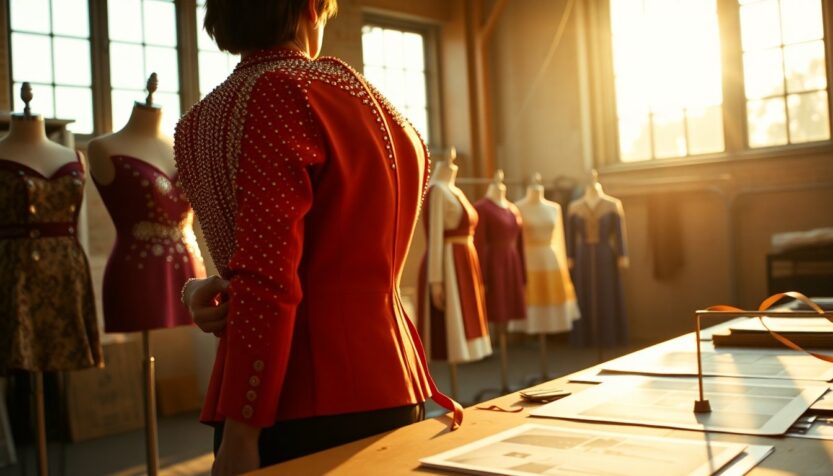
The film Michael centers on the early rise of Michael Jackson and his brothers, and its visual heartbeat is the clothing that charts that transformation. At the center of that work is Marci Rodgers, the costume designer tasked with rebuilding everything from the Jackson 5’s colorful stage wear to the singular jackets and accessories that define Michael’s solo era. This article examines the research-driven approach Rodgers used to translate archival images and physical garments into faithful, film-ready pieces, and why those wardrobe choices matter to the film’s narrative.
Rather than relying on ready-made museum loans, Rodgers opted to reproduce garments as precisely as possible. Her process balanced archival study, hands-on inspection and obsessive measurement: a methodology that turned visual references into wearable props that function as character shorthand. The goal was not only to mimic looks but to preserve the integrity of design so costumes could inform tone, evolution and identity across the story.
The research scale: digging through archives and museum holdings
Rodgers built a research vault that she describes as exhaustive. Her notes and clippings became a massive research book—well over 800 pages—composed of photographs, magazine scans and museum references. She visited institutions such as the Grammy Museum and the Rock & Roll Hall of Fame to study texture and construction up close. Physical access allowed Rodgers to see how fabrics catch light, how stitching aged, and how embellishments like rhinestones or metallic buckles sat on a garment in motion—details a flat image cannot convey.
Measuring the small things that make a big impression
What might read as minutiae became central to the work. Rodgers measured buckle widths, counted rhinestone rows on socks and examined glove construction. These items were not treated as accessories but as technical elements that modulate performance and presence. By measuring and documenting proportions, she could recreate items that moved correctly during choreography or sat properly under stage lights, ensuring authenticity when Jaafar Jackson performed signature moments like the Motown 25 moonwalk.
From photocopy to garment: the craft of recreation
With reference material in hand, Rodgers and her team set out to handmake many pieces rather than source them. Iconic outfits—like the red jacket associated with Thriller, the military-inspired coats and the black-and-white ensemble from the Motown 25 performance of Billie Jean—were reconstructed using period-accurate fabrics, notions and techniques where possible. The production also tackled group looks, like the Jackson 5’s matching stage costumes, making sure color, cut and sheen matched photographic records so that wardrobe would read as both period and performative.
Collaborating with performers and family
Jaafar Jackson, who portrays Michael, served as a crucial collaborator in translating archival garments into cinematic pieces; Rodgers calls him a key vessel for the work. The team also drew on family and personal sources when available, and relied on photographic documentation for supporting characters. Recreating these costumes carried a weight of responsibility: the wardrobe functions as a visual biography, and achieving believable continuity across eras required careful coordination between design, hair, makeup and movement departments.
Background, motivation and storytelling through clothes
Rodgers brought experience from projects including Till, Passing, BlacKkKlansman, Wu-Tang: An American Saga and the series She’s Gotta Have It, which informed her practice. Her education and early ambitions shaped a method that blends archival diligence with cinematic sensitivity. Personal connections—her family ties to Gary, Indiana, and emotional reasons for taking the job—added urgency to the work. For Rodgers, costumes were not decorative; they were narrative devices, marking psychological shift when Michael moves from group member to solo artist or when a jacket signals newfound authority.
In the end, the film’s clothing does more than reference famous outfits. It anchors scenes in time, communicates character arcs and invites viewers to recognize moments of change through fabric, hardware and silhouette. Rodgers’s process—equal parts scholarship and hands-on build—creates a costume language that lets audiences feel, as much as see, the evolution of Michael Jackson on screen.