

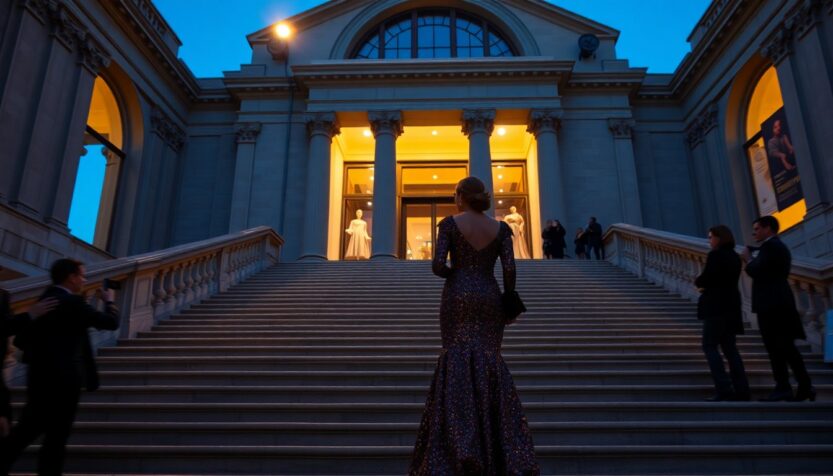
The Met Gala is the moment when fashion, celebrity and museum fundraising converge, and no one draws more attention on that staircase than Taylor Swift. For readers tracking runway evolution and cultural moments, Swift’s appearances offer a useful throughline: they trace a transition from a young country artist into a global pop icon while reflecting shifts in red carpet aesthetics. This piece sets Swift’s Met history against the broader backdrop of the Costume Institute’s current programming, including the Costume Art exhibition and the institution’s logistical changes for 2026. Throughout, I use Met Gala as shorthand for the annual benefit that anchors the Costume Institute’s spring moment.
Swift first walked the Met steps in 2008 as an 18-year-old with a single self-titled country record to her name; that same year her single “Teardrops on My Guitar” reached No. 13 on the Billboard Hot 100. She was months away from releasing Fearless, and roughly a year and a half before the highly publicized interruption at the MTV Video Music Awards that would later follow her career. In late 2026 Swift made chart history by simultaneously occupying every spot in the Hot 100 top 10, a milestone often referenced when charting her cultural ascent. These markers help explain why her Met outfits register beyond fashion: they are moments in a long public narrative.
How Swift’s red carpet choices evolved
Over six Met appearances, Swift’s runway language shifted markedly. At her 2008 debut she chose a shimmering Badgley Mischka gown in a tone that echoed her long curls and favored a soft petal pink lip rather than the bold red that would later define her image. In 2014 she embraced a romantic, blush-hued ballgown with a sweeping train and Old Hollywood waves, a look that emphasized glamour and timelessness. By 2016 she presented a striking contrast: a custom Louis Vuitton mini paired with a freshly bleached platinum bob and lace-up sandals, signaling a willingness to experiment with edgier silhouettes. That 2016 appearance coincided with her role as a co-chair alongside Jonathan Ive, Idris Elba and Anna Wintour, underscoring her status in the fashion world.
Signature details and stylistic pivots
Looking closely at those moments reveals recurring visual motifs and deliberate departures. Swift’s earlier looks leaned on femininity and classic Hollywood references, while later outfits played with contrast and modernity. The switch from petal pink lips to a more recognizable red lip and the shift from long curls to a platinum bob are examples of how an artist uses hairstyle and makeup to reframe a public persona. At the Met these choices operate as both personal statement and conversation with designers: they are curated performances that respond to a theme while signaling an ongoing reinvention.
What the Met Gala 2026 centers on
The 2026 gala centers on the Costume Institute’s Costume Art exhibition, a concept that pairs some 200 historical art objects with 200 garments to examine the dialogue between fashion and visual art. The evening itself will occur on May 4, 2026, consistent with the gala’s tradition of meeting on the first Monday in May, and the public exhibition opens May 10. High-profile co-chairs include Beyoncé, Nicole Kidman, Venus Williams and Anna Wintour, supported by a host committee led by Anthony Vaccarello and Zoë Kravitz with contributors from a range of creative fields. The exhibition and benefit are sponsored by Jeff Bezos and Lauren Sánchez Bezos, a fact that has prompted public response from activist groups.
Venue upgrades and exhibit design
For 2026 the Costume Institute is debuting the Conde M. Nast Galleries, a nearly 12,000-square-foot space carved from the museum’s former retail footprint. The redesign allows gala guests to move easily between the show and dinner at the Temple of Dendur and aims to ease crowds when the exhibition opens to the public. Curatorial choices also emphasize inclusivity: Andrew Bolton’s installation introduces roughly 25 new mannequins representing a wider range of body types, and nine of those forms derive from digital scans of real people — including disability advocate Sinéad Burke and musician Yseult — so visitors can literally see themselves alongside garments.
Gala mechanics and cultural stakes
The Met Gala began in 1948 as a charitable supper and evolved into an exclusive fundraiser for the Costume Institute, which is uniquely self-funded within the museum. Practical details matter: tickets run about $100,000 per person and tables start at $350,000, with roughly 400 guests typically invited. The evening follows a familiar arc — carpet, exhibition preview, dinner — with security measures such as stickers placed over phone cameras to protect the installations. Attendance remains a curated mix of wealth, influence and star power; some public officials decline invites, and past moments like Eric Adams’s 2026 tuxedo emblazoned with a message demonstrate how the gala can intersect with civic conversations.
Whether Swift returns to the Met steps is unknown, but her record there captures a broader story about celebrity, fashion and institutional platforms. The 2026 season—with its new galleries, inclusive mannequins and the Costume Art pairing of objects and garments—promises fresh material for red carpet narratives, and the gala on May 4 will be a reminder that the stair is both stage and stagecraft for cultural meaning.