



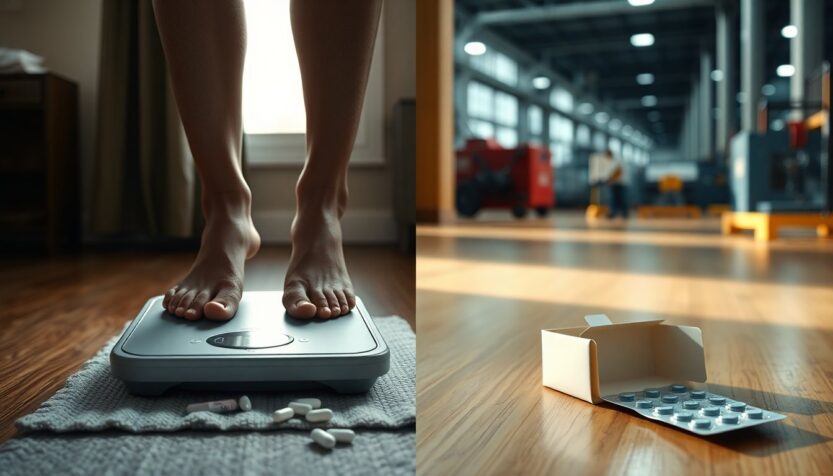
When the scale won’t budge and your feet ache Two very different “hidden forces” are quietly shaping health and work: commonly prescribed medicines that blunt weight loss and the gradual reshaping of factory floors with robotics that remove repetitive physical labour. Together they offer a window into how small, fixable changes can restore energy, reduce pain and free people for more satisfying work.
Why some women over 60 see no progress despite healthy habits
Many women over 60 tell the same story: they tighten their diet, sleep better, and move more — yet the scale barely changes. For some, the culprit isn’t willpower or lifestyle; it’s medication.
Several widely used drugs can affect appetite, fluid balance and metabolic rate. Classes most commonly implicated include:
– Certain antidepressants and antipsychotics – Corticosteroids – Some diabetes medications – Beta blockers and a few other cardiovascular agents
“These medicines save lives and control symptoms, but they can also change how the body stores energy,” says Dr. Elena Moretti, a geriatrician who runs a medication-review clinic in Milan. “When a patient’s weight stalls, the prescription list has to be part of the conversation.”
What to do if your weight plateaus
Practical, safe steps women can take:
– Bring a complete medicine list to appointments: prescriptions, over‑the‑counter drugs and supplements. – Ask your clinician which agents are likely to affect weight in your particular case. – Discuss alternatives, dose adjustments or timing changes—some patients can switch to drugs with a more neutral weight profile. – Request baseline measures (weight, fasting glucose, lipids) and agree on follow‑up intervals so any change is tracked objectively. – Consider non‑drug supports: a referral to a dietitian, tailored physical therapy, or behavioural coaching can help offset medication effects.
A clear warning: never stop or change a prescription without medical supervision. Abrupt withdrawal can cause serious rebound symptoms. If a change is appropriate, clinicians usually taper doses and monitor closely.
Questions to bring to your next appointment
– Which of my medicines could be affecting my weight or energy? – Are there safer alternatives for my condition? – What are the risks if we change the dose or switch drugs? – How will we monitor the effect on my weight and other health markers? – Who else should be involved—endocrinology, pharmacy, dietetics?
Real-world relief: automation that eases physical strain
Meanwhile, on the factory floor, companies are taking a different tack: remove the routine heavy lifting so people don’t pay for productivity with their bodies. In northern Italy, Duka, a shower-enclosure maker, replaced many internal transports with automated guided vehicles (AGVs). Workers who once walked nearly 20 km per shift now spend less time hauling components and more time on skilled assembly and quality checks.
“The machines handle the heavy, repetitive moving,” says Marco Ferri, Duka’s operations manager. “People do the work that needs judgement. We see fewer sore backs and a happier team.”
How these systems help
Modern AGVs and collaborative robots are not intended to replace human judgment; they automate predictable, non-value tasks:
– Goods-to-person systems deliver parts to the workstation so employees don’t walk long distances. – Robotic assistance can lift or position heavy items, reducing musculoskeletal strain. – Integrated fleet managers sync AGVs with ERP and WMS so materials arrive just in time.
Why some women over 60 see no progress despite healthy habits
Many women over 60 tell the same story: they tighten their diet, sleep better, and move more — yet the scale barely changes. For some, the culprit isn’t willpower or lifestyle; it’s medication.0
Why some women over 60 see no progress despite healthy habits
Many women over 60 tell the same story: they tighten their diet, sleep better, and move more — yet the scale barely changes. For some, the culprit isn’t willpower or lifestyle; it’s medication.1
Why some women over 60 see no progress despite healthy habits
Many women over 60 tell the same story: they tighten their diet, sleep better, and move more — yet the scale barely changes. For some, the culprit isn’t willpower or lifestyle; it’s medication.2
Why some women over 60 see no progress despite healthy habits
Many women over 60 tell the same story: they tighten their diet, sleep better, and move more — yet the scale barely changes. For some, the culprit isn’t willpower or lifestyle; it’s medication.3
Why some women over 60 see no progress despite healthy habits
Many women over 60 tell the same story: they tighten their diet, sleep better, and move more — yet the scale barely changes. For some, the culprit isn’t willpower or lifestyle; it’s medication.4
Why some women over 60 see no progress despite healthy habits
Many women over 60 tell the same story: they tighten their diet, sleep better, and move more — yet the scale barely changes. For some, the culprit isn’t willpower or lifestyle; it’s medication.5
Why some women over 60 see no progress despite healthy habits
Many women over 60 tell the same story: they tighten their diet, sleep better, and move more — yet the scale barely changes. For some, the culprit isn’t willpower or lifestyle; it’s medication.6
Why some women over 60 see no progress despite healthy habits
Many women over 60 tell the same story: they tighten their diet, sleep better, and move more — yet the scale barely changes. For some, the culprit isn’t willpower or lifestyle; it’s medication.7