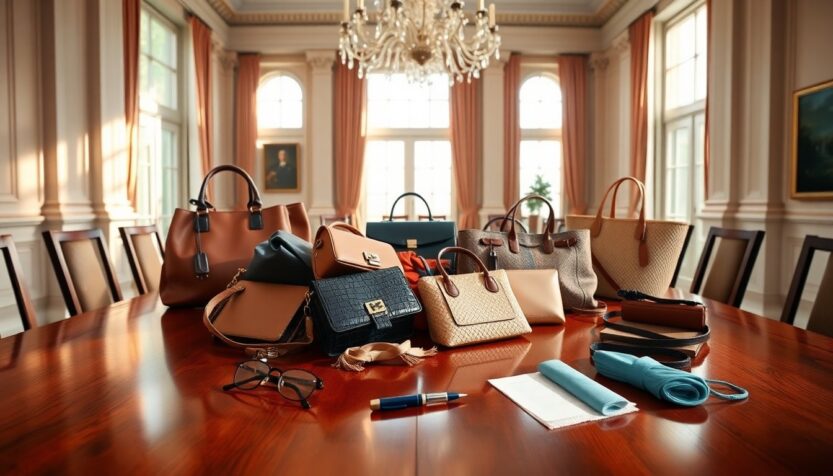
The Fostering the Future Together Global Coalition Summit in Washington, DC brought envoys from 45 countries to discuss improving children’s access to education and technology. Images from the gathering included the striking sight of Melania Trump walking beside a humanoid robot, but one quieter snapshot captured the public imagination just as effectively: a table piled with the handbags of attending first spouses. That photograph, shared by commentator Link Lauren, offered an unusual vantage point on the soft power of accessories inside a political setting.
On the tabletop sat an assortment of labels familiar to luxury observers — Chanel, Hermès, Saint Laurent, Michael Kors, and Ferragamo — alongside a more unexpected piece: a powder-blue mini trunk by Brandon Blackwood. The trunk, which retailed for $300 before selling out, represents a young New York–based brand that rose to mainstream attention in 2026 with a bag bearing the slogan End Systemic Racism. A portion of sales from that earlier design went to the Lawyers’ Committee for Civil Rights Under Law after the murder of George Floyd.
Why one small bag felt surprising
The presence of a Brandon Blackwood piece among established maisons felt notable because it disrupts expectations about whose names populate White House events. The label’s trajectory — an 11-year-old brand that broke through with a politically charged message — makes its appearance symbolically rich. Yet context matters: the trunk on the table did not display the earlier slogan, and without that explicit text the bag functioned largely as an object of style rather than a public statement. That distinction highlights a recurring tension in political fashion between intention and reception.
Blackwood and the limits of context
Although Brandon Blackwood’s profile is inseparable from its activist moment, inside a reception where accessories are removed and set aside, the designer’s broader reputation can be easily neutralized. The bag’s retail price and sellout status tell one story; the brand’s activist origin tells another. At the White House, the two narratives intersect yet do not necessarily reinforce each other. The owner’s choice to carry a non-slogan item meant the label’s activist associations were not front and center, illustrating how meanings can dilute when fashion leaves the body and enters a communal space.
Handbags as signals — and as blanks
Luxury items are expected at gatherings of political spouses, and their appearance rarely shocks: they signal access and taste. For example, Alexandra Gucci Zarini — granddaughter of Aldo Gucci and great-granddaughter of Guccio Gucci — attended the summit carrying a piece from her own label, AGCF. Her Unity Bag, launched last December at $2,800, pledged 20% of proceeds to Fostering the Future and reportedly sold out its first edition within a week. Similarly, Sara Netanyahu, the wife of Israeli Prime Minister Benjamin Netanyahu, carried a classic Chanel flap that is listed pre-owned for just over $8,000 (a new black example in that size retails for roughly $11,300).
When the object overshadows the message
Objects brought into institutional spaces often lose the explicit intentions attached to them. A bag purchased as a fundraising vehicle or a political statement can become, in practice, a stylish accessory among peers. This does not erase intent — the motives behind a purchase still matter — but it complicates assumptions about how garments function as political communication. The White House setting, in particular, filters aesthetic choices through expectations of decorum and neutrality, which can mute explicit messaging.
Past precedents and changing norms
The modern expectation that garments should carry clear political meaning is relatively recent and owes a lot to figures like Michelle Obama, who used fashion to advance ideas and visibility. Historically, however, high-end dressing often served primarily as a marker of status. Consider Eva Perón, a champion of Argentina’s working class who nonetheless embraced Christian Dior’s New Look during and after her 1947 European tour — a relationship so memorable that Dior reportedly called her “the only queen I ever dressed.” Elsewhere, the opulence of leaders’ families can create dissonance with political rhetoric: the term Boliburgoisie, coined by journalist Juan Carlos Zapata, captured the conspicuous consumption around Hugo Chávez’s government and its aftermath.
More recently, politicians and public figures have used fashion to lift domestic designers: Jill Biden frequently showcased American labels, and Kamala Harris spotlighted names like Tory Burch and Christopher John Rogers. By contrast, Melania Trump has generally preferred a neutral, polished approach — favoring houses such as Dolce & Gabbana and wardrobe collaborations with her stylist Hervé Pierre, while occasionally wearing American pieces like the Michael Kors Collection dress she wore to the Kennedy Center production of Chicago, which she first wore in 2017. The cumulative effect of recent years is a landscape where labels sometimes matter less than they once did — a shift the Trump era accelerated.
What the handbag table ultimately demonstrated is that accessories can be both loud and mute: they register wealth and identity, but their communicative power is shaped by context, ownership, and the choices individuals make about visibility. In political settings, the same piece may serve as a deliberate symbol for one person and a neutral object for another, making the politics of fashion an ongoing conversation rather than a straightforward language.