



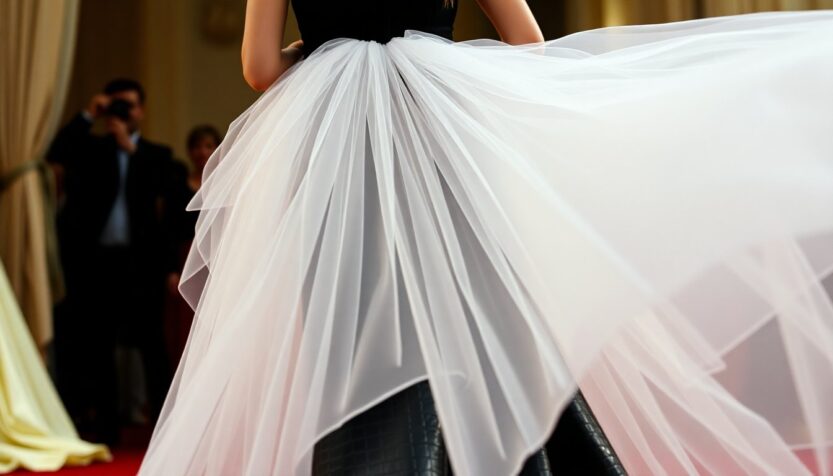
The arrival of Demi Moore on the red carpet in a Schiaparelli couture gown at the 2026 Actor Awards was the visible end point of a meticulous process. What appears as an effortless moment on camera actually reflects months of planning, multiple fittings, and an intensive artisanal effort from the House of Schiaparelli. The look—originating on Daniel Roseberry’s haute couture runway—combined a sleek bustier silhouette with a dramatic white tulle cloud at the back and a trompe l’oeil crocodile tail at the front.
This piece unpacks the sequence that moved the dress from the atelier to Los Angeles, the people who shepherded it, and the technical feats that make couture different from off-the-rack dressing. Alongside the gown, attention to accessories—the sculptural Schiaparelli mules with the brand’s signature keyhole bijou and the gilded satin clutch—completed a deliberately crafted image.
Where it began: atelier craftsmanship and the runway debut
The journey started in Paris at Schiaparelli’s workshops near Place Vendôme, where the gown was executed by the maison’s ateliers. The dress required an extraordinary volume of manual work: more than 7,700 hours of embroidery, using some 8,500 black mimosas in silk thread and over 11,000 crystals. After completion, the look traveled to the Petit Palais to appear on Roseberry’s couture runway—a public debut that allowed Moore and her team to see it in motion.
Fittings and the choreography of multiple cities
Turning a runway dress into a red carpet-ready garment means repeated refinements. Moore and her stylist, Brad Goreski, attended the show and decided quickly which pieces to pursue. Over the following days Roseberry personally fit Moore in Paris, establishing the foundation for the silhouette and proportion. That initial session set the direction for two additional fittings across Europe and the U.S.
From Paris to Milan to Los Angeles
After the Paris fitting, the gown was fine-tuned in Milan, addressing subtler fit points and movement. The final fitting occurred in Los Angeles the day before the ceremony. Rather than risk shipment delays, Schiaparelli arranged for a trusted tailor—identified as Stefan—to hand-carry the garment on flights between cities. This level of care ensured that the same hands who shaped the dress remained responsible for its alterations, preserving continuity in the construction and finish.
Practical alterations and red carpet considerations
Couture often includes functional adjustments to help a wearer navigate a live event. In Moore’s case the voluminous white tulle “poof” at the back was designed to be detachable so she could sit comfortably during the ceremony. The detachable element was packed carefully and transported alongside the gown. These pragmatic choices—removable trains, convertible components—are common in haute couture when garments must perform on a stage or during long evenings.
Accessories and complementary styling
The ensemble extended beyond the dress. Moore selected Schiaparelli satin mules, featuring an asymmetrical wavy vamp and the house’s signature gold Keyhole bijou, and carried the brand’s black satin Hand-in-hand clutch with a gilded metal hand detail. Jewelry and shoe construction were chosen to balance the gown’s sculptural back while maintaining a cohesive narrative of high-fashion theatricality.
People, process, and the ethos of couture dressing
Bringing a couture look to a public event requires collaboration: a committed stylist to advocate for the choice, a designer willing to tailor pieces for a specific client, publicists to coordinate appearances, and expert technicians who manage fittings and transport. Goreski emphasized that Moore’s approach to fittings is meticulous—an attitude that honors the craft behind each garment. For Roseberry, dressing Moore meant placing a creation on a wearer who embodies both glamour and approachability.
There are broader implications too: moving couture across continents entails flights and logistics that contribute to the carbon footprint of fashion moments. While teams often justify travel as unavoidable for time-sensitive work, this reality is part of an ongoing conversation about sustainability in high fashion.
Why this moment matters
When Demi Moore stepped onto the red carpet in Schiaparelli, audiences saw a finished image but not the labor behind it. The gown’s embroidery counts, the cross-continental fittings, and the decision to hand-carry the dress all underline that couture dressing is a coordinated performance. The result was a memorable red carpet moment that highlighted artisanal skill, collaborative planning, and the distinct drama that couture can bring to contemporary awards-season storytelling.
In short, a single look on the carpet represents a chain of decisions and a team committed to craft—one that starts in an atelier and culminates under flashing cameras, revealing the intricate choreography behind fashion’s public moments.