



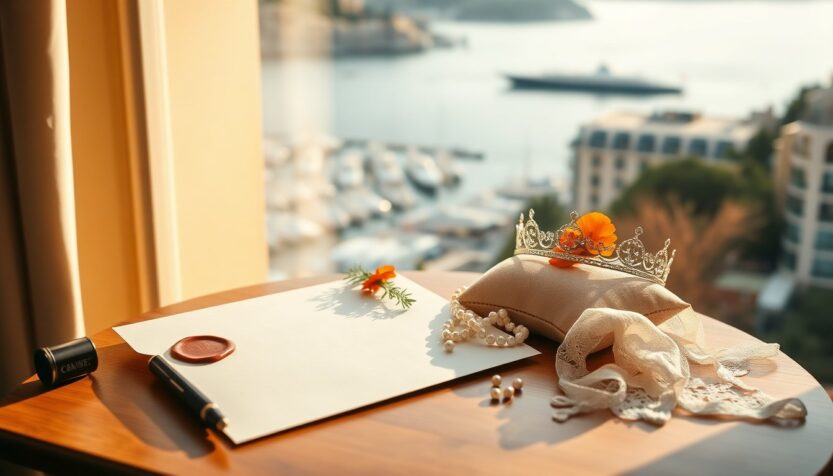
The union of Grace Kelly and Prince Rainier III is often described as a true fairy tale, and the real-life story behind that label is as theatrical as it is intimate. Their first meeting on the Croisette during the 1955 Cannes Film Festival sparked a discreet exchange of letters that steadily deepened into commitment. What began as a chance encounter while the actress promoted To Catch a Thief quickly became a private correspondence—an epistolary romance kept largely out of public view—until Rainier proposed with a remarkable 12-carat diamond ring and Grace made the life-altering decision to leave Hollywood.
Rather than jetting straight to Europe, the bride-to-be crossed the Atlantic in uniquely cinematic fashion: she sailed from New York Harbor surrounded by an entourage of about 70 people, including six bridesmaids and no less than 80 suitcases. That voyage signaled the scale of what followed. Their official church wedding took place on April 19, 1956, at St. Nicholas Cathedral, but it was only the second ceremony the pair held; a civil ceremony at the royal palace—required under Napoleonic law—had taken place the day before.
The courtship and formal vows
The path from the Croisette to the altar was neither immediate nor simple: at the time they met Grace was involved with Jean-Pierre Aumont, while Rainier was linked to actress Gisèle Pascal. Still, the clandestine correspondence that followed their Cannes meeting sealed their bond in under a year. The couple’s religious ceremony on April 19, 1956, became a global spectacle: the event was filmed by MGM, reportedly in exchange for Grace’s contract release, and the footage, edited into an official film, reached roughly 30 million viewers worldwide. That media frenzy is often cited as a precursor to modern live spectacle broadcasting.
The production behind the pageantry
Behind the glitter, Hollywood engines hummed: MGM treated the wedding like a studio production, coordinating camera placement, lighting in the cathedral, and even costume construction. The bride’s gown, a collaboration led by designer Helen Rose and assembled by 30 studio artisans, used 450 yards of fabric—peau de soie, taffeta and silk tulle—plus antique Belgian lace and multiple petticoats, resulting in a sweeping train that has inspired brides ever since. After the ceremony, Grace donated the dress to the Philadelphia Museum of Art, ensuring the costume’s preservation for future generations.
Dress, charm and ritual
More than ornament, certain details were personal tokens: the bride famously recited her vows in impeccable French, an intentional gesture that underscored her commitment to her new role. Her wedding shoes bore a private engraving—Rainier’s name on the right shoe and hers on the left—and tucked into the right heel was a copper coin for luck. During the ring exchange, a nervous Prince nearly fumbled; it was Grace who steadied the moment with a discreet guiding motion. These small rituals gave the public pageant a human center.
Guests, gifts and the less romantic ledger
The guest list turned Monaco into an international stage: over 600 invitees included personalities such as Aristotle Onassis, François Mitterrand, and Conrad Hilton, and Hollywood luminaries like Cary Grant, Ava Gardner, David Niven, Gloria Swanson and Jack Warner. Frank Sinatra was invited but chose not to attend to avoid overshadowing the ceremony. Behind the glamour, financial realities surfaced later: the 2026 documentary Grace Kelly’s Missing Millions alleges that the Grimaldi family required a dowry possibly as large as $2 million, a sum said to have significantly impacted Grace’s Hollywood earnings.
Reception, cake and the honeymoon at sea
The reception combined national symbolism with confectionery art: a six-tier wedding cake modeled on Monaco’s Pink Palace was elaborately decorated in sugar to depict scenes and motifs tied to the principality. After the public celebrations and a procession through Monaco’s streets, the newlyweds boarded the prince’s yacht Deo Juvante II for what was intended to be the honeymoon. Fatigue cut that first sailing short, and the couple postponed their departure until the following day; once rested, they set off on a seven-week cruise around the Mediterranean, a private ribbon of time that began their married life together.
The marriage ushered in decades during which Grace devoted herself to charitable work and family life, raising three children—Caroline, Albert and Stéphanie—alongside Rainier. The union, though often framed as a perfect storybook, contained complex human and financial layers that continue to fascinate historians and the public. The narrative’s lane ultimately narrows with the tragic end of the princess’s life on September 14, 1982, yet the wedding day of April 19, 1956, endures as an emblem of midcentury glamour, media spectacle and a private love made very public.