



Jean Pigozzi—known to many as Johnny—has long been a fixture in elite social circles and on awards-season guest lists, and his return to the Vanity Fair Oscar Party this year was no exception. As the central figure of the HBO documentary I Am Curious Johnny, Pigozzi brings not just celebrity connections but a personal photographic practice that predates modern trends. He has attended the party repeatedly over decades, including earlier iterations hosted as a dinner at Morton’s alongside Graydon Carter. That continuity—moving from intimate dinners to the glittering tableaus of today—frames his presence as both guest and chronicler, blending hospitality and observation.
At the dinner table he favored familiar companions, seated beside long-time friends and cultural figures whose relationships with him span decades. He described the meal as relaxed and convivial, the kind of gathering where decades-long acquaintances are easily recounted. The roster of companions included names like Anjelica Huston and Mick Jagger, underscoring how Pigozzi’s orbit overlaps entertainment, art, and publishing. His lineage—his late father served as CEO of the Italian automotive brand and Fiat spin-off Simca—is part of the backstory that has enabled a life combining privilege, curiosity, and creative output.
The photographer behind the snapshots
While Pigozzi moves comfortably among luminaries, many recognize him foremost for his contributions to visual culture: he is frequently credited as a pioneer of the celebrity selfie. During his undergraduate years at Harvard he famously turned his Leica around in 1974 to capture himself with actress Faye Dunaway, an early instance of an artist using a self-image to document social life. That moment sits next to later work in black-and-white and color that treats subjects with a casual intimacy rather than staged glamour. His photographic instincts favor spontaneity and human connection, positioning his archive as social history as much as portraiture.
How he shoots at big events
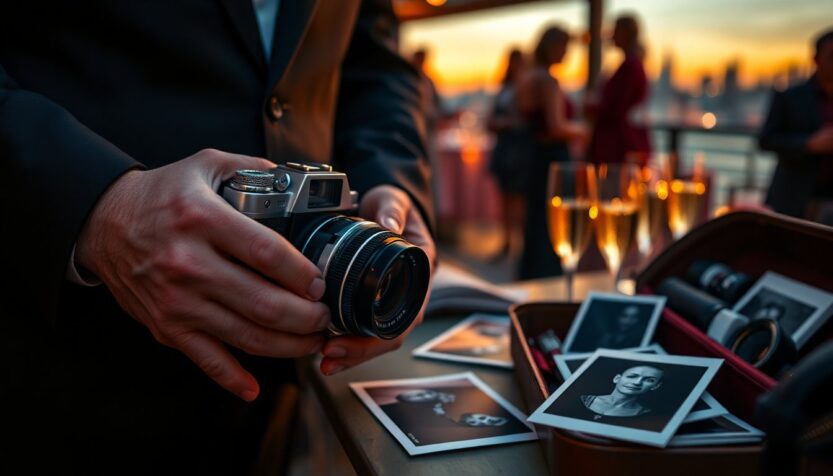
Pigozzi’s equipment and technique are central to his approach: instead of the large rigs and intrusive flash setups common at high-profile events, he prefers something minimal and mobile. He often uses a tiny Sony camera that fits easily in his hand, a tool that reduces intimidation and helps people relax. Standing at 6 feet 4 inches, his presence is physically imposing, yet the small camera creates a paradox of approachability. He works manually and moves through the room, making quick decisions about composition and tone. The result at the Vanity Fair table was a set of images that combined crisp black-and-white frames with colorful, kinetic shots of the evening’s guests.
Technique and photographic philosophy
Pigozzi’s philosophy rejects contrived poses in favor of authenticity. Where some photographers emphasize posed glamour—a formulaic arrangement to highlight features and fashion—he aims for normalcy and occasional wit. He looks for gestures, quirks, and exchanges that reveal character rather than perfection. This commitment to candidness produces pictures that feel lived-in and often humorous, reflecting his belief that informal snapshots tell more about a person’s spirit than carefully staged portraits. In short, his method privileges observation and connection over artifice.
Legacy and social influence
His social reach has been documented before: a notable magazine profile titled Five Degrees of Jean Pigozzi positioned him as a central node in a wide celebrity network, and the depiction remains relevant to understanding his role at events like Vanity Fair’s. Beyond the parties, his work and friendships chronicle decades of cultural life, merging personal archives with public moments. The HBO film I Am Curious Johnny amplifies that narrative by placing his images and relationships on screen, offering viewers a sense of how one person can document and participate in a shifting social scene without abandoning curiosity or humor.
Why the pictures matter
Pigozzi’s photographs matter because they capture intimacy in settings designed for spectacle. The compact camera, patient timing, and preference for natural expression allow him to preserve candid interactions that often vanish beneath public posturing. His images serve as informal records of well-known figures in moments of ease, creating an archive that complements more polished celebrity photography. Whether black-and-white simplicity or vibrant chaos, his frames remind viewers that social life is both communal ritual and personal story—a distinction that has defined his work for decades and continues to shape how we remember nights like the Vanity Fair Oscar Party.