

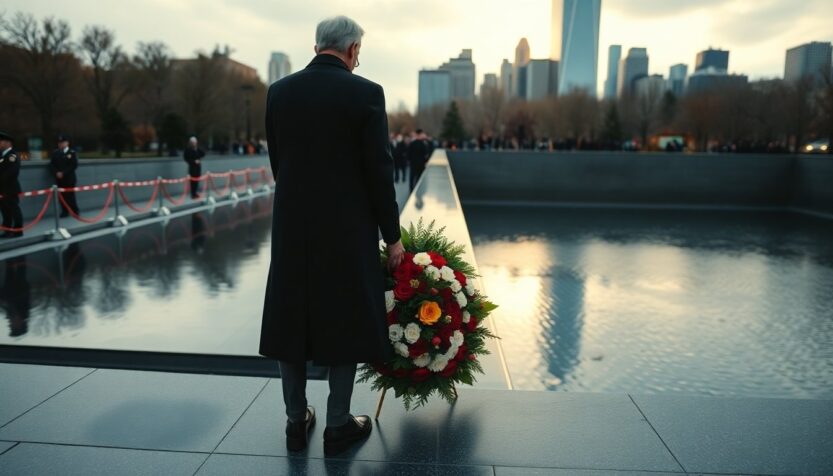
The visit by King Charles III and Queen Camilla to the 9/11 Memorial in New York was a brief but carefully staged moment during their multi-day state visit to the United States. Arriving in the city after a congressional address and a White House state dinner, the royal couple paused to lay a floral tribute and meet families of victims and first responders. The scene combined solemnity with spectacle: tourists turned away by barricades, multiple law enforcement agencies on site, and a handful of demonstrators determined to be heard.
Security was visible and extensive. Uniforms from the Secret Service, the New York City Police Department, the Port Authority and other agencies cordoned off the site; K-9 units and state police officers were also present. Inside the perimeter the museum continued its work after routine security checks, while the royals placed a wreath and left a handwritten message honoring those lost on September 11, 2001.
The ceremony and its details
The monarchs were guided to the memorial by former mayor Michael Bloomberg, who had previously escorted Queen Elizabeth II in 2010. The wreath—described by the British Embassy as including white lilacs, sweet peas, peonies, calla lilies and white daffodils—was carried by the king’s equerry, Lieutenant Colonel Jonny Thompson. (An equerry is an officer who attends to a member of a royal household.) The message left with the wreath read: “We honour the memory of all those who so tragically lost their lives on 11th September 2001, and stand in enduring solidarity with the American people in the face of such profound loss. Charles R, Camilla R.”
Atmosphere and onlookers
Outside the guarded perimeter, reaction ranged from quiet respect to bemused curiosity. Some tourists approached the closed memorial and were turned away, confused by the sudden restriction. A handful of locals and students gathered to watch, while one man played “God Save the King” on a portable speaker before riding off. A group of high school visitors and individual passersby lingered, many more interested in the spectacle than in the ceremony itself.
Politics, symbolism and context
The stop at the memorial carried clear diplomatic weight. Historians note that visiting national shrines during foreign trips is a longstanding royal custom that signals respect and solidarity. Observers pointed out that such imagery—leaders standing together in remembrance—plays well on the global stage. During his address to Congress earlier in the visit, the king referenced the attacks: “This year, of course, also marks the 25th anniversary of 9/11. This atrocity was a defining moment for America, and your pain and shock were felt around the whole world,” a line that reinforced the memorial’s significance in the itinerary.
Strategic messaging
Analysts saw the memorial visit as part of a broader effort to underscore alignment with the United States at a time when British foreign policy has been under pressure to recalibrate. The optics of joint appearances—outside the White House, on Capitol Hill and at sites of national memory—were described as deliberate: reaffirmations of friendship and shared history rather than announcements of new policy. The encounter with victim families and local officials was brief and focused, underlining the private, human dimension of the trip.
Protests and public encounters
Not everyone at the edges of the event was there to honor the dead. Demonstrators from groups such as Sikhs for Justice displayed banners calling for Khalistan, urging the royal couple to press the UK government on a referendum for Punjab. New York’s mayor, Zohran Mamdani, attended alongside other officials; he had previously said he would use any opportunity to raise questions about colonial-era artifacts and mentioned the Koh-i-Noor diamond as an example of contested heritage. A photograph captured a short, somewhat puzzled exchange between the mayor and the king, but whether that developed into an extended discussion was not clear.
Other moments around the memorial were distinctly local: students skipping class to see the royals, a mix of curiosity and cynicism among tourists, and debate in the crowd over news items such as a satirical outlet’s reported purchase of nearby property in 2026. Ultimately, the visit combined formal ceremony, crowd management and political theatre into one compact event, leaving an image intended to emphasize solidarity and remembrance.
Aftermath and itinerary
The memorial stop was one of several planned engagements in the city: the queen planned to visit the New York Public Library to add a new Roo doll to its Winnie-the-Pooh collection, while the king was scheduled to meet civic and business leaders and visit youth programs addressing food insecurity. The pair spent roughly 25 minutes greeting families and officials at the memorial, then continued with other components of their state visit—a tour designed to balance public condolence, cultural diplomacy and formal statecraft.