
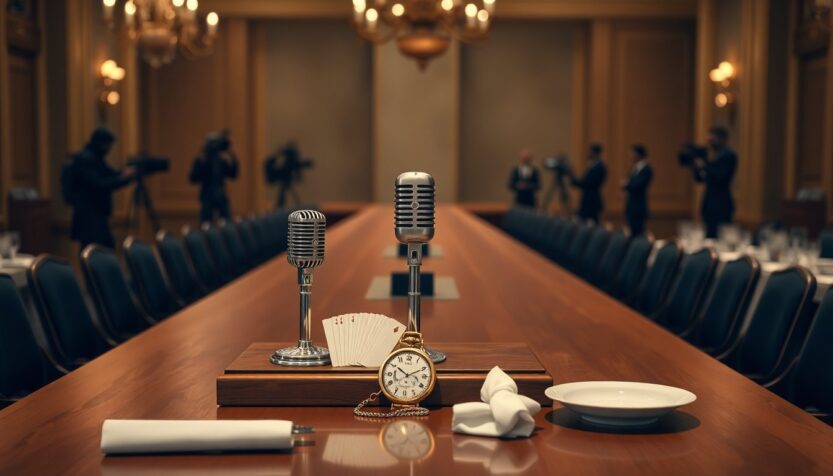
The annual White House Correspondents’ Dinner traditionally centers on a comic roast, but this year organizers selected a different kind of headliner: Oz Pearlman, a noted mentalist who specializes in creating astonishment rather than punch lines. The shift has extra gravity because Donald Trump is attending after skipping the event in prior years, and networks, guests and pundits are watching closely to see how a performance of mentalism will play in a room of journalists and political figures.
In conversations about the upcoming evening, Pearlman framed his role as one of making people feel unified through wonder rather than dividing them with satire. He has a long career arc—first attracted to magic as a teenager, working as a strolling magician in restaurants, balancing stints on Wall Street with entertainment, and later reaching a wider public after finishing third on America’s Got Talent in 2015. Pearlman also mentions that he left his finance job in ’05, and that his rise was steady rather than instant.
A different kind of headliner
Pearlman and the dinner organizers explained the choice as deliberate: in a polarized moment, the event wanted something that could bridge aisles. Where comedy can split a room because of subjective taste, mentalism tries to evoke a shared reaction—surprise. Pearlman says the producers, including the reporter who selected him, aimed for an experience that creates a single, communal memory. He intends to deliver one or two moments that linger in people’s minds long after the evening ends.
His trajectory to this marquee slot has been gradual. Pearlman describes the arc as taking years of practice and small bookings—working restaurants, performing for corporate clients, and steadily growing an audience. The overnight success image, he argues, masks the decade-spanning effort behind public breakthroughs such as television exposure. That background shapes how he approaches a high-stakes stage: methodical, practiced, and tuned to produce a compact, powerful set of astonishments rather than a conventional comedy routine.
Techniques, ethics and preparation
Pearlman is explicit about boundaries: he uses a public disclaimer to state he is not claiming supernatural powers, and he stresses that his methods are teachable skills grounded in psychology and observation. He compares his approach to a secret recipe—sharing hints without exposing every ingredient—so the effect remains potent. The choice to reveal partial mechanics serves a purpose: it engages curiosity while preserving the mystery that makes the performance meaningful.
Studying a high-profile subject
For this particular audience Pearlman shifted his prep. Instead of a broad focus suitable for many shows, he said he concentrated attention on the event’s most prominent attendee, studying behavioral patterns and possible “tells” with the care of someone researching a subject. He declined to reveal specifics—calling some insights analogous to a zero-day exploit that would lose value if exposed—but noted that preparing for a single figure demands a different level of focus than his usual touring work.
Viral moments, skepticism and public response
Recent viral clips demonstrate the effect he aims to produce. One notable example is an appearance where Pearlman seemingly identified an ATM code belonging to a guest during a long-form conversation, which generated astonishment and a strong emotional reaction. Pearlman insists the moment’s power came from its authenticity: the surprised response proved unscripted, which in turn fueled speculation about technique. That authenticity, he believes, is central to making a short sequence of events spread widely online.
Handling backlash and staying above politics
Viral fame has a downside: Pearlman has fielded conspiracy theories and abusive commentary, including antisemitic attacks in some corners of the internet. He says distinguishing real criticism from bots or coordinated content is increasingly difficult, and he prefers not to fuel that discourse by engaging with every rumor. Publicly, he keeps his politics private, describing his professional role as delivering a shared emotional break—what he calls a dopamine hit or escape—rather than advocating positions that would immediately alienate parts of his audience. He plans to appear at several events around the dinner, including the Vanity Fair party, and hopes to create a moment that defines the evening without turning it into a political spectacle.