



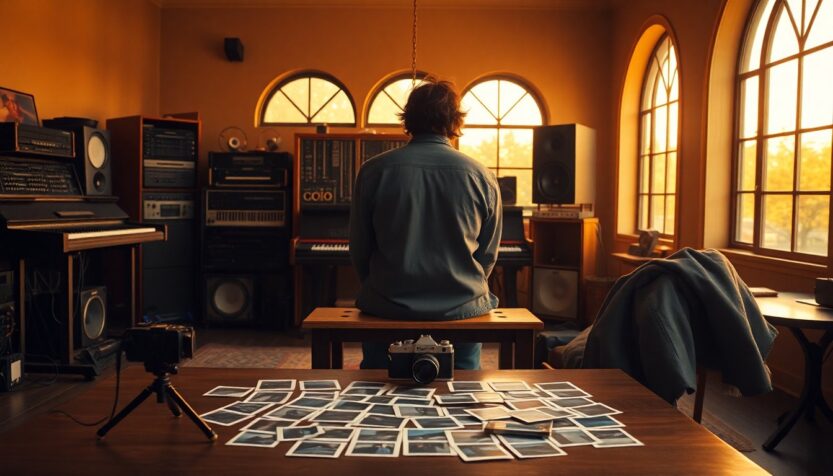
The story begins at a place that served as studio, residence and laboratory: Paisley Park. On April 21, 2016 the world lost Prince at the estate he had commissioned, and the place where Paisley Park became synonymous with his private and public worlds. Photographer and visual artist Steve Parke documented the musician across several sessions between 1996 and 2001, a time when the shift from film to digital photography was accelerating and offered new ways to capture and preserve creative moments. That archive has now been revisited and edited with contemporary tools to create a photo book that pairs technical restoration with memory.
Parke’s relationship with Prince did not start as a simple photographer–subject arrangement. He had collaborated with the artist since 1988, painting sets and designing visuals, and later moved into photography after Prince asked if he knew how to shoot. Their collaboration overlapped with a turbulent phase in Prince’s career — the dispute with his record label that led him to use an unpronounceable symbol — and with intimate chapters of his life, including his relationship and later marriage to dancer Mayte Garcia. Important moments such as the VHS tape that introduced Garcia to Prince in 1990, the song dedication in 1994, and the couple’s time in Marbella are woven into the visual narrative Parke assembled.
The Paisley Park creative ecosystem
Those who worked inside the estate describe it as a continuous experiment where Prince set the tone but encouraged collaborators to expand their practice. Parke recalls an atmosphere where designers became photographers, painters became set builders, and performers became co-conspirators in invention. The sessions often blurred roles: Prince would suggest a setting or an action and then improvise, treating the studio like a playground. Many images in the new book owe their energy to that openness — portraits that feel candid but were created with attention, and group shots that capture the effortless magnetism of a visionary directing his own mythos. Here, creative agency and radical curiosity were daily practices.
The playful studio
Parke shares small anecdotes that illuminate how those images came to be: a distinctive couch with an arched open back turned into an impromptu stage for a five-minute series of gestures, and a rushed passport-like portrait that may have been subtly retouched on the spot. Such episodes reveal an environment where decisions were quick and trust ran deep. Technical limitations of the time — slow file transfers, limited hard drive space, and the inability to recover deleted shots — shaped what was kept and what was lost. Parke’s modern editing work attempts to honor the original intent while rescuing what can be rescued from early digital originals, the digital negatives that now form part of the collection.
Portraits of tenderness
Among the book’s most affecting images are those that show Prince with Mayte Garcia, where public persona softens into domestic warmth. These photographs document chemistry and intimacy alongside the theatricality for which he was known: small gestures, a look, a private laugh. Parke names a favorite taken in an arboretum — Prince with closed eyes and sunlight at his back — as a quiet counterpoint to the exuberant studio scenes. Those outdoor shots, and the stories of life in Marbella, add texture to an archive that could otherwise read as strictly performance documentation; they emphasize vulnerability and the moments when an artist stops directing and simply is.
Technology, control and foresight
Prince was an early adopter of digital distribution strategies even as he remained protective of ownership. Between 2003 and 2004 he released several albums exclusively through his website, a precursor to conversations about creator control that are now central to debates over streaming and rights. Parke and Garcia both point to Prince’s instinctive mistrust of platforms that dilute artists’ control: he embraced technology that empowered him to sell directly but resisted systems that undermined creators’ pay. Today those convictions extend into concerns about artificial intelligence and the ways new tools use existing work without consent or compensation, an issue Parke believes Prince would have strongly opposed.
Editing and legacy
Revisiting raw files from the late 1990s and early 2000s has been a labor of restoration and interpretation. Parke used contemporary software to revisit exposures and recover tones, mindful that every adjustment changes how we remember the subject. Some material was never backed up and is gone; other frames survived as glimpses of a private life. The book opens with a portrait featuring Angie Stone — who passed in 2026 — and moves through musical collaborators, family scenes, and understated moments that resist mythologizing while still revealing magic. The result is an archive that reads as both documentation and elegy.
Why these images still matter
Photographs in this collection reaffirm aspects of Prince that persist in the cultural imagination: his visual fluency, fluid public identity, and his insistence on controlling how his work circulated. They also reveal softer dimensions — tenderness with a partner, the playful energy in a courtyard, and the quiet of an autumn day. Contemporary artists and fans find resonance in these pages because they show an artist who engineered his own world and invited collaborators to experiment within it. The book is not only a record of a musician but an invitation to consider how creative communities form, protect their work, and leave archives that speak across generations.