



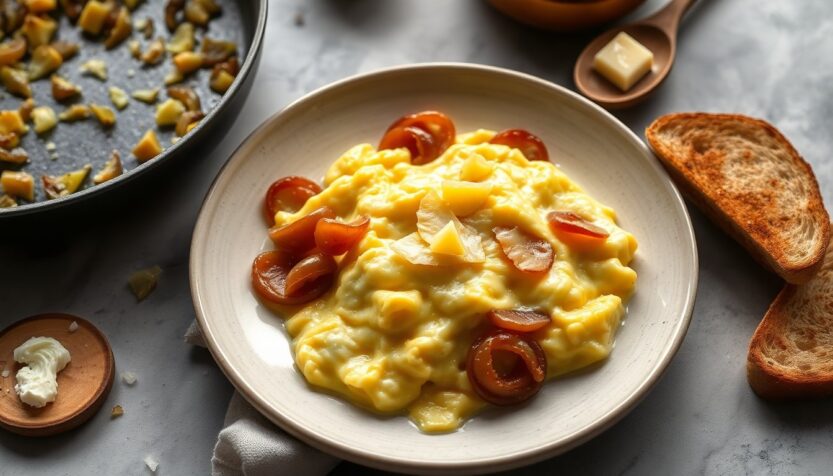
The simplest scrambled eggs, transformed into a silky curd
A few small choices—cold eggs, low heat, a patient hand—turn ordinary scrambled eggs into something like a delicate curd: glossy, tender and impossibly creamy. This version uses chilled eggs, a spoonful of crème fraîche, slowly caramelized shallots and nutty Comté. It’s quick to make but rewards gentle pacing: plan on about 15 minutes from start to plate.
Ingredients (one generous serving) and swaps
– 3 cold eggs, straight from the fridge – Pinch kosher salt (about ¼–½ tsp, adjust to taste) – 1 tbsp crème fraîche (or a spoonful of full-fat yogurt in a pinch—expect a slightly tangier, less silky finish) – 3 tbsp salted butter, divided – 1 large shallot (or 2 small), finely diced (substitute a mild yellow onion or the white part of a leek) – ¼ cup grated Comté (or another aged, nutty cow’s-milk cheese such as Gruyère) – Flaky sea salt and freshly cracked black pepper to finish
A quick note on sourcing
Choosing local eggs and cheese not only tastes better—freshness is obvious—it also reduces transport and packaging. Small ingredient choices like these can lower waste and make your cooking more sustainable without changing the flavor.
Why start with cold eggs and low heat?
Cold eggs coagulate more slowly, which encourages many tiny curds rather than a few large, rubbery ones. Low, steady heat gives the egg proteins time to set gently; the result is a glossy, custard-like texture. Crème fraîche adds both fat and a touch of acidity, stabilizing the emulsion and making the curds creamier. Butter helps control pan temperature and contributes richness; grated cheese folded in right at the end melts into the warm curds without toughening them.
Prep and technique — the fine points
1. Whisk and chill: Crack the eggs into a small bowl, add the salt and whisk vigorously for about 30 seconds until uniform. Dollop in the crème fraîche and whisk briefly so it’s dispersed. Put the bowl back in the fridge while you cook the shallots—keeping everything cool helps produce softer curds.
2. Caramelize the shallots: Warm a small-to-medium skillet over medium heat with 2 tbsp butter. Add the diced shallots and a pinch of salt. Slow-cook, stirring occasionally, for 8–10 minutes until translucent with brown edges. This gentle caramelization builds sweetness that pairs beautifully with the cheese.
3. Staged cooking for creamy curds: Push the shallots to the pan’s rim and add the remaining tablespoon of butter. Pour in the chilled egg mixture and resist the urge to stir immediately. Let the eggs sit undisturbed for about 90 seconds so a thin set layer forms at the edges. After that, rotate the pan and, using a silicone spatula, scrape broad strokes from the rim toward the center, lifting slightly to fold uncooked egg under the set curds. Work in pauses—90 seconds of rest, 90 seconds of gentle folding—rather than constant agitation. This measured rhythm yields small, tender curds and prevents overcooking.
4. Finish with cheese: When you see larger curds but the mixture still looks glossy and slightly underdone, scatter the grated Comté over the surface. Briefly raise the heat for 20–40 seconds to melt the cheese and finish the edges, then remove the pan. The eggs will keep cooking from residual heat; take them off while they’re still shiny and custard-like.
Serving suggestions
Slide the eggs onto a warm plate, season with a pinch of flaky salt and freshly cracked pepper, and serve immediately with well-buttered toast. A few fresh herbs—chives, tarragon or parsley—are lovely if you want a bright note. A chilled glass of crisp white wine makes it feel like a leisurely brunch, but this also works as a fast, elegant solo dinner.
Scaling and small experiments
This method scales to two people with only minor timing adjustments. Once you’ve mastered the rhythm, try small variations: swap cheeses, add a spoonful more crème fraîche for extra silkiness, or fold in a handful of chopped herbs at the end. Try one controlled change at a time so you can gauge the effect on texture and flavor.
Ingredients (one generous serving) and swaps
– 3 cold eggs, straight from the fridge – Pinch kosher salt (about ¼–½ tsp, adjust to taste) – 1 tbsp crème fraîche (or a spoonful of full-fat yogurt in a pinch—expect a slightly tangier, less silky finish) – 3 tbsp salted butter, divided – 1 large shallot (or 2 small), finely diced (substitute a mild yellow onion or the white part of a leek) – ¼ cup grated Comté (or another aged, nutty cow’s-milk cheese such as Gruyère) – Flaky sea salt and freshly cracked black pepper to finish0
Ingredients (one generous serving) and swaps
– 3 cold eggs, straight from the fridge – Pinch kosher salt (about ¼–½ tsp, adjust to taste) – 1 tbsp crème fraîche (or a spoonful of full-fat yogurt in a pinch—expect a slightly tangier, less silky finish) – 3 tbsp salted butter, divided – 1 large shallot (or 2 small), finely diced (substitute a mild yellow onion or the white part of a leek) – ¼ cup grated Comté (or another aged, nutty cow’s-milk cheese such as Gruyère) – Flaky sea salt and freshly cracked black pepper to finish1