



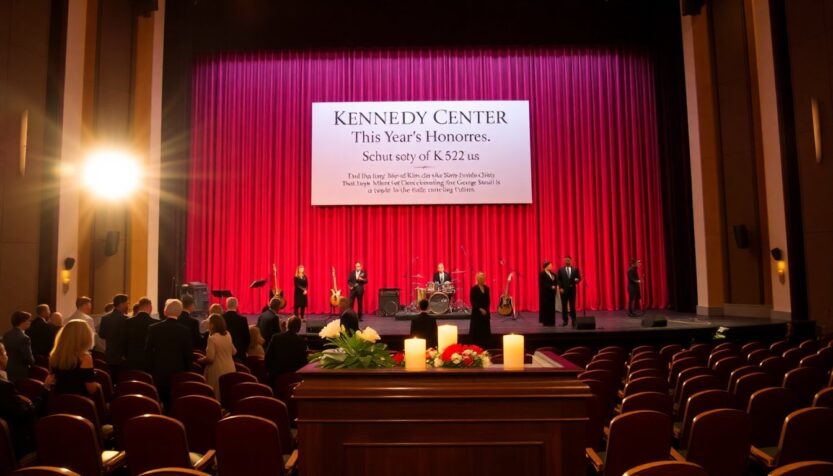
President Donald Trump hosted the 48th Kennedy Center Honors, marking a significant moment in the event’s history. As the chairman of the John F. Kennedy Center for the Performing Arts, he painted a picture of an alternate reality where he remained a celebrated television personality. Instead, he embraced the role of both the nation’s leader and the emcee for this prestigious gala.
This year’s ceremony honored a diverse group of icons, including the glam metal band Kiss, country music star George Strait, theatrical performer Michael Crawford, disco icon Gloria Gaynor, and Hollywood veteran Sylvester Stallone. Trump’s humor was evident as he quipped, “This is the first time a president has ever hosted this event. I don’t know why.” His jest highlighted the unusual nature of the evening.
Shifting the landscape of the Kennedy Center
Trump’s involvement with the Kennedy Center has been unconventional. Following a controversial first term during which he opted out of the event, he returned to exert considerable influence over the institution, reshaping it in his image. The president dismissed the previous bipartisan board, including its chair, David Rubenstein, and replaced them with allies. This included appointing Ric Grenell, a former ambassador known for his brash approach, as the interim executive director.
Changes and challenges
The changes made under Trump’s leadership have yielded mixed results. According to reports from The New York Times, ticket sales have dropped by approximately 50%, a significant decline in a predominantly liberal area. Many longtime staff members have either been let go or resigned. However, Trump’s administration secured $257 million for renovations in a recent spending bill, and the event raised an impressive $23 million, setting a new record for the Kennedy Center Honors.
Attendees enjoyed a lavish evening complete with high-end champagne, a stark contrast to the usual offerings at the gala. Maria Bartiromo, another figure appointed by Trump to the Kennedy Center board, praised his leadership, stating, “President Trump has shown great leadership at the Kennedy Center and I am honored to be part of this storied cultural institution.”
The atmosphere at the event
The atmosphere inside the grand Hall of Nations was filled with a mix of industry elites and political figures. Notable attendees included Robert Kraft, Doug Burgum, and Howard Lutnick, contributing to the diverse mix of personalities at the event. Trump, accompanied by First Lady Melania Trump, engaged with the crowd, reminiscing about his time hosting The Apprentice and its record-breaking viewership.
Star power and political undertones
The event notably lacked some of the star power typically associated with the Honors, likely due to Hollywood’s current sentiments toward Trump. Renowned actor Tom Cruise declined an honor this year, citing scheduling conflicts, underscoring the ongoing divide. Despite the political context, the evening remained largely nonpartisan, with speakers like Kurt Russell and Kelsey Grammer focusing on tributes rather than political commentary.
Ingraham, a prominent voice on Fox News, defended the Kennedy Center’s integrity, asserting that the board had never discussed politics during meetings. She dismissed calls for a name change to honor Trump, suggesting that it reflects a double standard in how political affiliations influence cultural institutions.
The broader implications
The Kennedy Center has long stood as a symbol of bipartisan American culture, and Trump’s hosting has sparked discussions about the politicization of such institutions. While his presence has undoubtedly altered the event’s dynamics, it remains to be seen how these changes will influence the Kennedy Center’s legacy moving forward. The honorees were mostly conventional choices, challenging the notion that Trump would lean toward less traditional figures.
As the evening concluded, the blend of politics, celebrity, and culture left many pondering the future of the Kennedy Center under Trump’s influence. Whether in support or opposition, his approach guarantees that events will be memorable, if not controversial, shaping the narrative of American cultural heritage.