



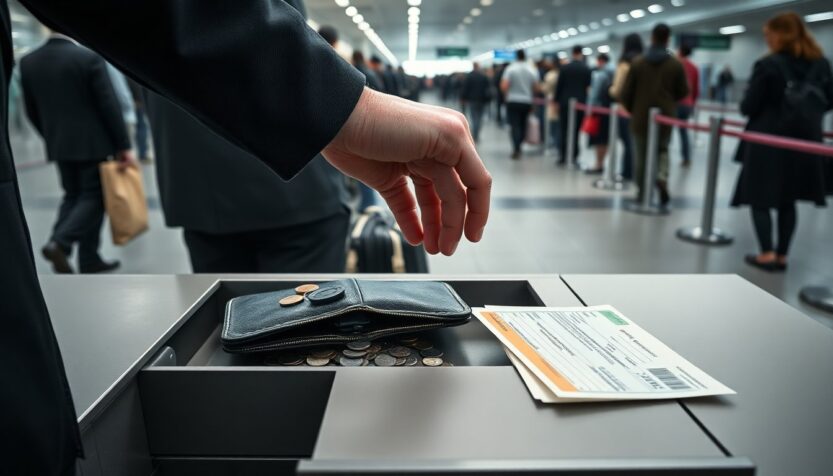
The story of the Transportation Security Administration during the partial government shutdown is best told through the people who still show up to work. One agent, who speaks under the pseudonym Kendra, received her last full paycheck on February 27 for roughly $250. Several coworkers that day were paid barely more than $20. Faced with empty bank accounts, some agents have cut groceries, skipped meals and developed a term they call “call out poor”—missing shifts because they cannot afford fuel to reach the airport.
Kendra and the other officers in these accounts have been given pseudonyms so they can describe their circumstances candidly. She and her spouse are both long-tenured TSA employees raising two children, ages four and six, and they are balancing the mission of the job against immediate survival needs. Without predictable income, they’ve leaned on food distributions, raffle gift cards, and relatives. The shame of visiting a food bank as an adult with children is palpable for her: she worries about taking resources from someone who might be worse off.
Financial strain and daily sacrifices
Across airports, agents report a growing list of practical pressures. Gas cards and emergency assistance requests to management have become routine — a practice one agent described as humiliating when pleading for fuel to keep a shift. Julie, another agent in her early 20s, said her last paycheck, about $720, arrived on February 16. She has altered her commute to save money and continues working because of the benefits and the long-term prospects she associates with a government career. Supervisors, she says, regularly instruct staff to limit political commentary in public, trying to preserve workplace decorum while morale erodes.
Operational ripple effects at airports
The revenue pause for TSA employees has coincided with visible operational strain at airports: longer queues, missed flights and moments of confusion. To address immediate gaps, the administration sent ICE agents to more than a dozen airports to assist, a move that left some officers uneasy because those agents remained fully paid while TSA officers did not. In Congress, lawmakers considered a spending measure that would restore funding for most Department of Homeland Security operations; the Senate passed it, but the measure did not clear the House. Meanwhile, a reported executive order by President Trump to return pay to TSA staff raised legal questions about authority and implementation. As lawmakers prepared for a two-week recess, many agents feared another payless period.
Morale, mission and professional identity
For many officers, the job carries a sense of purpose that has kept them on the front lines despite hardship. Carlton, stationed at a major Midwestern airport and assigned to baggage claim, traces his decision to join TSA to the aftermath of 9/11 and a desire to protect travelers. Yet the repeated shutdowns have tested that commitment. He described a recent paycheck in which a full month’s deductions were taken from a partial payment, leaving him financially strained in a way he did not expect. He says the inability to detach work stress from life stress makes the shutdowns feel like a personal assault on both identity and livelihood.
Decisions about staying or leaving
With bills mounting—electric companies threatening shutoffs and rent due—agents are weighing whether to endure the uncertainty or seek steadier, if lower-paying, employment. Kendra has considered retail work such as at Costco, not because she prefers it but because it might provide steadier pay. Carlton plans to hand in his notice after a planned vacation if shutdowns continue, noting that warehouse or private-sector roles might pay less but offer greater predictability. Others are calculating whether to return to school or retrain, constrained by childcare and the higher immediate cost of changing careers.
What it means for travelers and policy
The unfolding situation is more than an individual hardship; it has system-wide consequences for air travel reliability and public confidence. Travelers experience longer lines and irregular service when staffing is thin, and agents working without pay may feel unable to perform at their best. Restoring full budgets for the Department of Homeland Security, or a clear legal mechanism for payroll continuity, would relieve both operational pressures and human strain. Until then, the checkpoints will be staffed by people who believe in the mission but are also counting grocery bills and gas tanks, trying to reconcile civic duty with day-to-day survival.