
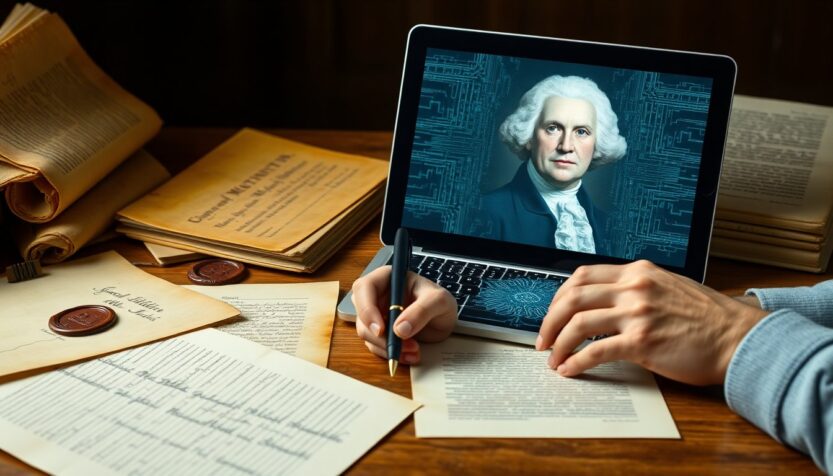
Glenn Beck has introduced an avatar that speaks as George Washington, claiming it was trained on a private trove of primary material. That digital figure, however, repeatedly departs from the well-documented record, producing statements and stances at odds with what historians have established. The result is less a faithful reconstruction and more a tailored character whose pronouncements match present-day debates rather than eighteenth-century practice. This is important because the tool functions as both a narrative device and a political amplifier: a programmed echo of its curator.
The creation raises two immediate questions: what sources were used to train the model, and how does a closed, curated archive change the output? In public archives, Washington’s correspondence, speeches, and the Farewell Address are available and well studied. By contrast, a privately maintained dataset lacks the transparency that lets scholars verify claims. When an AI speaks with authority but cannot be checked against accessible documentation, it risks spreading hallucinations—convincing falsehoods presented as fact.
How the model was built and why source transparency matters
The system in question reportedly learned from documents that its owner says he possesses. That approach bypasses the standard scholarly ecosystem of peer review and open archives. A model trained on a selective collection can emphasize certain letters or anecdotes while ignoring others, producing a profile of the founder that suits particular narratives. In AI terms, selective training data plus prompt engineering equals an output optimized for persuasion rather than historical accuracy. The problem is not just technical: it is about the public’s ability to check claims, which is central to responsible historical representation.
Sources and verification
Publicly available editions of Washington’s papers have been assembled and digitized by libraries and research projects; these form a verifiable corpus scholars rely on. A private collection exists outside that body of work, making cross-checking difficult. When an AI references Washington’s views on foreign policy or party politics, readers should be able to trace the quotation to a known document. Without that transparency, we move from documented history into the realm of curated myth, where the AI’s output becomes a function of selection and omission rather than a reflection of the full record.
Where the AI diverges from recorded history
Many of the digital Washington’s assertions contradict clear elements of the historical record. The real Washington favored avoiding foreign entanglements and warned against permanent alliances; his public guidance emphasized neutrality and caution in international disputes. He also used the Farewell Address to caution Americans about the dangers of factionalism and the corrosive potential of party machines. Recasting that legacy as enthusiastic endorsement of intervention or partisan zeal misstates Washington’s repeatedly articulated principles and compresses a complex political evolution into a simplistic present-day talking point.
Physical image and persona
The AI’s presentation leans heavily on Washington’s physical presence—his height, carriage, and imposing appearance—to sell an alpha aesthetic. Historical descriptions confirm Washington’s stature and bearing, and details such as his dental difficulties and the role of enslaved people in his household are part of the documentary record. But emphasizing physique to justify contemporary political stances transforms a biographical trait into rhetorical leverage. When a founder’s body becomes a brand, ideas are repackaged to fit current cultural narratives rather than to reflect the full texture of his life and choices.
Implications for public memory and democratic discourse
The stakes go beyond a single avatar. An AI that habitually invents or reshapes facts can influence listeners who assume the voice is authoritative. That is particularly fraught when the subject is a foundational figure whose words and reputation are invoked to justify modern policies. If private collectors can produce tailored historical voices, the marketplace of memory can be skewed toward whatever narratives those collectors prefer. This dynamic undermines the role of open archives and the norms of historical inquiry that allow societies to contest and correct interpretations.
Consequences and safeguards
Mitigations include demanding source citations for any historical claims, labeling synthetic personas clearly, and encouraging models trained on openly accessible and curated corpora. Readers and platforms should also prioritize cross-checking with established editions and academic work. Ultimately, technology can illuminate the past, but only when it respects the methods that make historical knowledge trustworthy. Otherwise, we risk replacing careful scholarship with persuasive fiction dressed up in a founder’s voice.